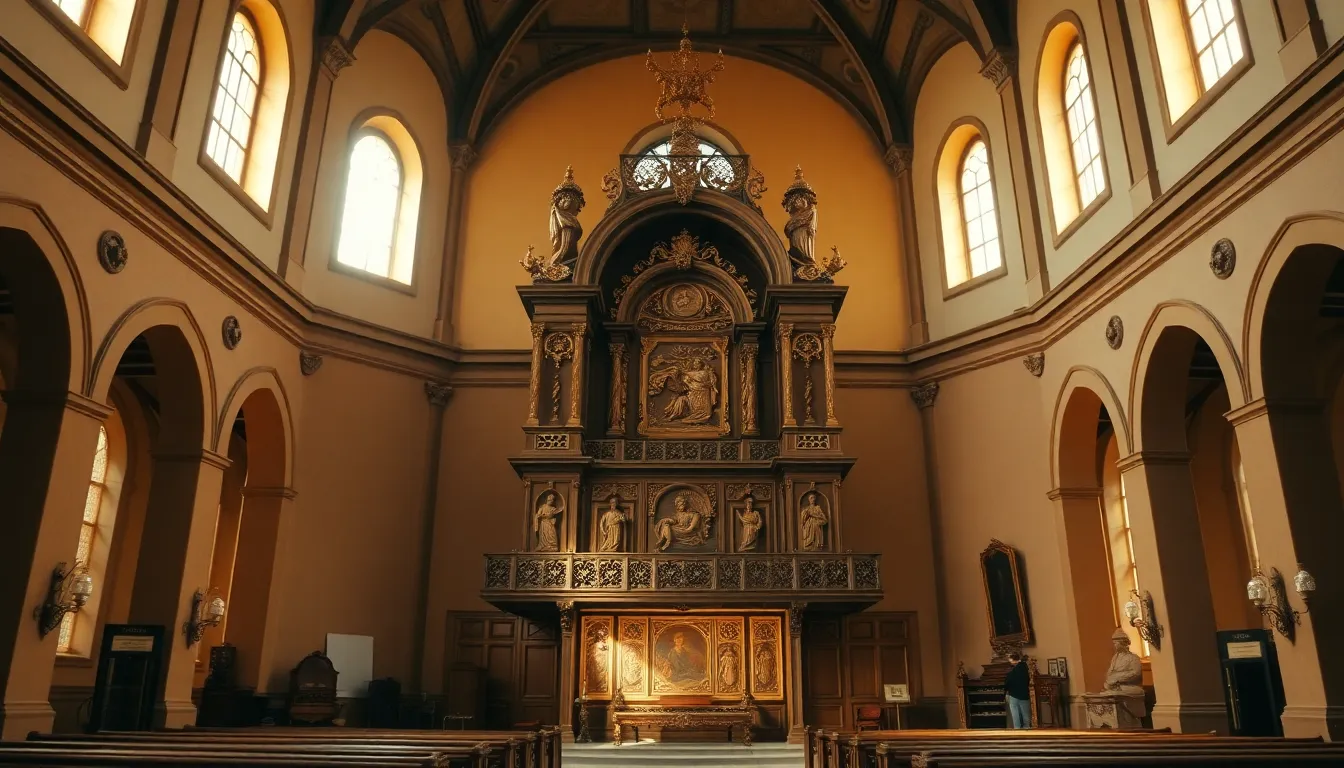
I always save the Nozyk Synagogue for a particular moment in a Warsaw itinerary. After a group has walked the ground of the ghetto, after the Umschlagplatz and its wall of names, after the weight of all that absence, I bring them here. Because the Nozyk Synagogue is where the sentence does not end with destruction. Before the war, Warsaw had hundreds of Jewish houses of prayer. After the war, this one was still standing. And on a Shabbat morning today, you can walk through its doors and hear it being used for exactly what it was built for. That continuity is not a small thing. For many in my groups, it is the most quietly hopeful moment of the entire journey.
This guide is meant to help you understand what the Nozyk Synagogue is, why it survived when so much did not, and why I believe a heritage group should not leave Warsaw without standing inside it.
A Synagogue Built in Confidence
The Nozyk Synagogue was built between 1898 and 1902, funded by Zalman and Rywka Nozyk, a Jewish merchant couple who gave it to the community on the condition that it bear their name and that prayers be said for them. It was constructed in a grand Neo-Romanesque style with Moorish and Byzantine touches, an ornate ark, a high central bimah, and the architectural confidence of a community that believed it was in Warsaw to stay.
That confidence is part of what makes the building so moving. It was not built in fear. It was built by people who imagined generations of their descendants worshipping here. By the years between the wars, Warsaw was one of the great centers of Jewish life on earth, with a Jewish population of around 350,000, roughly a third of the city. The Nozyk Synagogue was one of many. It is now the only one of the city’s prewar synagogues still standing.
How It Survived the War
The survival of the Nozyk Synagogue is not a story of miraculous protection. It is a story of brutal use, and that distinction matters.
When the Germans occupied Warsaw and later established the ghetto, the synagogue fell within or near the ghetto boundaries, and Jewish worship there was eventually forbidden. The occupiers did not preserve the building out of any respect. They desecrated it and turned it into a stable for horses and a warehouse and depot for supplies. It was spared the systematic destruction that consumed the rest of the Jewish district precisely because it had been put to use by the occupiers.
The building was damaged during the war, but its structure endured. When the ghetto was razed after the 1943 uprising, and when much of Warsaw was deliberately destroyed in the months that followed, the Nozyk Synagogue remained. It outlasted the community that built it. That is the painful truth at the center of its survival: the walls stood while the people who filled them did not.
A Living House of Prayer Again
After the war, the synagogue was repaired and reopened, and between 1977 and 1983 it underwent a thorough restoration. Today it is the principal active synagogue of Warsaw, the seat of the Orthodox community and the chief rabbi, and it holds regular services.
This is the part I most want group leaders to grasp. The Nozyk Synagogue is not a museum. It is a functioning house of prayer. There are daily and Shabbat services. There are weddings and bar mitzvahs. There is a small but real Jewish community in Warsaw today that gathers here, the descendants of survivors, returnees, and people rediscovering Jewish roots that were hidden for generations under communism. When your group stands inside, they are standing in a place that is alive, not preserved.
I have brought groups here on a Friday evening, and to hear Kabbalat Shabbat sung in this room, in this city, after everything, is something people do not forget. Where it can be arranged respectfully, joining or quietly witnessing a service can be the emotional resolution a heavy itinerary needs.
Why It Belongs at the End of the Story
In our guide to Jewish heritage in Poland, I make the case that a heritage journey should honor both what was built and what was destroyed, not destruction alone. The Nozyk Synagogue is where that principle becomes concrete.
A trip that ends at a death camp leaves a community with the final word given to the murderers. A trip that ends, or nearly ends, in a living synagogue gives the final word to continuity. It says that the attempt to erase Jewish Poland did not fully succeed. The thread is thin, but it was not cut. After the POLIN Museum has told the thousand-year story, and after the ghetto memorials have borne witness to the catastrophe, the Nozyk Synagogue shows the story continuing into the present. Our companion guides to the POLIN Museum and to walking the Warsaw Ghetto remembrance route cover the ground that comes before this one.
This is why I almost always place the synagogue late in a Warsaw itinerary. Sequence carries meaning. To arrive here after the weight of remembrance is to be given something to carry home besides grief.
Visiting With Respect
A few practical and respectful notes for group leaders.
The Nozyk Synagogue is an active Orthodox synagogue, and visitors are asked to dress modestly. Men are expected to cover their heads, and head coverings are usually available at the entrance. During services, seating follows Orthodox custom, with separate sections for men and women. Photography may be restricted, particularly during prayer, and a group should always follow the guidance of the community on site.
Because it is a working synagogue with its own schedule and its own security considerations, group visits should be arranged in advance rather than assumed. This is not a place to arrive unannounced with a large group. Coordinating access, timing a visit around the service schedule, and briefing your community on the etiquette of an active house of prayer are part of what allows the visit to be welcome rather than disruptive.
Heritage Tours arranges these visits with the community, handles the timing and the guidance, and builds the synagogue into the wider Warsaw itinerary so it lands in the right place in the story. You can see how we structure the group leader experience on our group heritage tours page, and our Poland destination overview sets the larger journey. Group leaders travel free with fifteen or more participants, which makes bringing a full community to stand in this room more achievable than many leaders expect.
FAQ: The Nozyk Synagogue
Why is the Nozyk Synagogue significant?
The Nozyk Synagogue, built between 1898 and 1902, is the only one of Warsaw’s prewar synagogues still standing. Before the Holocaust, Warsaw was one of the great centers of Jewish life with hundreds of houses of prayer. Today the Nozyk is the principal active synagogue of the city and the seat of its Orthodox community. It is significant both as a survivor and as a living place of worship, a thread of continuity after near-total destruction.
How did the Nozyk Synagogue survive the war?
It survived not through protection but through brutal use. The German occupiers forbade Jewish worship there and turned the building into a stable and a warehouse. Because they were using it, it was spared the systematic destruction that razed the surrounding Jewish district after the 1943 ghetto uprising. The structure endured even as the community that built it was murdered, a painful truth at the heart of its survival.
Is the Nozyk Synagogue still in use today?
Yes. After postwar repairs and a major restoration between 1977 and 1983, it serves as Warsaw’s main active synagogue. It holds daily and Shabbat services and hosts the city’s Jewish community, including survivors, returnees, and people rediscovering Jewish roots hidden under communism. It is a functioning house of prayer, not a museum.
Can a heritage group attend a service there?
Often, yes, when arranged respectfully in advance. Joining or quietly witnessing a service, particularly Kabbalat Shabbat on a Friday evening, can be a deeply moving conclusion to a heavy itinerary. Because it is an active Orthodox synagogue with its own schedule and security considerations, group visits must be coordinated ahead of time and conducted according to the community’s guidance.
What should we know about visiting respectfully?
Dress modestly. Men are expected to cover their heads, and coverings are usually provided at the entrance. During services, seating follows Orthodox custom with separate sections for men and women. Photography may be limited, especially during prayer. Always follow the direction of the community on site. Visits should be booked in advance, never assumed, so that a group is a welcome presence rather than a disruption to worship.
After a journey through so much loss, the Nozyk Synagogue offers a community the chance to stand in a living Jewish room in the heart of Warsaw and understand that the story did not end. If you are bringing your group to Poland, I would be glad to help you place this visit where it belongs and arrange it with the care a working house of prayer deserves.
Contact us when you are ready to start planning.