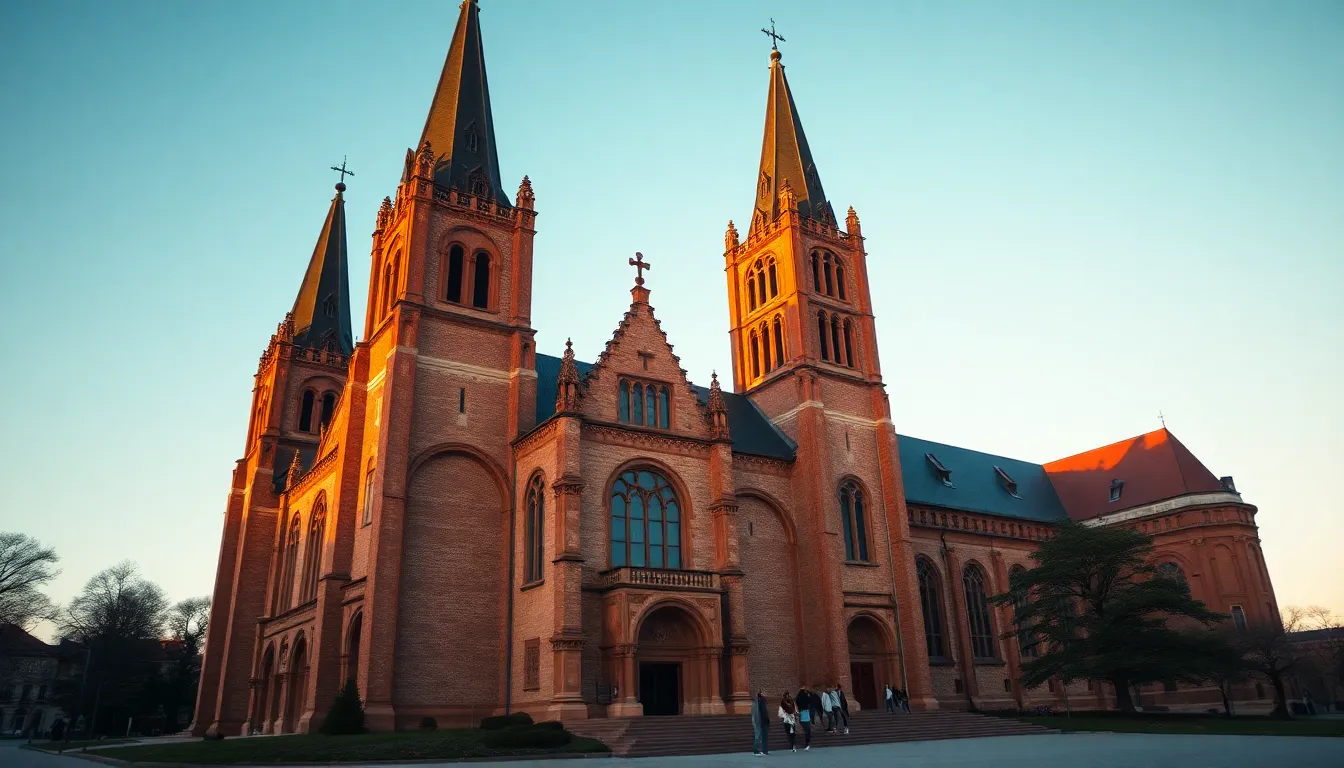
The first time I brought a group to Gniezno, one of the pastors traveling with me stood in the nave of the cathedral and said, quietly, “So this is where it started.” He was right. If you want to understand where Polish Christianity began, you do not start in Krakow or Warsaw. You start here, in a town most travelers have never heard of, an hour east of Poznan.
Gniezno is small. You can walk it in an afternoon. But what happened on this hill shaped a nation for a thousand years. This was the first capital of Poland. This is where the country’s first archbishopric was founded in the year 1000. And this is where the relics of Saint Adalbert, the missionary bishop whose death changed the course of Polish history, still rest. For a group leader bringing a Christian community to Poland, Gniezno is not a detour. It is a starting point.
If you are planning a wider faith itinerary, our guide to spiritual sites in Poland gives you the full map. But Gniezno deserves its own visit, and this article walks through why.
Why Gniezno Matters: The First Capital
Before Krakow, before Warsaw, there was Gniezno. The town sits in the historic region of Greater Poland, the heartland where the Piast dynasty, Poland’s first ruling family, established its power in the 10th century. The name itself comes from an old Polish word for nest, and the legend holds that the dynasty’s founder, Lech, settled here after finding a white eagle’s nest on the hill. That white eagle became the emblem of Poland and still appears on the national coat of arms today.
What matters for a faith traveler is what came next. In 966, Duke Mieszko I accepted baptism and brought his people into the Christian fold. We cover that turning point in detail in our guide to the baptism of Poland. But the institutional birth of the Polish church, the moment Christianity here became permanent and self-governing, happened in Gniezno in the year 1000.
That year, Holy Roman Emperor Otto III made a pilgrimage to Gniezno. The occasion was both political and spiritual, and it produced something lasting: the establishment of an independent Polish ecclesiastical province, with Gniezno as its metropolitan see. From that moment, Poland had its own archbishop, answerable to Rome rather than to the German church. For a young Christian nation, that independence was everything.
The Congress of Gniezno: The Year 1000
The Congress of Gniezno in the year 1000 is one of those events that does not get the attention it deserves outside Poland. When I explain it to a group, I tell them to picture the scene. An emperor walking barefoot toward a church to honor the tomb of a murdered missionary. A new nation being granted the right to govern its own church. A crown, according to some accounts, placed on the head of the Polish duke.
Emperor Otto III came to venerate the relics of Saint Adalbert. While he was there, he recognized Boleslaw the Brave, Mieszko’s son, as a sovereign equal rather than a vassal. He established the Archdiocese of Gniezno along with new bishoprics at Krakow, Wroclaw, and Kolobrzeg. In a single visit, Poland gained both a church structure and a path toward kingship. Boleslaw was crowned the first King of Poland in 1025.
For your group, the takeaway is simple. The cathedral they are standing in is not just an old building. It is the institutional cradle of an entire national church.
Gniezno Cathedral and the Bronze Doors
The cathedral that stands today, the Royal Cathedral of the Assumption of the Blessed Virgin Mary and Saint Adalbert, is a Gothic brick structure built mainly in the 14th and 15th centuries. It replaced earlier churches on the same site, and the continuity of the location is part of what makes it powerful. People have worshipped on this exact ground for more than a thousand years.
The Gniezno Doors
The single object I always make sure my groups see is the pair of bronze doors at the cathedral’s south entrance. Cast around 1175, the Gniezno Doors are one of the most important works of Romanesque art in Central Europe. They tell the story of Saint Adalbert’s life and martyrdom across eighteen scenes, read from the bottom up on the left door and the top down on the right.
Stand in front of them and you can trace his entire story: his ordination, his missionary journeys, his death at the hands of pagan Prussians, and the recovery of his body. For a group, these doors are a sermon in bronze. I usually give people a few quiet minutes here and let the images do the teaching before I say a word.
Inside the Cathedral
Inside, the cathedral holds the silver reliquary of Saint Adalbert, raised on a baroque coffin supported by silver figures. The chapels lining the nave contain centuries of Polish church history, including the tombs of archbishops who served as primates of Poland. The Primate of Poland, the senior bishop of the Polish church, still carries the title Archbishop of Gniezno today. The line is unbroken.
The Relics of Saint Adalbert
Saint Adalbert, known in Polish as Wojciech, is central to understanding why Gniezno matters. He was a bishop of Prague, born around 956 into a noble Czech family. He was a reformer, frustrated by the slow pace of Christianization, and twice he left his diocese to pursue missionary work. In 997, he traveled north to bring the Gospel to the pagan Prussians on the Baltic coast.
They killed him. According to tradition, he was martyred on April 23, 997, struck down for trespassing on sacred pagan ground. Boleslaw the Brave reportedly ransomed his body for its weight in gold and had it brought to Gniezno, where it was enshrined in the cathedral.
Adalbert was canonized within two years, an extraordinarily fast recognition that reflected how significant his death was. His martyrdom gave the new Polish church a saint of its own, a tomb worth an emperor’s pilgrimage, and a story of sacrifice that bound faith and nation together from the very beginning. When you stand at his reliquary, you are standing at the spiritual foundation stone of Catholic Poland.
Planning a Group Visit to Gniezno
Gniezno works best as part of a wider itinerary through Greater Poland. Most groups base themselves in Poznan, which has the hotels, restaurants, and transport links that a town the size of Gniezno cannot offer, and make the trip out for half a day. The drive is around 50 kilometers and takes about an hour.
A focused visit to Gniezno needs two to three hours. That gives you time for the cathedral, the bronze doors, the Adalbert reliquary, and the small museum nearby that tells the story of the Piast beginnings. If your group is interested in the deeper national-origins story, the nearby site of Ostrow Lednicki, an island where Mieszko I may have been baptized, is worth adding.
I tell group leaders to frame Gniezno carefully. It is not a grand pilgrimage destination the way Czestochowa is. It is quieter, smaller, and more historical than devotional. But for a community that wants to understand the roots of the faith they will encounter across Poland, beginning here changes how they see everything that follows.
One practical note for group leaders weighing the economics: with Heritage Tours, the group leader travels free when you bring fifteen or more participants. That makes building a group around your congregation far more achievable.
FAQ: Gniezno and Polish Christianity
Why is Gniezno called the cradle of Polish Christianity?
Gniezno was Poland’s first capital and the site of its first archbishopric, established in the year 1000 during the Congress of Gniezno. It became the metropolitan see of the Polish church, giving the new Christian nation its own self-governing ecclesiastical structure answerable to Rome. The Primate of Poland still holds the title Archbishop of Gniezno today.
Who was Saint Adalbert and why is he buried in Gniezno?
Saint Adalbert, known in Polish as Wojciech, was a bishop of Prague who was martyred in 997 while bringing Christianity to the pagan Prussians. Duke Boleslaw the Brave had his body brought to Gniezno and enshrined in the cathedral. His relics drew Emperor Otto III on pilgrimage in the year 1000 and remain in the cathedral today.
What are the Gniezno Doors?
The Gniezno Doors are a pair of bronze doors cast around 1175, among the finest works of Romanesque art in Central Europe. They depict the life and martyrdom of Saint Adalbert across eighteen scenes. They hang at the south entrance of Gniezno Cathedral and are one of the site’s most important treasures.
How long do groups need in Gniezno?
Most groups spend two to three hours in Gniezno, covering the cathedral, the bronze doors, the reliquary of Saint Adalbert, and the local museum. It works well as a half-day trip from Poznan, which is about an hour away and offers the hotels and amenities a group needs.
Is Gniezno a good fit for a Christian heritage group?
Yes, especially for groups that want to understand the historical roots of Polish Christianity rather than only its major pilgrimage shrines. Gniezno is quieter and more historical than devotional, but it is the foundation stone of the Polish church and a meaningful starting point for a faith itinerary across Poland.
If you are building a Christian heritage itinerary through Poland and want to begin where the story began, I would be glad to help you shape it. Gniezno is the kind of place that makes the rest of the journey make sense. Contact us whenever you are ready to start planning.