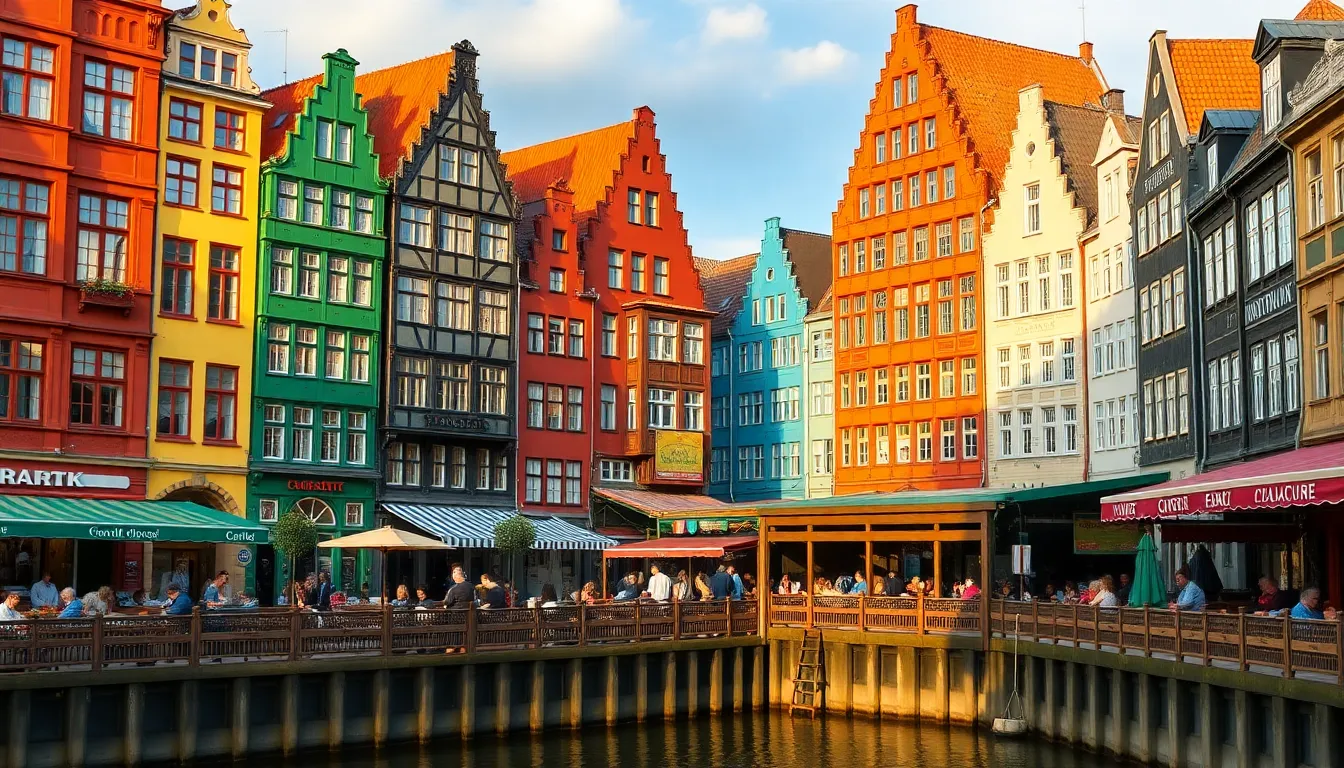
When I bring a group north to Gdansk, I always watch their faces as we walk into the old town for the first time. After the weight of Krakow and the camps, Gdansk feels different. The streets are wide and bright. Tall merchant houses in cream and ochre line the river. Church towers rise over the rooftops. People often say it does not feel like the Poland they expected, and they are right. Gdansk has its own story, shaped by the sea, by trade, by faith, and by the moment in 1980 when a shipyard electrician helped bring down an empire.
I have spent more than forty years planning heritage journeys, and I think of Gdansk as the city that gives a Poland trip its breadth. It holds the medieval Hanseatic world, the great brick churches of the Baltic, the birthplace of Solidarity, and a Jewish history that most visitors never hear about. Let me walk you through it.
A City Shaped by the Sea
Gdansk sits on the Baltic coast at the mouth of the Vistula River, and for most of its history it was a great port. It belonged to the Hanseatic League, the medieval network of trading cities that ran the commerce of northern Europe. That history gave the city wealth, a mixed German and Polish character, and the architecture that still defines it.
For centuries Gdansk was a meeting point of cultures and faiths, more cosmopolitan than most of Poland, with German, Polish, Dutch, and Jewish communities living in a city that traded with the whole continent. Understanding Gdansk means understanding that it was never a simple place. It changed hands, it was fought over, and it was nearly destroyed in 1945, then painstakingly rebuilt. What your group walks through today is a careful reconstruction of a thousand-year-old trading city.
The Old Town: Walking the Hanseatic City
Gdansk’s old town is compact and walkable, and a half day on foot covers most of it.
The Long Market and the Royal Way
The heart of the old town is the Long Market, a wide pedestrian street lined with tall, ornate merchant houses, each facade competing with the next. At one end stands the Golden Gate, at the other the Green Gate. This was the Royal Way, the route Polish kings took when they entered the city. Neptune’s Fountain stands in the center, a nod to the city’s bond with the sea. For your group, this is where Gdansk’s wealth and confidence are written in stone.
The Main Town Hall and Artus Court
The Main Town Hall, with its tall clock tower, anchors the Long Market and houses the city museum. Beside it stands Artus Court, a grand merchants’ meeting hall that gives a vivid sense of the trading life that built Gdansk. Together they show your group how a medieval port governed itself and did business.
The Great Churches of Gdansk
For faith travelers, Gdansk’s churches are central. The city has a remarkable concentration of medieval brick churches, the great architectural tradition of the Baltic coast.
St. Mary’s Church
St. Mary’s is the centerpiece, one of the largest brick churches in the world, with room for around 25,000 people. Begun in the fourteenth century, its sheer scale stops people in their tracks. Inside, the vast white interior holds an astronomical clock, a stone Pieta, and a copy of Hans Memling’s “Last Judgment.” Climbing the tower, for those who can manage the stairs, gives your group a view across the whole city to the Baltic. St. Mary’s also tells a Reformation story: for centuries it was a Protestant church in a Catholic country, a reminder of how mixed Gdansk’s faith life was.
St. Bridget’s and the Solidarity Connection
St. Bridget’s Church is smaller but historically important. During the 1980s it became a refuge and rallying point for the Solidarity movement, closely tied to the workers of the nearby shipyard. For Christian groups, it shows how the church in Poland became a shelter for the movement that eventually broke the communist hold on the country. Faith and freedom meet here in a way that is concrete and recent.
Solidarity: Where the Cold War Began to End
Gdansk holds one of the most important stories of the twentieth century, and it is not a religious one in the usual sense, though faith ran through it.
In 1980, workers at the Gdansk shipyard went on strike, led by an electrician named Lech Walesa. Out of that strike came Solidarity, the first independent trade union in the Soviet bloc, a movement that grew to ten million members and, over the following decade, helped bring down communism across Eastern Europe.
The European Solidarity Centre
The story is told at the European Solidarity Centre, a striking modern building beside the historic shipyard gate. The museum walks your group through the strike, the movement, martial law, and the eventual fall of communism in 1989. It is one of the best modern history museums in Poland, and for groups it raises real questions about faith, conscience, and the cost of standing up. The Catholic Church, and Pope John Paul II in particular, played a central role in supporting Solidarity, which makes this site meaningful for Christian groups in particular.
The Jewish Heritage of Gdansk
Most visitors never learn that Gdansk had a significant Jewish community, and I make a point of telling its story. Before the war, the city, then the Free City of Danzig, had a Jewish population of around 10,000. In a remarkable episode, much of the community organized its own emigration in 1939 as the threat grew, selling the contents of the Great Synagogue and sending its treasures to safety in New York before the building was demolished. Some of those ceremonial objects survive today in collections abroad, a rare case of a community saving its heritage even as it was forced to flee.
There is a restored Jewish cemetery and a small synagogue still serving the community today. For Jewish groups, Gdansk offers a different chapter than the shtetls of the east: an urban, German-speaking, merchant Jewish world, and a story of a community that managed to save much of itself and its sacred objects.
How Group Leaders Should Plan Gdansk
How Much Time
A focused visit to Gdansk takes a day and a half to two days: half a day for the old town and churches, half a day for the Solidarity Centre, and time for the Jewish sites and the waterfront. If your group wants to add the nearby Westerplatte, where the first shots of the Second World War were fired in 1939, allow another half day.
Where It Fits
Gdansk sits in the far north, on the Baltic, several hours by road or a short flight from Warsaw and Krakow. Most groups reach it by train or domestic flight as part of a wider Poland itinerary. It works well as a lighter, broadening counterpoint after the intensity of the southern sites. Our Poland heritage travel guide shows how to connect it into a full route, and it pairs naturally with Poznan to the southwest for groups exploring western Poland.
A City to Breathe In
I tell group leaders that Gdansk is a good place to schedule after the heaviest days. The mood of the city is open and bright, the history is inspiring as well as sobering, and your group can walk, eat by the river, and absorb a different side of Poland. After the camps and the cemeteries, that change of register matters for a group’s wellbeing.
The Free Leader Program
If you are organizing a heritage group of 15 or more, your travel is covered. You fly free, stay free, and tour free. For the person carrying the work of planning a journey across the whole of Poland, that support changes the math. You can see how it works across our group heritage tours and read more on our Poland destination page.
FAQ: Visiting Gdansk
What is Gdansk known for?
Gdansk is a historic port city on Poland’s Baltic coast, known for its colorful Hanseatic old town, its great medieval brick churches including St. Mary’s, and as the birthplace of the Solidarity movement that helped end communism in Eastern Europe. It was nearly destroyed in 1945 and carefully rebuilt, so the old town your group walks through is a faithful reconstruction.
What is the Solidarity story in Gdansk?
In 1980, workers at the Gdansk shipyard, led by Lech Walesa, went on strike and founded Solidarity, the first independent trade union in the Soviet bloc. The movement grew to ten million members and helped bring down communism by 1989. The European Solidarity Centre, beside the historic shipyard gate, tells the full story and is one of the best modern history museums in Poland.
Did Gdansk have a Jewish community?
Yes. Before the war, Gdansk, then the Free City of Danzig, had a Jewish population of around 10,000. In a rare episode, much of the community organized its own emigration in 1939 and sent the treasures of its Great Synagogue to safety in New York before the building was demolished. A restored cemetery and a small active synagogue remain today.
How much time does Gdansk need?
Plan a day and a half to two days: half a day for the old town and churches, half a day for the Solidarity Centre, and time for the Jewish sites and waterfront. Adding nearby Westerplatte, where the Second World War began in 1939, takes another half day.
Where does Gdansk fit in a Poland itinerary?
Gdansk sits in the far north and is usually reached by train or domestic flight from Warsaw or Krakow as part of a wider trip. It works well as a brighter, broadening counterpoint after the intensity of the southern heritage sites, and it pairs naturally with Poznan for groups exploring western Poland.
If you are thinking about including Gdansk in your community’s Poland journey, I would be glad to help you plan it. It is the city that gives a Poland trip its full range, and where it fits in your itinerary depends on what your group needs. Reach us any time through our contact page.