St. Paul’s Bay: Where the Bible Meets the Shore
Malta is one of the few places in Europe where a specific event from the New Testament happened, and where you can stand in the place it happened.
Around 60 CE, a ship carrying the Apostle Paul as a prisoner to Rome was caught in a storm that lasted fourteen days. The crew of 276 had lost all hope. Paul told them an angel had appeared to him, promising that every person aboard would survive but that the ship would be lost. On the fourteenth night, as the crew sensed they were approaching land, the ship struck a sandbar and began to break apart. Everyone made it to shore.
That shore was Malta. The bay is still called St. Paul’s Bay.
What happened next is described in Acts 28. The islanders received the survivors with kindness and built a fire. A viper came out of the brush and fastened itself on Paul’s hand. He shook it off, unharmed, and the Maltese took it as a sign that he was no ordinary man. Paul then healed the father of Publius, the island’s chief official, who was suffering from fever and dysentery. During the three months Paul stayed on the island, many others came to be healed.
For a Christian group standing at the bay, looking across the water where the ship went down, this is sacred geography. It is not symbolic. It is the actual place. That directness is what gives Malta its particular power as a Christian heritage destination.
The Grotto of St. Paul in Rabat: Where Paul Lived for Three Months
In the town of Rabat, adjacent to the ancient capital of Mdina, a narrow staircase leads down beneath the streets into a rock cave. This is the Grotto of St. Paul.
Christian tradition holds that Paul lived in this cave during his three months on Malta. The grotto has been a place of pilgrimage since at least the medieval period, and a church was built above it to mark the site.
Descending into the grotto is a quiet experience. The space is small, the stone is cool, and the golden limestone that makes up the entire island surrounds you. A statue of Paul stands in the cave. Candles burn. The sounds of the street above fade.
Whether one accepts the tradition as historical or not, the grotto conveys something that heritage sites often struggle to communicate: the feeling of being in a place where something important happened. The scale is intimate. A group of ten or fifteen can stand together in the cave and read from Acts, and the space fits the moment.
For over forty years, I have watched faith groups descend into the Grotto of St. Paul. The reaction is almost always the same. People go quiet. They look around. They feel the weight of the place. It is one of the most moving stops in a Malta heritage journey.
Mdina Cathedral: Built on the Governor’s House from Acts 28
According to Acts 28, Paul healed the father of Publius, Malta’s chief official. Publius is traditionally regarded as Malta’s first bishop, and the cathedral of Mdina is built on the site traditionally identified as the location of Publius’s house.
A church has stood on this ground since the earliest centuries of Christianity in Malta. The current cathedral, rebuilt after an earthquake in 1693, is a baroque masterwork, but what makes it spiritually significant for heritage travelers is not the architecture. It is the ground it sits on.
For a Christian group visiting Mdina Cathedral, the connection to Acts 28 is direct. Paul came to the house of the island’s governor. He healed the governor’s father. Publius became a believer. A church was built on the place where that happened, and a church has stood there ever since. The line from Paul’s arrival to the cathedral you stand in today is unbroken.
Inside, the cathedral holds paintings, marble, and the quiet that Mdina is known for. It is not crowded like St. John’s Co-Cathedral in Valletta. It is older in its roots, more intimate, and for groups following the St. Paul’s narrative through Malta, it is an essential stop.
St. John’s Co-Cathedral: Three Centuries of Knightly Faith
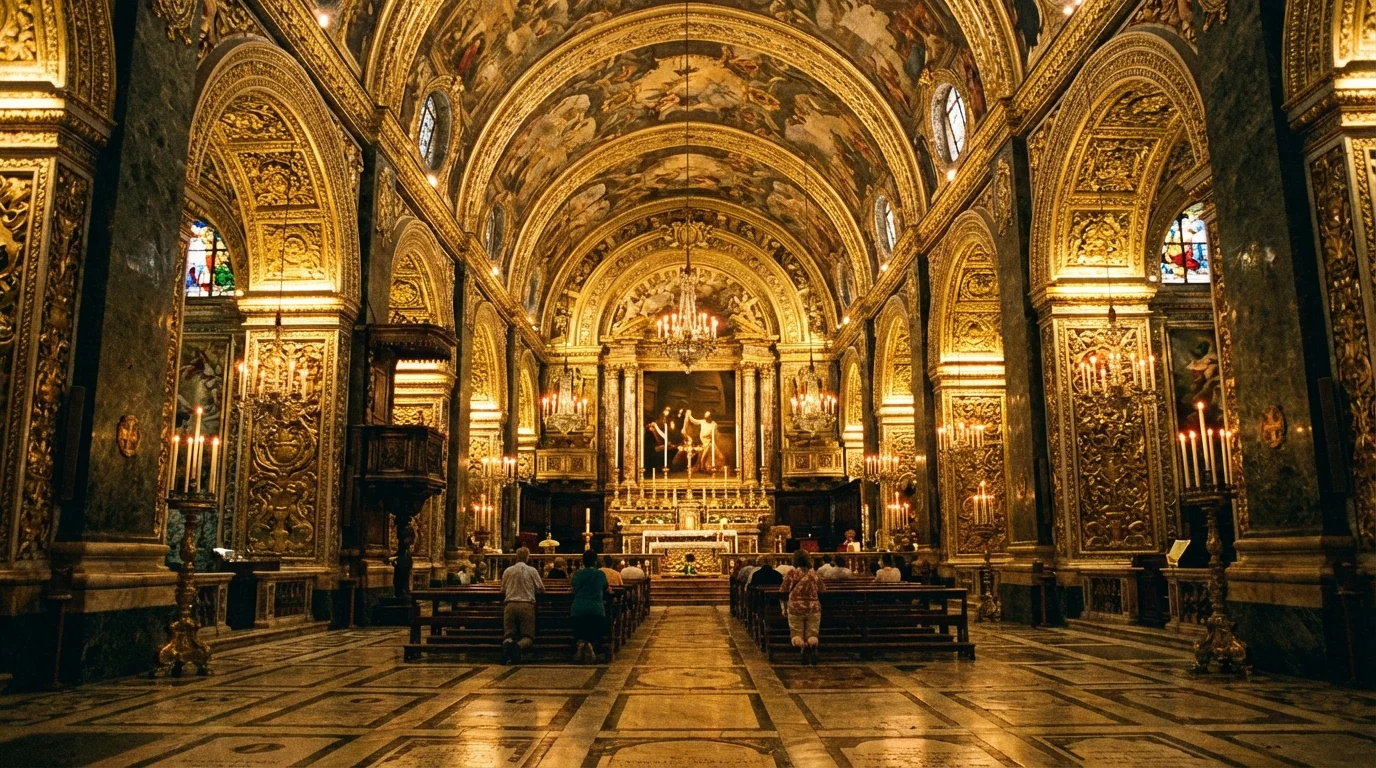
St. John’s Co-Cathedral in Valletta is one of the great spiritual monuments of Europe. It was built by the Knights of St. John in the 1570s, shortly after they founded Valletta, and it served as the order’s principal church for over two centuries.
The exterior is plain, almost fortress-like. But inside, every surface is covered with gold, marble, and painting. The barrel-vaulted ceiling, painted by Mattia Preti, depicts scenes from the life of St. John the Baptist. The side chapels, each dedicated to one of the eight langues (national divisions) of the Knights, are individually decorated and richly appointed.
Caravaggio painted “The Beheading of St. John the Baptist” for this church. It hangs in the oratory. It is the largest painting Caravaggio ever produced and the only one he signed. The signature is in the blood flowing from the saint’s neck.
But the most moving element of St. John’s for faith travelers is the floor. Over 400 marble tombstones, each marking the grave of a Knight, form the entire surface you walk on. Every stone bears a coat of arms, a name, dates of birth and death. Some stones are worn smooth by centuries of feet. Others are sharp and clear. You walk across three centuries of men who gave their lives to this order and were buried in the church they built.
For a heritage group, this is devotion made physical. The Knights did not simply believe. They built, they fought, they were buried here. The faith is in the stone.
The Church of St. Paul’s Shipwreck: The Relics and Their Meaning
In Valletta, a few streets from St. John’s Co-Cathedral, stands the Church of St. Paul’s Shipwreck. It is smaller, less visited, and holds something that draws Christian pilgrims from around the world.
The church claims to hold relics of the Apostle Paul: a portion of the bone from his wrist and a fragment of the column on which he was beheaded in Rome. These are objects of religious veneration. They are not archaeologically verified, and honesty about that distinction matters. But for a Christian pilgrim, the question is not whether the relic can be scientifically proven. The question is what it means to stand in a church dedicated to Paul, on the island where he was shipwrecked, before objects that the faithful have venerated for centuries.
The church itself is richly decorated, with a painted ceiling depicting the shipwreck. It receives far fewer visitors than St. John’s, and heritage groups often find it to be one of the most personal and reflective stops in Valletta.
For Jewish Travelers: Rabat’s Jewish Catacombs and Mdina’s Giudecca
Malta’s spiritual landscape is not exclusively Christian. Beneath Rabat’s streets, in the same network of catacombs that holds early Christian burial chambers, there is a Jewish section.
The Jewish catacombs are identified by menorahs carved into the rock walls and by the characteristic absence of figural imagery. They date to approximately the 4th century CE and represent one of the very few Jewish catacomb sites in the Mediterranean outside of Rome. The space is modest, but its existence confirms what the historical record tells us: a Jewish community lived on this island for more than a millennium before the expulsion of 1492.
In Mdina, the Giudecca, the old Jewish quarter, offers a different kind of spiritual encounter. There are no buildings of worship remaining. But the streets themselves, the layout of the quarter, the proximity to the cathedral and the main market, all tell the story of a community that existed as part of the island’s fabric.
For Jewish heritage travelers, these sites are not grand. But they are real, they are ancient, and they carry the memory of a community that most people have never heard of.
Heritage Tours includes both the Jewish and Christian spiritual sites in our Malta itineraries. If your group spans both traditions, or if you are a rabbi looking to bring a community to a place with genuine Jewish heritage in the Mediterranean, visit our Malta destination page to begin planning.
Frequently Asked Questions
Where exactly did St. Paul’s shipwreck happen in Malta? The shipwreck described in Acts 27 is traditionally associated with what is now called St. Paul’s Bay, on the northern coast of Malta. The bay’s name reflects this tradition, and the geography matches the biblical description of a place where two seas met and a sandbar caused the ship to run aground.
What is the Grotto of St. Paul in Rabat? The Grotto of St. Paul is a rock cave beneath the town of Rabat where Christian tradition holds that the Apostle Paul lived during his three months on Malta. A church was built above it, and a staircase leads down into the cave. It has been a pilgrimage site since at least the medieval period and is one of the most intimate spiritual stops on the island.
What is the biblical connection of Mdina Cathedral? Mdina Cathedral is built on the site traditionally identified as the house of Publius, Malta’s chief official during Paul’s time on the island. According to Acts 28, Paul healed Publius’s father of fever and dysentery. Publius became a Christian and is traditionally regarded as Malta’s first bishop. A church has stood on this site since the early centuries of Christianity in Malta.
Is St. John’s Co-Cathedral in Valletta a place of active worship? Yes. While St. John’s Co-Cathedral is primarily known as a heritage and art site, it remains a consecrated church and services are held there. Heritage groups visiting for spiritual purposes can coordinate with the cathedral for group devotional moments, though this requires advance arrangement.
What spiritual sites does Malta offer for Jewish heritage travelers? Malta offers the Jewish section of the Rabat catacombs, with menorahs carved into rock walls dating to the 4th century CE, and the Giudecca, the medieval Jewish quarter in Mdina. A new synagogue is also being established in Valletta, the first since the expulsion of 1492. These sites are modest in scale but genuine in their historical and spiritual significance.