
A congregation president once described her group to me this way: “I’ve got two members who hike on weekends and I’ve got my mother-in-law with a walker, and they’re all coming on the same bus.” That is not an unusual group. It is, honestly, most of the groups I plan for. The question is never whether your congregation has a range of mobility levels. It almost always does. The question is whether the trip is built around that range or built around an assumption that everyone moves the same, and then quietly fails the people who do not.
Here is how I think about planning a Malta trip for a group that genuinely spans wheelchairs, canes, walkers, and strong walkers, all in the same group, all wanting the same trip.
Start With an Honest Conversation, Not a Form
The single biggest mistake I see is a group leader sending out a generic sign-up sheet with a checkbox for “mobility concerns” and treating whatever comes back as the full picture. It rarely is. People underreport their own limitations, especially in a congregational setting where nobody wants to be the reason the group moves slower.
Instead, I ask leaders to have a real conversation, one-on-one or in small groups, before the itinerary is finalized. Ask specifically: can you manage stairs, and how many in a row? Do you use a cane, walker, or wheelchair, and is it foldable for a coach? Do you tire on long stretches of walking, or is it uneven ground specifically that gives you trouble? These are different limitations that call for different planning, and lumping them into one category leads to a trip that half-solves everyone’s actual needs.
Know Which Malta Sites Are the Hard Ones
Once you know your group’s range, match it against the terrain, not against a general sense of “Malta is old, so it’ll be tricky.” Some sites are genuinely difficult. Others are easier than people assume.
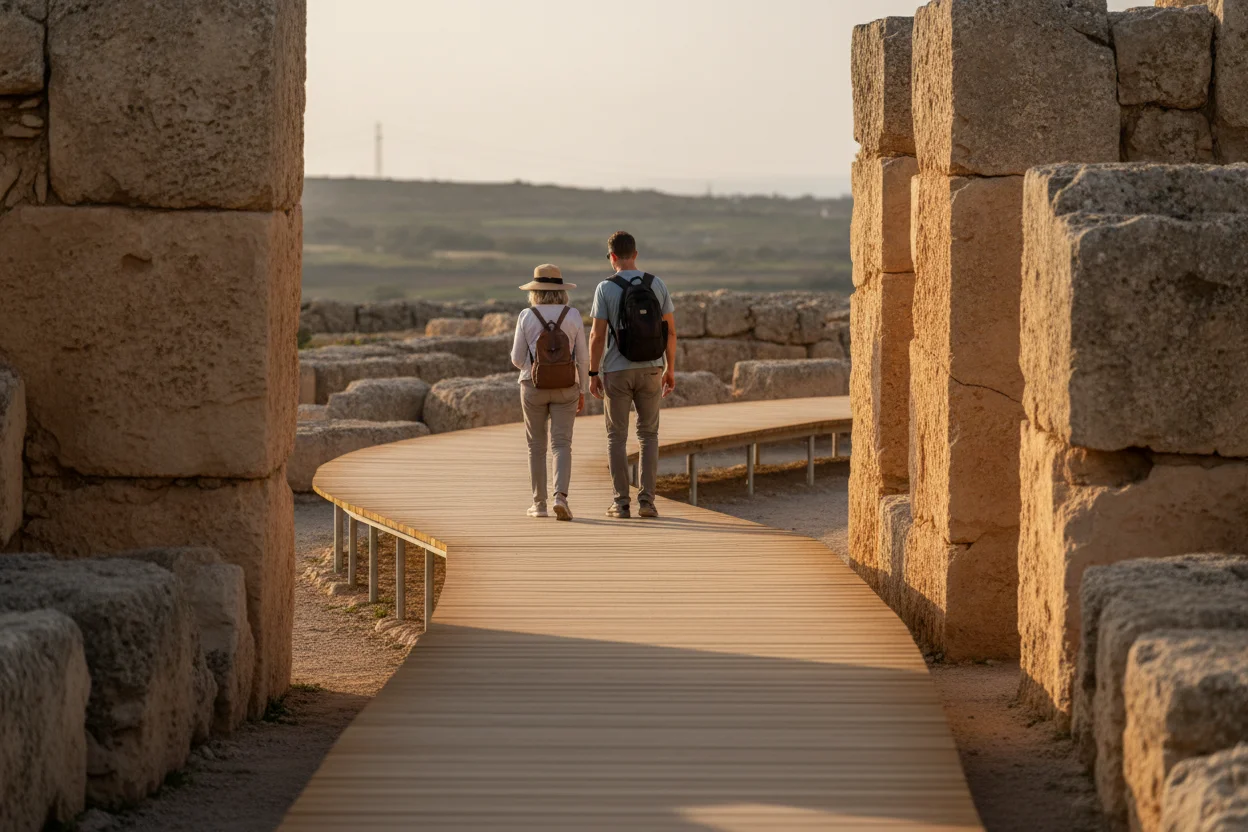
Mdina’s interior streets, the Grotto of St. Paul, the Rabat catacombs, and parts of the Gozo Citadel are the stops that involve stairs, uneven historic paving, or both, with limited or no accessible alternative. St. Paul’s Bay, St. John’s Co-Cathedral in Valletta, and the modern walkway at the Ġgantija temples on Gozo are considerably more manageable, often more than first-time leaders expect. I go through each site specifically in our accessibility overview for Malta, and a full adapted itinerary is laid out in our accessible Malta itinerary.
Knowing this in advance changes how you talk to your group about the trip. Instead of a vague “there will be some walking,” you can tell your mother-in-law with the walker exactly which two or three stops will require her to sit out part of the visit, and exactly which ones, including the spiritually central St. Paul’s Bay, she will experience fully alongside everyone else.
Plan to Split, Not to Force
For the handful of stops that are genuinely stairs-only, like the Grotto of St. Paul, the answer is not to push everyone through regardless, and it is not to remove the stop for the whole group either. It is to split, briefly and with a plan.
Those who can manage the stairs go down as a smaller group. Those who cannot wait nearby, ideally somewhere with seating and shade rather than standing in a doorway. The part that makes this work, and the part leaders often skip, is giving the group above something meaningful to do rather than simply waiting. A short devotional reading in the courtyard above the Grotto, timed to happen while the others are below, means nobody experiences the stop as something that happened to everyone but them.
This is a small logistical decision, but it is the difference between a mixed-mobility group that feels united and one where the slower members quietly feel like a burden on the schedule. I have watched both versions happen, and the difference is entirely in the planning, not in anyone’s attitude.
Pace the Whole Day Around the Group You Actually Have
A group of eighteen with a wide mobility range should not follow the same minute-by-minute schedule as a group of eighteen college students. This sounds obvious, but I still see itineraries built from a template rather than around the specific people on the bus.
Build in longer transition windows between stops. Schedule a real rest break after Mdina, which is physically demanding for almost everyone, not just for those with mobility limits. Put the most difficult walking stop of the day earlier, when people are freshest, rather than at the end of a long afternoon. None of this changes what the group sees. It changes whether they arrive at each site with the energy to actually take it in.
Equipment and Practical Logistics
A few practical items make a real difference and are worth sorting out before you leave home. Confirm whether wheelchairs and walkers need to be foldable for coach storage, and let your tour operator know exact equipment types in advance so the vehicle and drop-off points are chosen accordingly. Bring a lightweight folding stool or two for anyone who needs to sit unexpectedly at a site with no benches. Malta’s uneven historic paving is harder on wheels and canes than flat concrete, so rubber cane tips and all-terrain wheelchair attachments, if your traveler has access to them, genuinely help.
Coordinate with your driver and guide about drop-off points closest to each site’s most accessible entrance rather than the standard tourist entrance, which is not always the same door.
The Trip Is Still One Trip
The goal in all of this is not to run two separate itineraries side by side. It is to run one trip that flexes at the two or three moments where the terrain genuinely requires it, and stays unified everywhere else. Most of a Malta heritage week, including its most spiritually significant stop at St. Paul’s Bay, works for the whole range of mobility in your group without any adjustment at all. Planning well for the handful of exceptions is what lets the rest of the week feel like exactly what it is: one congregation, one journey, together.
With fifteen or more participants the group leader travels free, and part of using that role well is making sure every person you brought, regardless of how they walk, gets the same trip you promised them.
FAQ: Mixed-Mobility Malta Groups
How do I find out my group’s real mobility needs before the trip?
Have individual conversations rather than relying on a generic sign-up form. Ask specifically about stairs, walking distance, uneven ground, and mobility aids. People often underreport limitations on a form, especially in a group setting, so a direct conversation gets a far more accurate picture.
Which Malta sites are hardest for travelers with limited mobility?
Mdina’s interior streets, the Grotto of St. Paul, the Rabat catacombs, and parts of the Gozo Citadel involve stairs or uneven historic paving with little or no accessible alternative. These are the stops that require a split-group plan rather than a full-group visit.
What should the group do at a stairs-only site like the Grotto of St. Paul?
Split the group. Those who can manage the descent go down together, and those who cannot wait nearby with seating and a planned activity, such as a short devotional reading, so the stop remains meaningful for everyone rather than becoming dead time for those who stay above.
Does a mixed-mobility group need extra days added to the itinerary?
Usually not. The standard four to six-day Malta itinerary works well with adjusted pacing, longer transitions, and a rest break after the most demanding days, particularly Mdina. Adding days is rarely necessary if the existing days are paced around the group’s actual needs.
Should we bring our own mobility equipment or arrange it locally?
Bring what your travelers already use and are comfortable with, and confirm with your tour operator in advance whether it needs to be foldable for coach storage. Malta’s uneven historic paving is harder on standard wheels and cane tips than flat pavement, so all-terrain attachments help if available.
Every group I have led has had this range of mobility in it somewhere, and every one of them has made the trip work with the right planning. Tell me about your group specifically, and we will build a week that includes everyone properly.
Contact us to start planning a Malta trip suited to the group you actually have.