Mdina’s Giudecca: The Jewish Quarter Before 1492
Most visitors to Malta walk through Mdina, the old walled capital, and admire its medieval silence. The city has earned its nickname, the Silent City. But very few visitors know that within Mdina’s walls lies a quarter that once held an entire community, now gone.
The Giudecca was Mdina’s Jewish quarter. For over a thousand years, a Jewish community lived within these narrow streets, traded in these markets, and maintained their faith on this small Mediterranean island. In 1492, the same year Spain expelled its Jews under Ferdinand and Isabella, the Knights of Malta did the same. The community was forced to convert or leave.
Today the Giudecca’s streets still stand. The layout is unchanged. The buildings have been repurposed, but the geography of the quarter is identifiable. For Jewish heritage travelers, walking the Giudecca is walking through a place where your ancestors lived for fifteen centuries before they were erased from the record. It is quiet, it is small, and it is almost entirely absent from any guidebook you will find in English.
The Church of St. Paul’s Shipwreck: More Than a Name
In Valletta, there is a church dedicated to St. Paul’s Shipwreck. Many visitors see the name and assume it is one of the island’s many baroque churches named after a saint. It is more than that.
This church holds what it claims to be a relic of the Apostle Paul himself: a portion of the bone from his wrist. It also holds a piece of the column on which Paul is said to have been beheaded in Rome. These are religious relics, not archaeologically verified artifacts, and that distinction matters. But for a Christian pilgrim standing in this small church in Valletta, the weight of what it claims to hold is real.
The church itself is beautifully painted, richly decorated, and far less crowded than St. John’s Co-Cathedral a few streets away. Heritage groups who visit often find that this quieter church, with its direct connection to the Apostle, is one of the most moving stops on the island.
Ggantija Temples on Gozo: The World’s Oldest Freestanding Religious Structures
A short ferry ride from Malta lies Gozo, the smaller and quieter of Malta’s two inhabited islands. On Gozo, near the town of Xaghra, stand the Ggantija temples.
These temples were built around 3,600 BCE. That is roughly 900 years before Stonehenge and 1,000 years before the Great Pyramid of Giza. They are among the oldest freestanding structures in the world, and they were built for religious purposes. The name Ggantija comes from the Maltese word for giant, because local tradition held that only a giant could have moved the stones.
For a faith traveler, standing inside the Ggantija complex is standing in a place where human beings first built permanent structures dedicated to something beyond themselves. This predates every monotheistic tradition. It predates written language. Whatever those builders believed, they believed it enough to cut and stack enormous limestone blocks into walls that have stood for over 5,600 years.
Most tour itineraries treat Gozo as a scenic day trip. For heritage groups, the Ggantija temples alone make Gozo essential.
The Wignacourt Museum: Caravaggio’s Other Painting
Everyone who visits Valletta hears about Caravaggio’s “Beheading of St. John the Baptist” in St. John’s Co-Cathedral. Far fewer know that there is another Caravaggio painting in Malta.
The Wignacourt Museum, housed in a 17th-century building in Rabat adjacent to the Grotto of St. Paul, holds “St. Jerome Writing,” a smaller but powerful Caravaggio work. The museum also sits above a network of underground chambers and tunnels that connect to the catacombs beneath the town.
For heritage groups visiting Rabat for the St. Paul’s Grotto and the catacombs, the Wignacourt Museum is a natural addition. You see a Caravaggio without the crowds, explore underground passages that most tourists never enter, and gain a deeper understanding of Malta’s layered history. It is the kind of place that rewards the traveler who looks past the standard itinerary.
Rabat’s Underground Catacombs: Jewish, Christian, and Pagan Together
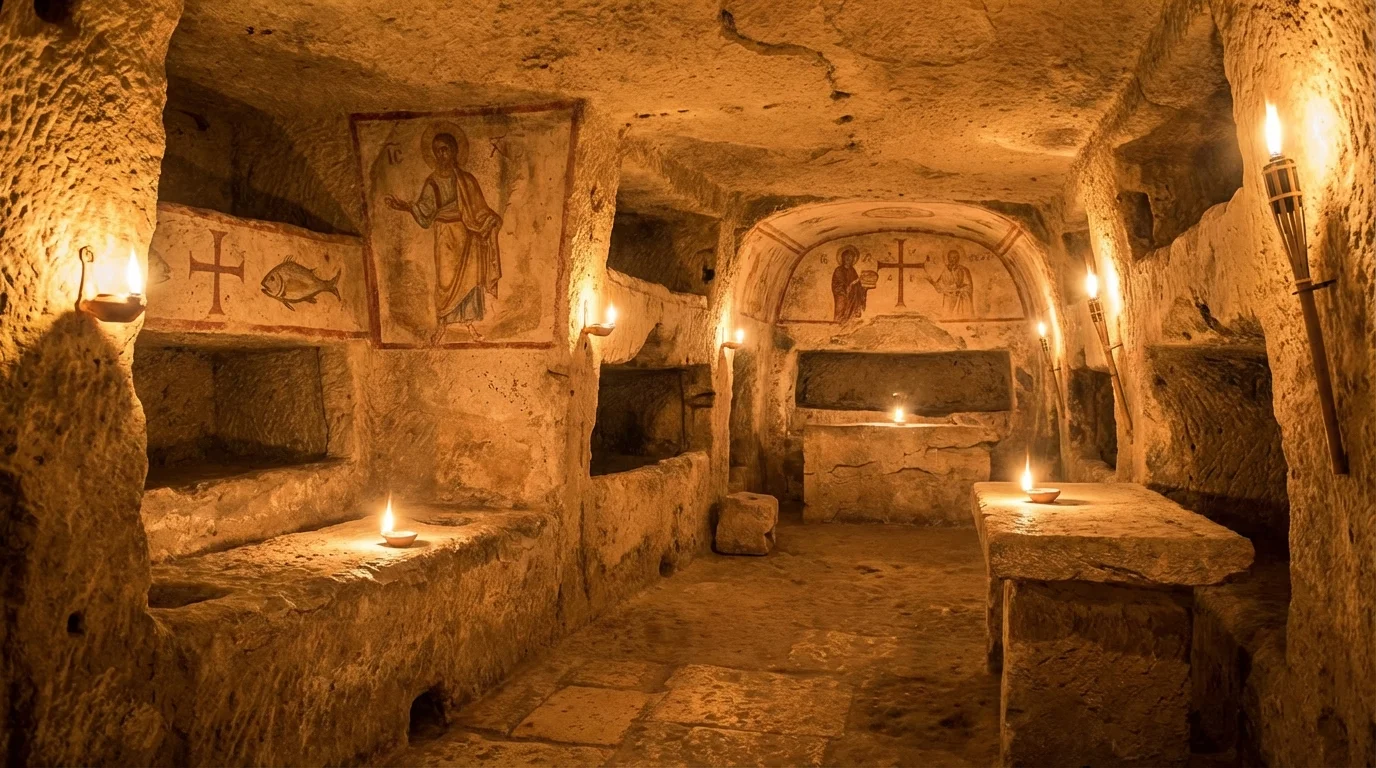
Beneath the town of Rabat, just outside Mdina’s walls, lies one of the most remarkable burial sites in the Mediterranean. The catacombs of Rabat contain Jewish, Christian, and pagan sections, all carved into the same rock, all dating from roughly the 4th century CE.
The St. Paul’s Catacombs are the largest and most visited, with their round agape tables where early Christians held funeral meals beside the graves of their dead. But the Jewish section of the catacombs, identified by its menorahs carved into the rock and the absence of figural decoration, is far less known. It is one of the only Jewish catacomb sites in the Mediterranean outside of Rome.
What makes this place remarkable is the proximity. Jewish, Christian, and pagan communities buried their dead in adjacent chambers beneath the same town, in the same rock. It is coexistence carved in limestone, from an era when these three traditions shared a small island.
For heritage groups that include both Christian and Jewish members, Rabat’s catacombs offer a rare moment of shared history.
How to Add These to a Group Heritage Itinerary
All five of these sites fit naturally into a Malta heritage itinerary without adding days to the trip. Mdina’s Giudecca and Rabat’s catacombs are adjacent and can be visited in a single morning. The Wignacourt Museum is steps from the Grotto of St. Paul. The Church of St. Paul’s Shipwreck is in Valletta, easily combined with St. John’s Co-Cathedral. And Gozo’s Ggantija temples are the centerpiece of the standard Gozo day trip.
The difference is knowing they are there and knowing why they matter. Heritage Tours includes these sites in our Malta itineraries because they tell the full story, not just the one on the tourist map.
If you are planning a group heritage trip to Malta and want to go beyond the standard circuit, we would be glad to help you build an itinerary that includes what most visitors miss. Learn more about Malta on our destination page.
Frequently Asked Questions
What was the Jewish quarter in Mdina called? The Jewish quarter in Mdina was called the Giudecca. It was home to a Jewish community for over 1,500 years until the expulsion of 1492. The streets of the Giudecca still exist within Mdina’s walls, though no synagogues remain standing.
Is there a relic of St. Paul in Malta? The Church of St. Paul’s Shipwreck in Valletta claims to hold a relic of the Apostle Paul, specifically a portion of his wrist bone. It also holds a fragment of the column on which Paul is said to have been martyred. These are religious relics, held as articles of faith rather than archaeologically verified objects.
Are the Ggantija temples worth visiting for heritage travelers? Absolutely. The Ggantija temples on Gozo, built around 3,600 BCE, are among the oldest freestanding religious structures in the world. They predate Stonehenge by roughly 900 years. For faith travelers thinking about the long arc of human spirituality, they are one of the most significant sites in the Mediterranean.
What are the catacombs in Rabat, Malta? The catacombs beneath Rabat are underground burial chambers dating to approximately the 4th century CE. They include separate Jewish, Christian, and pagan sections carved into the same rock. The St. Paul’s Catacombs are the largest, and the Jewish section contains menorahs carved into the stone walls.
Is Gozo worth a day trip from Malta for a heritage group? Yes. Gozo is accessible by a short ferry ride and offers the Ggantija temples, the Citadel (a medieval fortified town), and a quieter, more rural character than the main island. For heritage groups, the Ggantija temples alone justify the trip. Heritage Tours coordinates the ferry crossing and local guiding for groups.