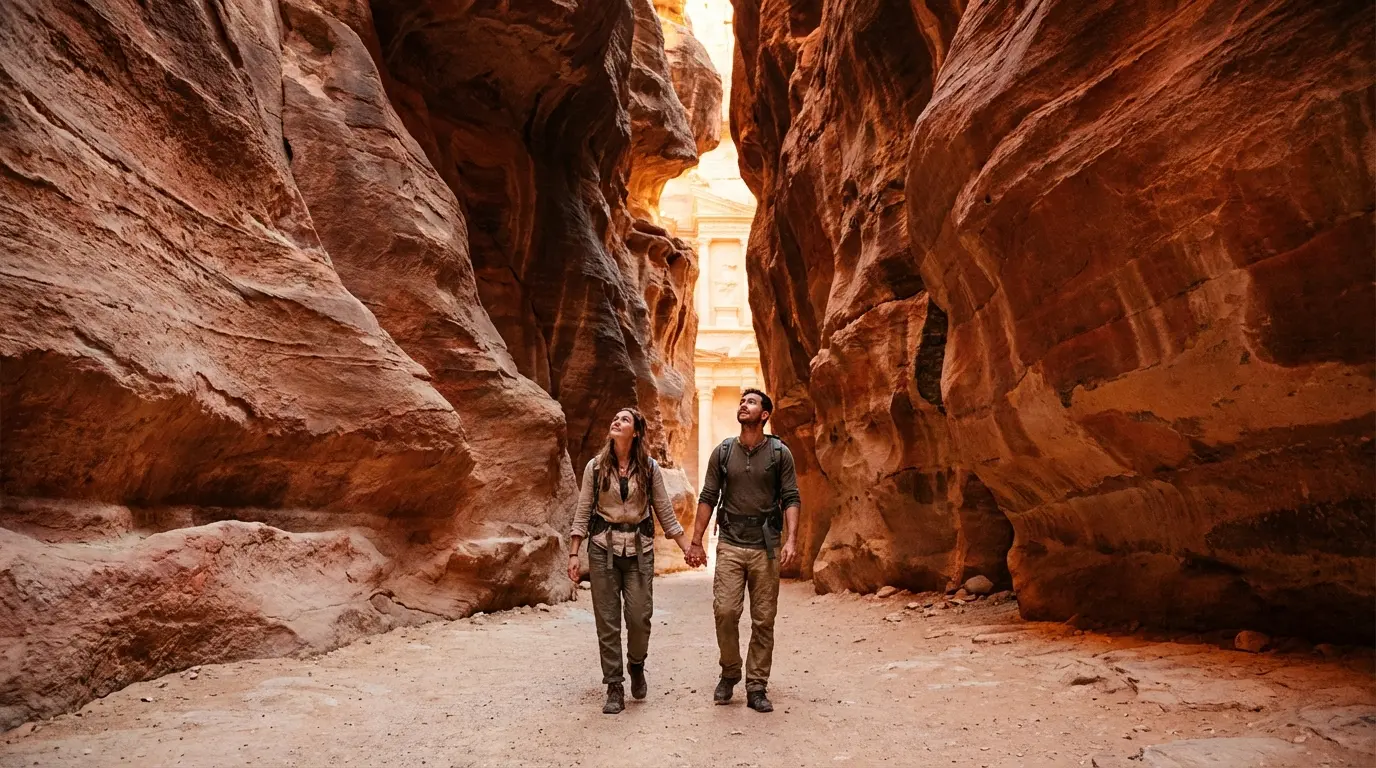
This is a question I get from rabbis and pastors more than almost any other. Not “should we go to Jordan?” They’ve usually already decided that. The question is: “Should I go first on my own, or should I take the whole congregation?”
Both are the right answer, depending on where you are. I want to help you figure out which one fits your situation, because these are genuinely different trips with different purposes, and making the choice thoughtfully will make the experience better whichever way you go.
The Question Behind the Question
When a spiritual leader asks me about a private tour versus a group tour, they’re usually asking something deeper. They want to know: will I be able to give my congregation what they need if I take them? Am I ready to lead this? Or: if I go privately first, is there value in that, or am I just delaying the real thing?
The honest answer is that both are real. A private trip and a group trip serve different purposes. They’re not the same journey done at different scales. They’re two distinct experiences, and many of the spiritual leaders I work with have done both, in that order, and found each one essential.
Let me walk you through what each one actually looks like.
What a Private Heritage Tour to Jordan Actually Looks Like
“Private” in Heritage Tours’ context doesn’t mean resort packages or luxury-only travel. It means a custom itinerary built around you: your family, your travel partner, a small delegation from your board, or just you alone. We handle hotel pickup and dropoff, arrange your local guides, build the schedule around your priorities, and adjust as you go.
The size of a private group can range from one person to about twelve or fifteen. Beyond that, you start to move into group tour territory both in terms of pricing and in terms of the group dynamic itself.
Who Private Tours Are Best For
Private tours work especially well for a few kinds of travelers.
Rabbis and pastors doing a scouting trip, people who want to see Jordan for themselves before deciding whether to bring their community. This is probably the most common reason clergy come to us for a private itinerary. They want to stand at Mount Nebo, walk the Bethany baptism site, and experience Petra with their own eyes before they stand in front of their congregation and say: “This is worth your time and your trust.”
Families with specific heritage connections, Jewish families tracing roots through the Transjordan regions, Christian families who want to visit the baptism site as a family experience.
Couples or small groups who want depth over breadth. On a private tour, we can spend three hours at Mount Nebo if that’s what the group needs. We’re not managing forty people with different needs and energy levels.
Clergy who want unstructured time. On a group tour, you’re usually in a leadership role, looking after your congregation. On a private tour, someone looks after you. Many spiritual leaders find that the private trip is where they actually receive, rather than give.
What You Gain and What You Give Up
The gain on a private tour is flexibility and personal depth. Your guide’s full attention. The ability to slow down when something moves you and pick up the pace when something doesn’t. No one waiting on you, no one running behind.
What you give up is the shared experience of traveling with your community. There’s something that happens when forty members of a congregation stand together at a site they’ve been reading about for years. That collective encounter is its own spiritual event, and it doesn’t happen on a private trip. You also give up the economics of scale, which I’ll explain in a moment.
What a Group Heritage Tour to Jordan Actually Looks Like
A group heritage tour is built around a spiritual leader and their community. The rabbi or pastor is the protagonist of the trip, not Heritage Tours. We are the invisible structure that makes everything work so the leader can focus entirely on their people.
This means that when your group stands at the Jordan River, you’re the one reading the text. When your congregation gathers at Mount Nebo, you’re the one leading the devotional. You came to Jordan with the people you’ve been doing life with, and the sacred sites become the context for a shared spiritual experience that your congregation will talk about for years.
For more on what this format can look like for your specific community, the group heritage tours to Jordan page walks through the full structure.
Who Group Tours Are Best For
Group tours are built for spiritual communities who travel together. Synagogues, churches, and other faith-based organizations whose members share a common tradition and a common leader. They’re for groups of fifteen or more who want to experience Jordan’s sacred sites as a community rather than as individuals.
They’re also, practically speaking, for group leaders who want to offer their congregation an experience they couldn’t arrange on their own, and who want a partner they can trust to handle every detail.
The Power of Traveling with Your Community
I want to say something here that doesn’t usually appear in tour descriptions. When a congregation travels together to Jordan, the trip changes the community. I’ve seen it happen too many times to think it’s accidental.
People who’ve sat next to each other in a synagogue or church for fifteen years and never really talked find themselves in a conversation they couldn’t have had at home. Something about being on foreign ground, standing at a site that carries the full weight of your shared tradition, opens people in ways that the ordinary rhythms of community life don’t.
The members of your congregation who go to Jordan together will come back bonded in a way they weren’t before. That bond feeds your community for years. It’s one of the real, lasting gifts of a group heritage journey, and it’s something that no private trip for one or two people can replicate.
The Economics: When Group Travel Changes Everything
Here’s the part of the conversation that often surprises people. The economics of group travel, when the numbers work in your favor, are genuinely transformative.
The Free Leader Travel Policy and What It Means
When a group reaches fifteen paying participants, the group leader travels free. That’s a Heritage Tours policy, and it matters more than it might sound.
Think about what it means for a rabbi or pastor. You’re already investing significant time in planning and leading this trip. Your congregation is asking you to be their spiritual guide for ten or twelve days in a foreign country. Under the group model, that contribution is recognized directly: the trip doesn’t cost you anything.
For congregations, it also means that the person best positioned to lead this experience, the one who knows the texts, knows the people, and knows how to create meaning from sacred geography, is fully present and fully invested without carrying a personal financial burden.
Cost Per Person: Private vs. Group Compared
A private tour typically costs more per person than a group tour. That’s not unique to Heritage Tours. It’s the nature of custom, small-group travel: the fixed costs of guiding, transportation, and coordination are spread across fewer people.
When a group reaches fifteen or more, several things shift. The per-person cost comes down. The group leader’s travel is covered. And the overall value of the experience goes up, because you’re traveling with your community rather than alongside strangers.
For groups of twenty, twenty-five, or thirty, the economics can be significantly more favorable than a private trip for two or three people. If cost is a factor in your congregation’s decision, reaching fifteen participants is the threshold worth aiming for.
If you want specific numbers for your situation, the private heritage tours page covers the private format in detail, and our team can provide comparisons for your specific group size.
A Specific Scenario: The Rabbi or Pastor Considering Both
Let me describe a pattern I’ve seen play out many times, because I think it’s worth naming explicitly.
Doing a Personal Scout Trip First
A pastor approaches us wanting to bring his congregation to Jordan. He’s read about the Baptism Site and Mount Nebo. He’s preached on the Jordan River crossing. But he’s never been, and he feels it would be wrong to lead people somewhere he hasn’t stood himself.
He books a private trip, usually five to seven days, often with his spouse or a trusted colleague. He visits the major sites, spends time in the places where he’ll eventually lead his congregation, asks his guides the questions he’ll need to answer when eighty people are looking at him for meaning.
He comes home knowing what he’s talking about. He can stand in front of his congregation and say: “I’ve been there. I know what it feels like. And I want you to feel it too.”
That’s the scout trip. It’s not a preliminary. It’s a preparation, and it makes the eventual group trip better by a significant margin.
Then Bringing the Community
Six months to a year later, he’s back in Jordan, this time with forty members of his congregation. The sites are familiar to him now. He’s not navigating the experience in real time. He can be fully present to his people because he already knows what’s coming.
At Mount Nebo, when the group gathers and he reads Deuteronomy 34, he reads it with authority. He’s stood there before. He knows the weight of the view. His congregation feels that, and it changes what the moment is for them.
This sequence, private first, group second, is genuinely the most powerful way to use both formats. It’s not required, and many group leaders go straight to the community trip with great results. But if you have the opportunity to do both, the two trips together are worth considerably more than either one alone.
What Heritage Tours Offers in Both Formats
I want to be direct about what we do. Heritage Tours works in both formats, private and group, and we don’t have a preference for which one you choose. Our interest is in making sure you and your community have the experience that’s right for you, not in fitting you into a format that’s convenient for us.
For private tours, we build a custom itinerary around your specific interests, schedule, and budget. Hotel pickup and dropoff, local expert guides who understand both the archaeological and religious layers of each site, and a flexible pace that lets you spend more time where it matters.
For group tours, we handle everything from initial planning through the last day on the ground. Our group leader travel policy (free travel with 15+ participants) applies. We coordinate devotional and prayer opportunities at the key sites, build in time for the moments that matter spiritually, and make sure your role as the group’s leader is supported rather than complicated.
You can explore the Jordan heritage destination page for an overview of what a Jordan itinerary includes in either format.
FAQ: Private vs. Group Jordan Tours
What is the difference between a private and group heritage tour in Jordan?
A private tour is a custom itinerary built for a small number of travelers, typically one to about twelve people, with full flexibility over the schedule, pace, and sites visited. A group tour is organized around a spiritual community traveling with their leader, typically fifteen or more participants, with a shared itinerary, group coordination, and the collective experience of traveling as a community.
Is a private tour or group tour better for a faith community trip to Jordan?
If you are bringing members of your congregation together for a shared faith experience, a group tour is almost always the better fit. The collective experience of a community standing together at sacred sites, led by their rabbi or pastor, is something the group format is specifically designed to support. A private tour is better suited for personal scouting trips, family travel, or small delegations who want depth and flexibility over shared community experience.
How many people do you need for a group heritage tour?
The meaningful threshold for a group tour is fifteen paying participants. At that number, the group leader travels free, the per-person pricing shifts, and the group dynamic takes on the character of a genuine community journey. Heritage Tours can work with groups of fifteen up to several hundred, with custom arrangements for very large groups.
Can a pastor or rabbi do a private scouting trip before bringing their community?
Absolutely, and many do. This is one of the most common ways spiritual leaders use Heritage Tours: a private trip to experience Jordan firsthand, followed by a group trip to bring their congregation. The scouting trip lets you lead from experience rather than from research, which makes a significant difference to the quality of the group experience.
Is a private tour to Jordan more expensive than a group tour?
Per person, yes, typically. Private tours spread fixed costs, guides, transportation, and coordination, across fewer travelers. When a group reaches fifteen or more, the per-person cost comes down, the group leader travels free, and the overall economics shift in favor of the group model. For families or individuals where flexibility and pace matter more than cost, the private tour’s price premium is often worth it.
Still weighing your options? That’s exactly where you should be at this stage, and there’s no wrong answer until you understand your own situation better. Heritage Tours can walk you through both options with specifics for your group size, your budget, and the kind of experience you’re hoping to create. Reach out and let’s have that conversation.