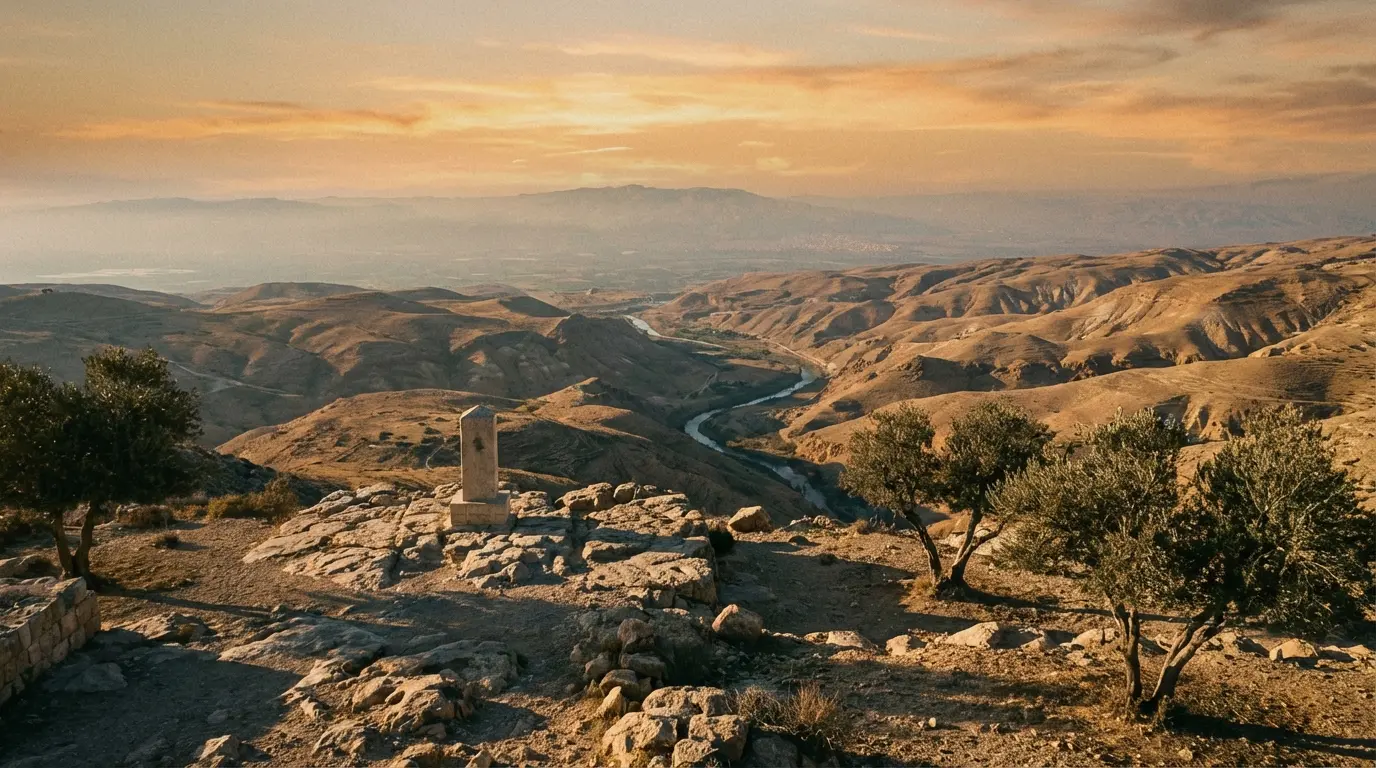
People are sometimes surprised when I tell them that some of the most sacred ground in all of Jewish history lies in what is today the Hashemite Kingdom of Jordan. And I understand the surprise. When we think about our biblical ancestors, we tend to picture Israel, the land they were promised, the land they eventually entered. But before they entered, they wandered. They camped. They prayed. Moses received his final prophecies. The Torah itself was spoken a second time, repeated to a generation standing on the eastern side of the river.
That ground is Jordan.
I have been guiding Jewish travelers through this land for over two decades, and I will tell you plainly: the Jewish story in Jordan is not a footnote. It is the prologue to everything.
What Jewish Travelers Often Don’t Know About Jordan
There is an important thing to understand before we go any further. Jordan does not have a living Jewish community today. The Jewish connection here is entirely biblical and historical. When I say this is sacred ground, I mean it in the sense of ancestral memory, not in the sense of a thriving community you will meet on arrival.
What you will find instead is landscape that has barely changed. The Plains of Moab. The mountains above the Dead Sea. The valley where the Jordan River winds its way south. When you stand on these hilltops and look west toward Israel, you are seeing exactly what our ancestors saw. That is a rare and humbling thing.
For a rabbi considering this trip for their congregation, that is the opening you are looking for. Not a museum. Not a reconstruction. The actual place, the actual view.
Mount Nebo: The Final View Moses Was Given
Mount Nebo sits in the rolling hills east of the Dead Sea, and on a clear day the panorama from its summit takes in Jerusalem, the Jordan Valley, and the northern shores of the Dead Sea. It is breathtaking in the most literal sense.
This is where Moses stood at the end of his life. God showed him the land, every inch of it, knowing that Moses himself would not enter. He could see it, he could name it, but it was not his to walk.
I have stood on that mountain with many groups over the years, and I have never once found a way to make that story feel small. It does not shrink. It only expands the longer you stand there.
What the Site Looks Like Today
Mount Nebo is today managed by the Franciscan Archaeological Institute, and there is a small church on the summit, the Memorial Church of Moses, built over what is believed to be his tomb area. The church contains stunning Byzantine mosaics that are worth seeing in their own right. There is also an iron sculpture, the Brazen Serpent, which recalls the story from Numbers 21.
The site is well-maintained and accessible. There is a viewing terrace that faces west, and the placards identify the landmarks visible on the horizon. On clear winter or spring days, when the haze lifts, you can sometimes see the outlines of Jerusalem’s hills.
The Spiritual Weight of Standing There
For a Jewish group, I would encourage you not to rush this moment. The view westward is the heart of the experience, but the context matters too. Before you step onto that terrace, sit together and read Deuteronomy 34, the final chapters of the Torah. Read it there, with the land spread out before you. I have watched groups do this and I have watched something happen to people. It is not theater. It is simply being in the right place at the right moment with the right words in front of you.
There is nowhere else in the world where you can do that and have it be geographically accurate.
The Jordan River Crossing: Where the Israelites Entered the Land
The book of Joshua opens with God’s command to cross the Jordan. The priests carried the Ark of the Covenant into the water, and the river stopped flowing. The Israelites crossed on dry land. Twelve stones were set up as a memorial.
That crossing happened near a site called Bethany Beyond the Jordan, which lies just a few kilometers north of the Dead Sea on the Jordanian side of the river.
Bethany Beyond the Jordan and Its Jewish Significance
The site is most commonly associated with the baptism of Jesus, and many Christian pilgrims visit it for that reason. But for Jewish travelers, the significance runs deeper into history. This is where Joshua led the crossing. This is where Elijah ascended in the chariot of fire, with Elisha watching from the opposite bank.
The Jordan River here is narrower than most visitors expect. You can sometimes see the Israeli shore clearly. The water moves slowly, brownish with sediment. It does not look like a miraculous river. And yet the weight of what happened on these banks is undeniable.
For a Jewish group, I suggest framing this site around the Joshua narrative specifically. The crossing marked the end of forty years of wandering and the beginning of the covenantal possession of the land. Standing on the Jordanian bank and looking west toward Israel, that movement, that direction, that meaning is still alive in the geography.
The Plains of Moab: Where the Torah Was Repeated
The book of Deuteronomy takes place almost entirely in the Plains of Moab, the flat land east of the Jordan River near where it empties into the Dead Sea. This is where Moses gathered the Israelites for forty days of teaching. Where he repeated the covenant. Where he spoke the Shema.
Today, driving through this region, you pass through agricultural land and stretches of desert. There is no marker that says “The Torah was spoken here.” But if you have studied Deuteronomy carefully, the geography will match the text in ways that will catch you off guard.
I often ask groups: where did the Shema come from? They know the words. They can recite them. But standing in the actual valley where those words were first spoken, on the road north toward Jordan’s river, something about the prayer changes. It gets older. It gets heavier. In the best possible way.
Lot’s Cave and the Story of Abraham’s Family
South of the Dead Sea, perched on a cliffside with a view of the water below, is a site known as Lot’s Cave. The Book of Genesis tells us that after the destruction of Sodom and Gomorrah, Lot and his daughters took refuge in a cave in the mountains. This cave, identified through Byzantine records and archaeological excavation, is believed to be that place.
The connection here is Abrahamic in the oldest sense. Lot was Abraham’s nephew. His story is woven through Genesis at the same time as the founding narratives of the Jewish people. Visiting this site alongside the story of Abraham, Sarah, and their descendants gives the Jordan journey a family dimension, not just a national one.
Machaerus: Where the Moabite Story Intersects Jewish History
Machaerus is an ancient fortress on a volcanic hilltop east of the Dead Sea, and it appears in both Jewish and early Christian history. It is best known to most Christian visitors as the site where John the Baptist was imprisoned, but for Jewish groups it holds an earlier layer of meaning.
The fortress was built by the Hasmonean king Alexander Jannaeus in the first century BCE and later expanded by Herod the Great. It sits in Moabite territory, the same region that appears throughout the biblical narrative from Ruth’s story to the wanderings of the Israelites. The view from the top is extraordinary, and the site is rarely crowded.
For groups with time to include a second full day in Jordan, Machaerus rewards the extra drive.
Practical Considerations for Jewish Groups Visiting Jordan
I want to speak plainly here, because these questions come up every time and it is better to address them honestly.
Kosher Food in Jordan
This is the most common question I hear, and I will be direct: Jordan does not have a certified kosher restaurant infrastructure the way Israel does. For groups that keep strictly kosher, the practical reality is that you will need to plan around this limitation.
What we typically arrange is a combination of approaches: packaged kosher food brought from Israel, meals at hotels that can accommodate specific dietary restrictions, and fresh fruit and produce that is naturally permissible. For groups doing a Jordan extension as part of a larger Israel trip, we coordinate with the Israel-side suppliers to pack appropriately.
This is manageable. It requires planning, but it does not make a Jewish group trip to Jordan impractical. We have done it many times.
Shabbat and Prayer Logistics
Most Jewish groups visit Jordan as a day trip or a two-to-three-day extension of an Israel itinerary, which makes Shabbat planning relatively straightforward. If your group’s Jordan visit falls near Shabbat, we design the schedule so that you are back in Israel before Shabbat begins.
For groups that do stay in Jordan over a Shabbat, Amman has a small but real Muslim-majority population that is accustomed to accommodating Western guests. The major hotels understand dietary observance in a general sense. Minyan is possible if you bring your group’s members. Torah and prayer materials travel with you.
Crossing the Border from Israel
There are three border crossings between Israel and Jordan: the Allenby Bridge (near Jericho), the Sheikh Hussein Bridge (in the north, near Beit She’an), and the Yitzhak Rabin Terminal in the south (near Eilat).
For groups based in Jerusalem or central Israel, the Allenby Bridge is the most convenient. For groups coming from northern Israel or including Galilee in their itinerary, the Sheikh Hussein crossing makes more geographic sense.
The border crossing process takes time. Build at least ninety minutes into your schedule on crossing days, more if the group is large. We handle the coordination and know what to expect at each crossing. This is not something to worry about, but it is something to know.
How to Combine Jordan’s Jewish Heritage with an Israel Itinerary
The most natural structure is to begin in Israel, spend your primary days in Jerusalem, the Galilee, and the coastal sites, then add Jordan as a closing chapter.
Arriving in Jordan from Israel, crossing the Jordan River at Allenby or Sheikh Hussein, gives the journey a natural geographical arc. You are moving in the direction of the biblical story, from the east, the wilderness, into the west, the land. The reversal of the Israelites’ original crossing becomes a kind of homecoming narrative in its own right.
We regularly build custom itineraries around specific Torah portions for groups that want to connect their Jordan experience to their synagogue calendar. A group preparing for the reading of Deuteronomy in the fall can plan a trip for the summer before. A group exploring the book of Numbers can structure their Jordan days around the wilderness narrative.
This kind of layering is what makes a heritage journey different from a tour. For more on planning that kind of experience, see our Jordan heritage destination guide.
FAQ: Jewish Heritage Travel to Jordan
What Jewish historical sites are in Jordan?
The major biblical Jewish sites in Jordan include Mount Nebo (where Moses viewed the Promised Land before his death), the Jordan River crossing site near Bethany Beyond the Jordan (where Joshua led the Israelites into the land), the Plains of Moab (where Deuteronomy was delivered), Lot’s Cave south of the Dead Sea, and Machaerus, the Hasmonean and Herodian fortress. The Jewish connection throughout Jordan is entirely biblical and historical, not related to a modern Jewish community.
Is Jordan accessible and safe for Jewish travelers?
Yes. Jordan has been politically stable for decades and welcomes visitors from Israel and Jewish travelers from around the world. The Wadi Araba peace treaty between Israel and Jordan has been in place since 1994. There is no issue with traveling openly as Jewish visitors. Groups do this regularly and safely.
Can Jewish groups find kosher food in Jordan?
Certified kosher restaurants are not available in Jordan. Groups that keep strictly kosher typically bring packaged food from Israel, supplement with fresh produce, and coordinate with their tour operator well in advance. For most Jewish groups visiting Jordan as part of a larger Israel trip, this is a practical rather than prohibitive challenge.
What is the significance of Mount Nebo for Jewish travelers?
Mount Nebo is the mountain in present-day Jordan where the Torah tells us Moses stood at the end of his life. God showed him the land of Israel from this vantage point, the Jordan Valley, Jerusalem, and the hills of Judea visible to the west. Moses died there without entering the Promised Land. For Jewish travelers, standing on that summit and reading the final chapter of Deuteronomy in place is one of the most powerful moments the entire Holy Land experience can offer.
How do you cross from Israel to Jordan for a heritage tour?
There are three crossing points. Groups based in Jerusalem or the center of Israel typically use the Allenby Bridge near Jericho. Groups in the north use the Sheikh Hussein Bridge near Beit She’an. The southern crossing near Eilat is used for trips that include Petra and Wadi Rum. Plan for ninety minutes or more at the crossing itself. Your tour operator handles the coordination and documentation requirements in advance.
If this is a journey you are beginning to consider for your congregation, I would love to talk through what it could look like for your group. There is no standard tour here. We build each itinerary around the people making the journey, the texts they carry, and the questions they are bringing. Reach out when you are ready, and we will start from there.