Every group leader I’ve worked with eventually asks me the same question. They’ve read about Petra. They know about Bethany Beyond the Jordan and Mount Nebo. And then, usually a few weeks into planning, they lean forward and say: “Dina, what are the places you’d go if it were your group?”
That’s the question I want to answer here.
After twenty years with the Israel Ministry of Tourism and more years than that building itineraries in this region, I’ve spent a lot of time in Jordan at sites that don’t appear on standard tour programs. Not because they’re inaccessible, but because most operators simply don’t know them well enough to include them, or don’t have the local relationships to do so properly.
These are the places that, in my experience, become the moments your congregation talks about when they get home. Not the sites they expected to be moved by. The ones that caught them by surprise.
Why the Guidebooks Miss the Best of Jordan
Guidebooks are written for individuals moving quickly. They emphasize the sites that photograph well, that can be seen in an hour, that appear in enough other guidebooks to be considered essential.
Faith group travel is different. You’re not trying to check boxes. You’re trying to give your community an encounter with the biblical world that reshapes how they read scripture, how they understand their faith, how they see themselves. For that, you need sites with depth and meaning, not just visual impact.
The sites I’m about to share with you are real places with real spiritual weight. Some have extraordinary mosaics. Some have direct New Testament connections. One sits on a mountaintop where the Nabataeans burned incense to their gods, and you can stand in that place and feel the ancient world pressing very close.
All of them are accessible to faith groups traveling with proper support. None of them require trekking or special permits. What they require is a guide who knows where they are and why they matter. That’s what I want to give you here.
Our Jordan heritage destination page shows you the framework of a full Jordan journey. This post is about what you add when you want to go deeper.
Umm Qais: Where Jesus Healed the Gadarene Demoniacs
Umm Qais sits at the far north of Jordan, on a promontory above the Yarmouk River gorge. On a clear day, you can see the Sea of Galilee, the Golan Heights, and the hills of southern Lebanon from the same spot. It is one of the most extraordinary views in the entire region.
But the view isn’t why I bring faith groups here.
Umm Qais is ancient Gadara, one of the cities of the Decapolis. This is where, according to Matthew, Mark, and Luke, Jesus crossed the Sea of Galilee and healed the men possessed by demons, who then entered the herd of pigs that ran into the sea. That sea is visible from where you stand. The geography is exact.
For many Christian communities, reading those passages while looking out over the actual landscape they describe is an experience unlike anything that can be arranged at a more famous site. There’s no crowd here. No tour buses. Just basalt ruins, Roman columns lying on their sides, and a view that puts the whole biblical world into physical perspective.
What to Expect When You Arrive
The site is managed by the Jordanian government and is genuinely well-kept. There’s a small but good museum with artifacts from the Roman and Byzantine periods. The old village of Umm Qais, built into and around the ancient ruins over centuries, gives the place a layered, living quality that more excavated sites sometimes lose.
Plan for two to three hours here. Bring water. Walk out to the viewpoint before you do anything else. Let your group see what they’re standing in before you tell them the story.
Iraq al-Amir: The Palace of Tobiah in the Jordan Valley
Most visitors to Jordan never leave the main tourist corridor between Amman, Madaba, and Petra. Iraq al-Amir sits just thirty kilometers west of Amman, down into the Jordan Valley, and it holds something genuinely rare: the only surviving Hellenistic-period structure in Jordan.
The Qasr al-Abd, the Palace of the Servant, is a reconstructed manor house built by the Tobiad family in the second century BCE. And that name, Tobiad, will ring a bell if your congregation has read Nehemiah. The Tobiads are named repeatedly in Nehemiah and Ezra, as adversaries of the returning exiles. This was their family estate. The patriarch’s name, Tobiah, is actually carved in Aramaic letters into the cliff face above the caves nearby. It is one of the oldest inscriptions in the region.
For Jewish communities in particular, standing at the ancestral home of a family whose opposition to Nehemiah is recorded in scripture is a remarkable thing. The people in that book were real. Their houses are still here.
The site requires a short drive on a winding road, and the last stretch is unpaved. But it’s entirely manageable for a group bus, and I’ve never had a group that didn’t consider it worth it.
Wadi Seer and the Qasr al-Abd Ruins
Wadi Seer is the valley that leads down to Iraq al-Amir, and the village of Wadi Seer itself is worth a stop if your itinerary allows. This is a working Jordanian agricultural community, and the welcome is genuine and warm. The valley has been inhabited continuously for thousands of years.
I include it here because the combination of Wadi Seer and Iraq al-Amir creates something that the individual sites don’t: a sense of the Jordan Valley as a living landscape, not just a location for monuments. Your group will see olive trees and vegetable gardens in the same ground where Tobiah walked. That continuity is, in my experience, deeply meaningful for faith communities.
The Byzantine Church Mosaics of Umm ar-Rasas
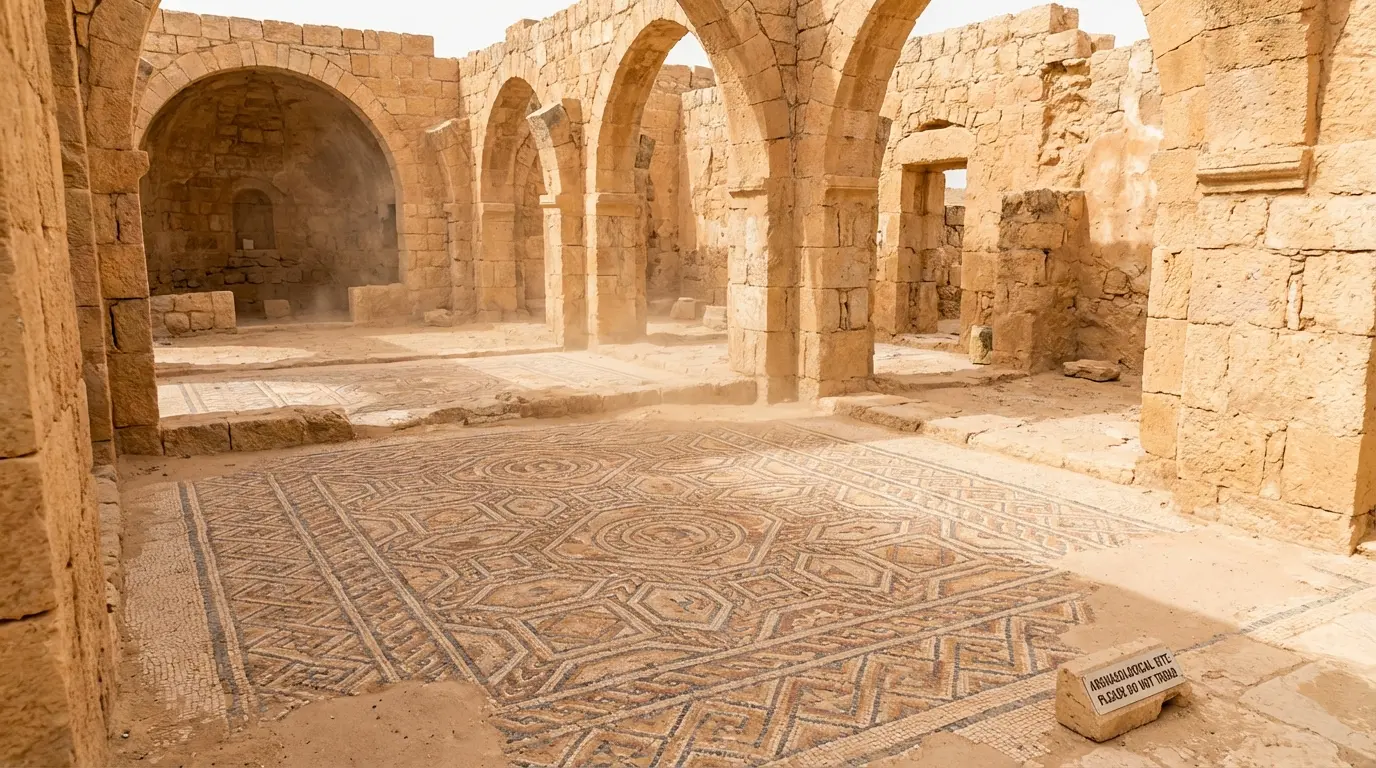
If Madaba’s mosaic map is on your itinerary, and it should be, then Umm ar-Rasas deserves to be there too. It is a UNESCO World Heritage Site, and it contains the largest mosaic floor in Jordan.
The Church of Saint Stephen at Umm ar-Rasas has an extraordinary 8th-century mosaic depicting cities of the Holy Land, both on the Jordan side and the west bank, including Jerusalem, Nablus, Gaza, and Alexandria. It is a companion to the Madaba map in some ways, an ancient inventory of the biblical world made in tile and stone.
What makes this site unusual is its age. The mosaics survived into the medieval period because the site was abandoned before it could be built over or destroyed. They were only rediscovered and excavated beginning in the 1980s. The protective structure built over them is not beautiful, but what’s underneath it is.
Umm ar-Rasas is about an hour south of Madaba, and it pairs naturally with a Madaba visit. Most group itineraries I know of treat Madaba as a half-day stop. Adding Umm ar-Rasas turns it into a full day of mosaic heritage that tells a coherent story about Byzantine Christian devotion in this region.
Abila (Quweilibeh): A City Mentioned in the Gospels
Abila is another Decapolis city, less excavated than Jerash, less visited than Umm Qais, and more intimate than either. The site is near the modern village of Quweilibeh in northern Jordan, and it holds layers of occupation from the Bronze Age through the Byzantine period.
For faith groups, the significance is in the name. Abila appears in early Christian texts, and the region of Abilene is mentioned in Luke chapter 3, in the passage that establishes the historical setting for the ministry of John the Baptist. The city sat on one of the ancient trade routes, and you can still see the Roman road that connected it to the rest of the Decapolis.
What I value about Abila for group visits is its quietness and its depth. The site has a quality I can only describe as undisturbed. It hasn’t been rebuilt or heavily interpreted. You are walking through the place essentially as archaeologists found it. Some groups find that more affecting than the grander reconstructed sites.
The Springs of Moses at Ayoun Musa
Just a few kilometers north of Mount Nebo, in a small valley that most visitors drive straight past, there are springs that have been associated with Moses since ancient times. Ayoun Musa, the Springs of Moses, are mentioned in Byzantine pilgrimage accounts and were visited by early Christian travelers coming to Mount Nebo.
The springs flow into a small green valley with palm trees and reeds, startling against the dry landscape around them. There is a traditional connection here to Numbers 33, where the Israelites camped at a place called Oboth, and to Exodus 15, where Moses sweetened bitter water at Marah. These identifications are traditional rather than conclusive, but that’s true of many biblical sites, and the physical reality of springs in the wilderness near Nebo is striking regardless of the exact exegetical questions.
What I find valuable about stopping here is what it does to the Mount Nebo experience. When your group arrives at Nebo after pausing at the springs in the valley below, they’ve already been walking in the landscape of the Exodus. The altitude and the view from Nebo have a different quality when you’ve felt the ground underfoot first.
Khirbet et-Tannur: Jordan’s Mountaintop Nabataean Temple
This one requires a short uphill walk, about forty minutes round trip on a clear trail, and I want to be honest about that so you can assess it for your group. But for communities that can manage it, Khirbet et-Tannur is unlike anything else in Jordan.
The site sits on a mountaintop above Wadi Hasa, the Zered River of the Old Testament. The Nabataeans built a temple here in the first century BCE and expanded it through the first century CE. It was a place of sacrifice and religious ritual, dedicated to their god Dushara and the goddess Atargatis. The archaeological finds from the site, including extraordinary sculptural work, are displayed in the Cincinnati Art Museum and the Jordan Archaeological Museum in Amman.
What makes this mountaintop temple significant for faith groups is the context it provides. The Nabataeans were the people who controlled the ancient trade routes and whose civilization Paul moved through during his years in Arabia. Standing on their mountain sanctuary, looking out over the ancient valleys, gives you a visceral understanding of the religious world that the early church moved through and eventually transformed.
The walk is worth it. I’ve done it with groups in their seventies. The trail is clear, the footing is good, and nobody has ever been sorry they made the effort.
How to Include These Sites in a Faith Group Itinerary
The honest answer is: not all of them on one trip. A focused Jordan itinerary of five to seven days can absorb three or four of these lesser-known sites alongside the essential ones, and doing so creates a trip that feels genuinely different from anything a standard tour operator will offer.
The way we approach this at Heritage Tours is to start with what your community cares about most. If your congregation is deeply rooted in the New Testament, Umm Qais and Abila and the Decapolis connections might define the itinerary. If they’re more drawn to Old Testament narrative, the Springs of Moses, Iraq al-Amir and the Tobiad connections, and Khirbet et-Tannur in the Zered valley create a different kind of journey.
If you want a complete framework, our Jordan heritage travel guide walks through the full range of sacred sites and how a Jordan itinerary can be structured, from the border crossings to the essential stops.
The group leader travels free with fifteen or more participants, and we build the custom itinerary around your community’s specific spiritual focus. These aren’t sites we add as novelties. They’re places we’ve been taking groups for years because they reliably create the most meaningful moments of the trip.
FAQ: Hidden Heritage Sites in Jordan
What are the most underrated historical sites in Jordan?
In my experience, Umm Qais and Umm ar-Rasas are the two most consistently underrated. Umm Qais has direct New Testament connections to the Decapolis and an extraordinary view over the Sea of Galilee that most visitors never see. Umm ar-Rasas has the largest mosaic floor in Jordan and is a UNESCO World Heritage Site that most tour groups simply never visit.
Are lesser-known sites in Jordan accessible for faith groups?
The sites I’ve described here are accessible to faith group travel with proper support and planning. None require special permits or significant physical exertion, with the exception of Khirbet et-Tannur, which has a forty-minute walking trail. Group transportation can reach all of them. The key is having guides with genuine on-the-ground knowledge, not guides who are reading from the same general tourism materials your group already has.
How do I add off-the-beaten-path sites to a Jordan tour?
The practical answer is: by working with an operator who builds custom itineraries and doesn’t run a fixed program. Our approach is to start with your community’s spiritual focus and build the itinerary from there. Lesser-known sites don’t replace the essential ones; they deepen them. Umm ar-Rasas pairs with Madaba. Umm Qais pairs with Jerash. The Springs of Moses pair with Mount Nebo. We build these combinations into the day so they enhance rather than extend.
What makes Umm Qais significant for Christian travelers?
Umm Qais is ancient Gadara, one of the cities of the Decapolis, and the site of the healing of the Gadarene demoniacs as recorded in Matthew 8, Mark 5, and Luke 8. Standing there, you can see the Sea of Galilee where Jesus crossed to reach this place. That view, reading those passages in the location they describe, is something many of our group leaders describe as one of the most powerful moments of the entire trip.
Which hidden Jordan sites have the strongest biblical connections?
Iraq al-Amir holds the name of Tobiah carved in ancient Aramaic, connecting directly to the book of Nehemiah. Abila is connected to the Abilene mentioned in Luke 3. The Springs of Moses carry ancient associations with the Exodus wilderness. Umm Qais is the Gadara of the Synoptic Gospels. Khirbet et-Tannur sits above the Zered River, the Wadi Hasa of Numbers 21. Each of these sites has a direct scriptural thread you can hold while you stand in the place.
If you’re putting together an itinerary for your community and you want it to include something more than what any travel agency can book you, I’d genuinely love to talk. These are the conversations I find most interesting. Tell me who your congregation is, what they care about, what they’re hoping to feel. We’ll build from there.
There’s no obligation in a conversation. Just the beginning of something that might become a journey your community carries with them for years.