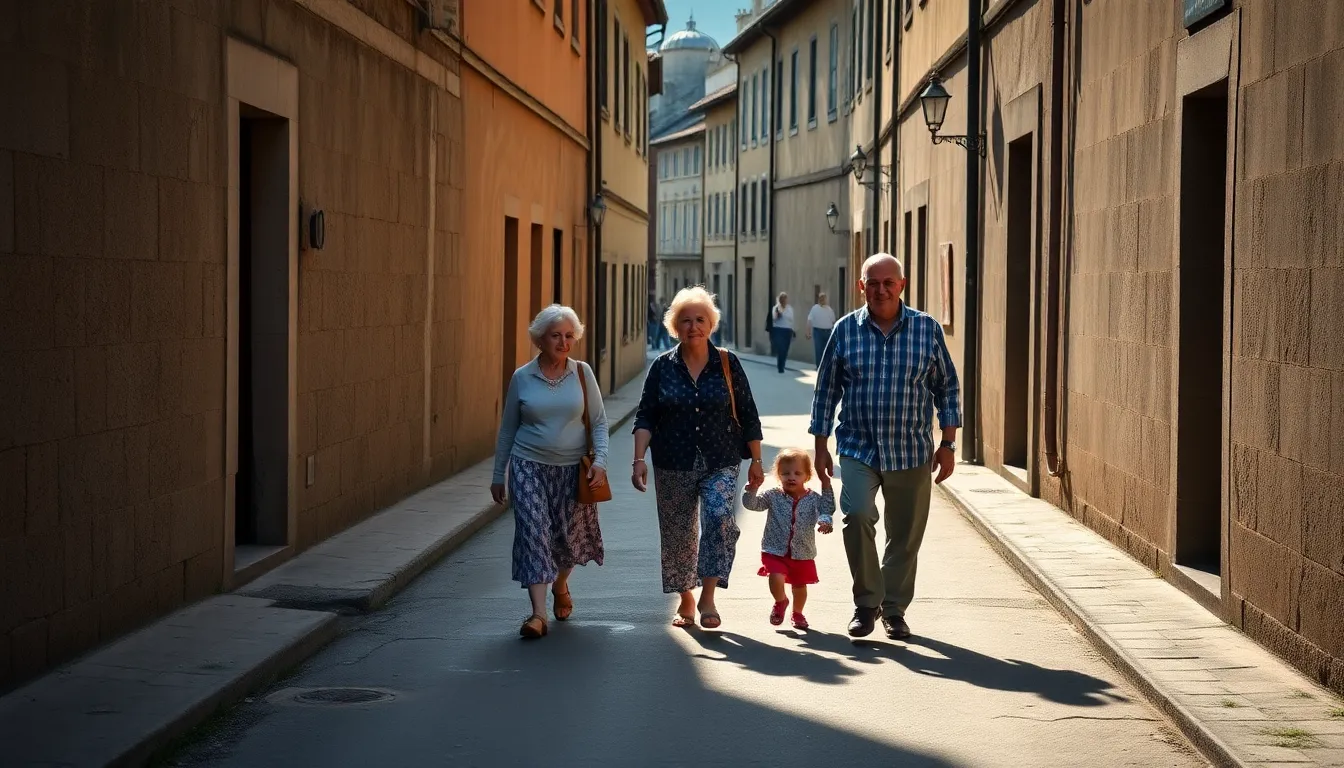
The hardest itinerary I build is not the longest one. It is the one for a congregation traveling with grandparents, parents, teenagers, and small children all in the same group. A trip that thrills a twelve-year-old can exhaust an eighty-year-old, and a day that moves a grandmother to tears can lose a restless ten-year-old by mid-morning. After forty years of leading these groups, I have learned that a multigenerational trip is not about seeing less. It is about pacing differently, choosing sites that reward every age, and building in the unstructured time where the generations actually connect.
This is the route I build for mixed-age congregations. It is shaped around three things: walking distances that work for the slowest member, sites that hold something for the youngest, and a rhythm that leaves real margin. It is roughly nine days, centered on Rome, Assisi, and Florence, the three cities that handle a mixed group best.
How This Itinerary Is Paced Differently
Before the day-by-day, it helps to understand the pacing rules I build into a multigenerational trip, because they are different from a standard route.
I plan one major site per day, not two or three. A morning at the Vatican and an afternoon at the Forum is fine for a group of adults. For a group with small children and elderly members, it is a recipe for a meltdown by four o’clock. One anchor site per day, then rest, then an easy evening.
I build in a slow morning every third day. No early start, no site, just a late breakfast and an open piazza. These are not wasted days. They are when the grandparents tell the grandchildren the stories, when the family talks about what they saw, when the trip stops being a schedule and becomes a memory.
And I choose hotels for location over price, so that the youngest and oldest can return mid-day for a nap or a rest while the others keep exploring. That single choice prevents more trouble than any other.
Days 1 to 4: Rome at a Sustainable Pace
Rome anchors the trip, but we take it slowly, one major site at a time.
Day 1 arrives and rests. No site on arrival day with a mixed group. A gentle evening walk to a gelato shop and an early night lets everyone reset from the flight, the elderly especially.
Day 2 is the Colosseum and the Forum in the morning only. Children love the Colosseum, the gladiator story is concrete and exciting in a way that holds a ten-year-old, and the ground is mostly flat. We book a skip-the-line entry so nobody stands in a long queue in the sun. Afternoon free for rest.
Day 3 is the Vatican, and we handle it carefully. Early entry before the crowds, a guide who knows how to keep children engaged, and we focus on the Sistine ceiling and St. Peter’s rather than every gallery. A full Vatican day overwhelms a mixed group. A focused morning with an afternoon off works. The Swiss Guards and the dome climb give the teenagers something, and grandparents have St. Peter’s tomb.
Day 4 is a slow morning by design, then the Jewish Ghetto in the late afternoon when the heat eases. The Ghetto is flat, walkable, and full of life, and a kosher lunch or an early dinner there gives the whole group a shared table. For Christian groups, the catacombs work this day instead, though I note that the narrow underground corridors can unsettle small children and very elderly walkers, so we gauge the group first.
Days 5 to 6: Assisi, the Easiest Stop for Every Age
Assisi is the gift of a multigenerational trip. It is small, quiet, beautiful, and it asks less of the body than any other major stop.
Day 5 travels from Rome by private coach, a two-hour drive that doubles as a rest. Assisi’s Basilica of St. Francis is the anchor, and the Francis story, a rich young man who gave it all away and talked to the birds, lands genuinely with children. The town is compact, though I will be honest that it sits on a hill and a few streets are steep, so we choose the gentler routes and arrange a vehicle for members who cannot manage the climbs.
Day 6 is deliberately light. The morning can hold San Damiano, a short, peaceful visit, and the afternoon is open in the town. Assisi after the day-trippers leave is one of the calmest places in Italy, and an evening here, with the family scattered across a quiet piazza, is often the moment the trip comes together for everyone.
Days 7 to 8: Florence with the Children in Mind
Florence closes the trip, and it offers more for younger travelers than its reputation as an art city suggests.
Day 7 starts at the Great Synagogue of Florence, beautiful, flat, and easy to walk, with a museum the right size for a mixed group’s attention. The Duomo follows. The cathedral interior is accessible to everyone, and for the teenagers and able-bodied adults the dome climb is a thrill, while grandparents and small children wait in the piazza with a gelato. Splitting the group here, rather than forcing one pace, keeps everyone happy.
Day 8 is flexible and family-led. Some groups visit the Galileo science museum, which holds children far better than a painting gallery. Others take the easy walk up to Piazzale Michelangelo for the view, or simply spend the day in the Oltrarno wandering. With a mixed group, a flexible final full day, shaped by what the families want rather than a fixed list, ends the trip on the right note.
Day 9: Departure and a Shared Closing
The last morning is for the whole group together. After a week of splitting by pace and energy, I bring everyone back into one circle. A reflection where each person, from the youngest who can speak to the oldest, names one thing they will remember. The children often surprise everyone. We handle departure transfers so the final hours are not spent wrestling luggage and schedules with tired travelers of every age.
Adapting the Pace for Your Specific Group
Every multigenerational group has a different center of gravity. A group heavy with young children needs more rest mornings and more concrete, story-driven sites. A group heavy with elderly members needs shorter walks, more accessible alternatives, and vehicles arranged in advance for the hills. We assess your group before building the final pace, because the difference between a trip with four toddlers and a trip with four wheelchairs is the entire shape of the itinerary.
If your group is more uniform in age and energy, our 10-day heritage itinerary for Italy moves at a fuller pace through more cities. The 5-day Rome heritage itinerary keeps everyone in one city with no travel days, which also suits mixed-age groups well, and the 7-day Christian heritage itinerary pairs Rome with Assisi. You can see how we structure these journeys on our Italy destination page.
One thing worth knowing as you plan: with fifteen or more participants, the group leader travels at no cost. For a congregation bringing whole families, reaching fifteen is rarely the hard part, and that math helps the trip pencil out for everyone.
If a heritage trip the whole congregation can take together, every generation included, is what your community wants, I would welcome the conversation. You can learn more on our group heritage tours page.
FAQ: An Italy Heritage Itinerary for Multigenerational Groups
How do you pace an Italy trip for a group with both children and elderly travelers?
One major site per day, not two or three. A slow morning every third day with no schedule. Hotels chosen for location so the youngest and oldest can return mid-day to rest while others keep exploring. And sites chosen to hold every age, the Colosseum and the Francis story for children, the basilicas and synagogues for the grandparents. The trip sees less per day but holds together far better.
Which Italian cities work best for a multigenerational faith group?
Rome, Assisi, and Florence. Rome anchors the heritage but needs careful pacing. Assisi is the easiest stop for every age, small, quiet, and built around a story children connect with, though it sits on a hill. Florence offers more for younger travelers than expected, including the Galileo science museum and the dome climb for teenagers. Venice, with its many stepped bridges, is harder for a mixed group and we add it only with planning.
Are Italy’s heritage sites accessible for elderly travelers?
Many are, with planning. The major basilicas, synagogues, and museums are largely accessible, and we book skip-the-line entries to avoid long queues in the sun. Some sites are harder, the catacombs have narrow corridors, Venice has stepped bridges, and Assisi has steep streets, so we choose gentler routes and arrange vehicles where needed. We assess your group’s specific needs before finalizing the route.
What do you do to keep children engaged on a heritage trip?
We choose sites with a concrete story or a physical thrill, the Colosseum with its gladiators, the Francis story of a rich man who gave everything away, the dome climbs, and the Galileo science museum in Florence. We keep site visits to one per day so attention does not run out, and we build in gelato stops and open piazza time. The unstructured hours are often when children connect with the trip most.
How many rest days should a multigenerational itinerary include?
I build in a slow morning roughly every third day, plus an open afternoon most days when there is a single morning site. On a nine-day trip that means three or four genuine slow periods. These are not wasted time. They are when the generations actually talk, when grandparents tell the stories, and when the trip becomes a shared memory rather than a schedule everyone endured.
If you want to talk through a heritage trip the whole congregation can take together, every generation included, I would love to start that conversation. Every mixed-age group has a different center of gravity, and the best version of this route is the one built around yours.
Contact us whenever you are ready.