Most pastors who call me about Italy start with the same instinct: cram in as much of the country as possible. I understand it. But a Christian heritage week is not a checklist of cities. It is a journey through the places where the early church survived persecution, where the faith took institutional form, and where one man in Assisi reminded all of Christianity what poverty and devotion could look like. That story does not need ten cities. It needs Rome, it needs Assisi, and it needs enough time in each to let your congregation stop and pray.
This is the seven-day route I build for Christian groups who want depth over distance. It puts you in the catacombs where believers hid, the basilicas where the church declared itself, and the Umbrian hills where Francis walked.
Days 1 to 3: Rome and the Birth of the Church
Rome holds the deepest Christian history in the Western world, and three days is the minimum to feel it rather than rush past it.
Day 1 I begin underground, in the Catacombs of San Callisto or San Sebastiano along the Appian Way. This is where the earliest Christians gathered to bury their dead and to worship when the faith was illegal and dangerous. The corridors are narrow and close, the inscriptions simple, the fish and anchor symbols scratched into stone by people who could be killed for them. For a faith group, starting here grounds the whole week. Before there were basilicas, there was this. Walk the Appian Way afterward, the same road Peter is said to have fled along before turning back to Rome and his own martyrdom.
Day 2 is the Vatican. Arrive early, before the crowds thicken. The morning holds the Vatican Museums and the Sistine Chapel, and here is my standing advice: do not try to see every gallery. Choose the Raphael Rooms and the Sistine ceiling, and give your group time to sit with the ceiling rather than glance at it. In the afternoon, St. Peter’s Basilica, built over the tomb of the apostle himself. Stand at the confessio above Peter’s grave. For most groups, this is the moment Rome stops being a tourist city and becomes something else.
Day 3 I keep in early Christian Rome. San Clemente is the site I never skip: a twelfth-century church built over a fourth-century church built over a first-century Roman house and a Mithraic temple, three layers of history you descend through one floor at a time. It is the clearest physical picture in Rome of how the faith grew up through the old pagan world. Pair it with San Giovanni in Laterano, the actual cathedral of Rome and the oldest church in the West, and the Scala Sancta nearby, the holy stairs that pilgrims still climb on their knees. End the day in Trastevere with a group dinner where everyone can talk through what they have seen.
Days 4 to 5: Assisi and St. Francis
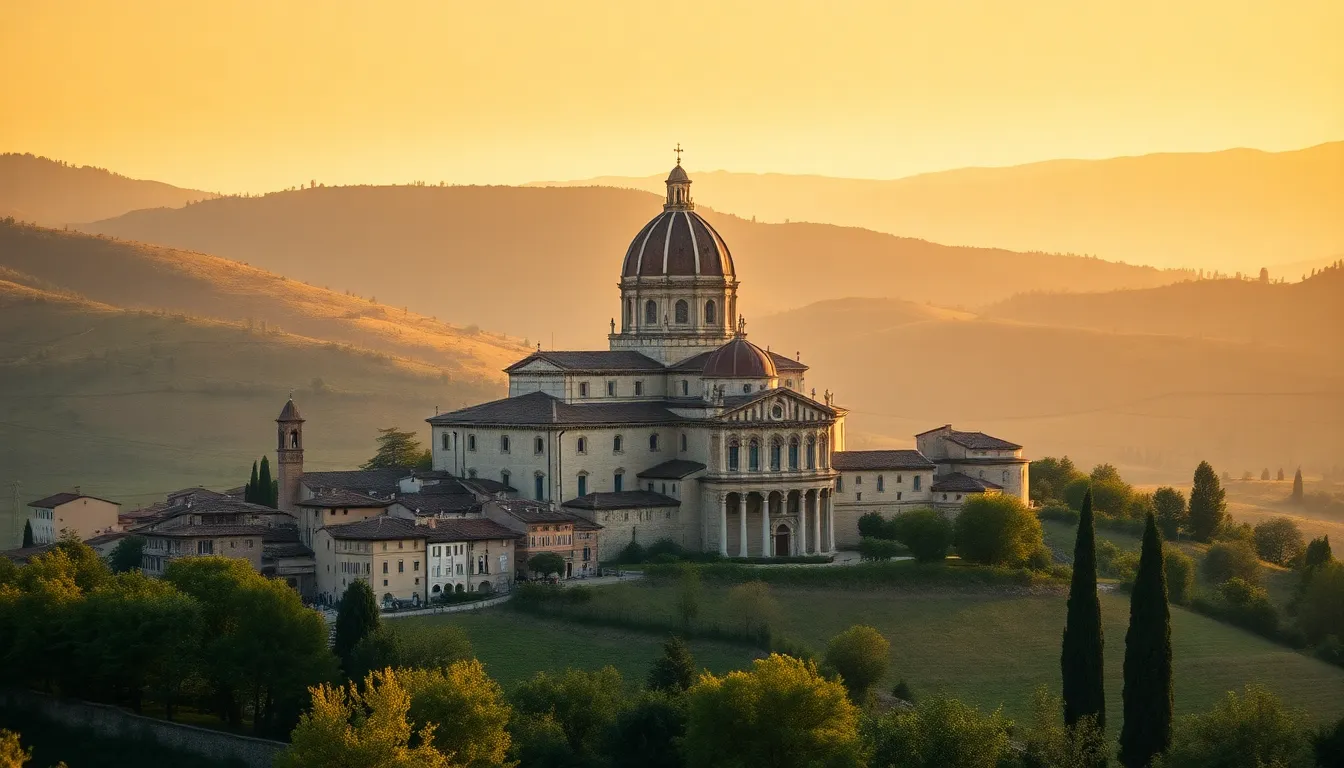
The drive from Rome to Assisi takes about two hours, and the change is immediate. The city falls away and you climb into green Umbrian hills where the light softens and the noise drops. Assisi is the spiritual hinge of this whole week.
Day 4 centers on the Basilica of St. Francis. The lower church holds Giotto’s frescoes of Francis’s life, and the crypt beneath holds his tomb. But Assisi is not really about any one building. It is about the town. Francis was born here to a wealthy cloth merchant, and one day in the public square he stripped off his fine clothes in front of his own father and chose poverty. That act reshaped Christianity’s relationship with wealth and possessions. Walking the streets where it happened gives the story a weight that no sermon about it ever could. Visit San Damiano too, the small church where Francis heard the call to rebuild, and the Basilica of Santa Chiara, who followed his path and founded the Poor Clares.
Day 5 I take up the mountain to the Eremo delle Carceri, the hermitage where Francis retreated to pray in the caves above the town. It is quiet, wooded, and physically modest, and for many groups it is the most moving stop of the entire trip, more than the great basilicas of Rome. Spend the morning there. The afternoon can hold Orvieto on the way, a hilltop town whose cathedral marks one of the most significant Eucharistic miracle sites in Catholic tradition, or simply more time in Assisi as the tour buses leave and the town goes still.
Days 6 to 7: The Early Church and Departure
The final stretch depends on your group. Many of my Christian groups close in Rome, returning for the sites the first three days could not hold.
Day 6 can take you to the basilicas you missed: San Paolo Fuori le Mura, built over the tomb of the apostle Paul, and Santa Maria Maggiore, the great Marian basilica. For groups with time and interest, a side trip to the early church beyond Rome works well too. We have taken groups north toward Ravenna, where fifth and sixth century mosaics preserve the earliest Christian imagery in extraordinary color, a glimpse of the church as it looked when Rome’s empire was still fading. Either way, Day 6 lets the early church story finish properly rather than getting cut off.
Day 7 is departure, and I always ask group leaders to use the last morning intentionally. A short gathering, a final prayer, a walk to a quiet church for one last moment together. Some pastors hold a brief reflection where each traveler names one place that stayed with them. It takes half an hour and turns a series of visits into a shared story the group carries home. We handle the departure transfers so your last day is not spent wrestling with logistics.
Adapting This Week for Your Congregation
This route flexes around your tradition. For Catholic groups, we can arrange a Mass at one of the major basilicas or in Assisi itself, and add a papal audience when the schedule allows. For Protestant and evangelical groups, we lean the teaching toward the early church, the catacombs, and the apostolic sites, and keep the focus on the faith’s first centuries. If your congregation has a devotion to a particular saint, we build a stop around it, Padua for St. Anthony, Siena for St. Catherine.
If your group wants more, our 10-day heritage itinerary for Italy adds Florence and Venice to this core. If you want to follow Paul specifically, the Italy and Greece heritage itinerary traces his footsteps across two countries. For a Rome-only week with no travel days, see our 5-day Rome heritage itinerary. You can see how we shape these trips on our Italy destination page.
One detail worth knowing as you plan: with fifteen or more participants, the group leader travels at no cost. The pastor or educator who builds the trip is what makes it a heritage journey rather than a tour, and we have always kept the economics built around that.
If a focused Christian week through Rome and Assisi is what your congregation needs, I would welcome the conversation. You can learn more on our group heritage tours page.
FAQ: A 7-Day Christian Heritage Itinerary for Italy
Is 7 days enough for a Christian heritage tour of Italy?
Yes, if you focus on Rome and Assisi. Three days in Rome covers the catacombs, the Vatican, and the early church, and two days in Assisi gives the Francis story room to breathe. A week built around those two places goes deep. Trying to add Florence, Venice, and the south in the same week turns a pilgrimage into a sprint.
What are the most important Christian sites in Rome?
The catacombs along the Appian Way, where the early church worshipped in secret, the Vatican and St. Peter’s Basilica over the apostle’s tomb, San Clemente with its three layers of history, and San Giovanni in Laterano, the oldest church in the West and the cathedral of Rome. San Paolo Fuori le Mura over Paul’s tomb is essential if you have a sixth day in the city.
Why include Assisi in a Christian itinerary?
Assisi is where St. Francis renounced wealth and reshaped Christian devotion in the thirteenth century. The Basilica holds his tomb and Giotto’s frescoes, but the town itself, San Damiano, Santa Chiara, and the mountain hermitage at the Eremo delle Carceri, carries a stillness that many groups find more moving than the grandeur of Rome. It changes the pace of the trip at exactly the right point.
Can you arrange a Mass or papal audience for our group?
Yes. For Catholic groups we can arrange a Mass at one of the major basilicas or in Assisi, and we can request a papal audience when the schedule permits, though those are subject to the Vatican calendar and need to be requested well in advance. Let us know early so we can build it into the plan.
Should we end this trip in Rome or somewhere else?
Most Christian groups close in Rome, returning for the basilicas the first three days could not hold and flying home from there. Some extend toward Ravenna for the early Christian mosaics before departing. We plan the final days and the departure transfers around whichever ending fits your group’s flights and focus.
If you want to talk through a Christian heritage week in Italy for your congregation, I would love to start that conversation. Every group brings a different tradition and a different focus, and the strongest version of this route is the one built around yours.
Contact us whenever you are ready.