There is one journey in the New Testament that two countries share, and most itineraries split it in half. Paul preached across Greece, was arrested, appealed to Caesar, and was carried to Rome to stand trial. His story does not stop at a border, and I have long thought the strongest Pauline trip does not either. This two-week itinerary holds Italy and Greece together, which lets your group walk the whole arc: Paul’s Greek mission, his sea journey, and his final years in Rome where Acts leaves him under house arrest, still teaching.
I build this route as a fortnight because anything shorter forces you to gut one country. Two weeks gives Greece its week and Italy its week, with a sensible flight between them. The pacing below assumes a group that wants both the biblical sites and the early church, which is the combination most pastors who ask for this trip have in mind.
Days 1 to 4: Rome, Where Paul’s Journey Ended
I open in Rome, the destination of Paul’s last voyage, because it frames everything that follows. Your group sees where the story arrived before tracing where it began.
Day 1 settles the group and walks ancient Rome: the Forum, the Colosseum, and the Mamertine Prison near the Forum, traditionally held to be where both Peter and Paul were imprisoned before their executions. Standing in that small stone cell is a sobering start.
Day 2 is the Vatican and St. Peter’s Basilica, built over Peter’s tomb. Arrive early. Focus the Museums on the Raphael Rooms and the Sistine ceiling rather than chasing every gallery, and give your group time at the confessio above Peter’s grave.
Day 3 centers on Paul directly. San Paolo Fuori le Mura, the great basilica built over the apostle’s tomb on the road where tradition says he was martyred, and the nearby Abbey of the Three Fountains marking the traditional site of his beheading. For a Pauline trip, this is holy ground, and it deserves an unhurried morning.
Day 4 takes your group underground to the catacombs along the Appian Way, the same ancient road Paul would have traveled into the city, and into early Christian Rome at San Clemente, where you descend through three layers of history. By the end of the Roman leg, your group understands where the journey concludes. Now you fly to Greece to see where it started.
Days 5 to 6: Athens and Corinth
A short flight brings you to Athens, and the second half of the trip steps back in time to Paul’s actual mission field.
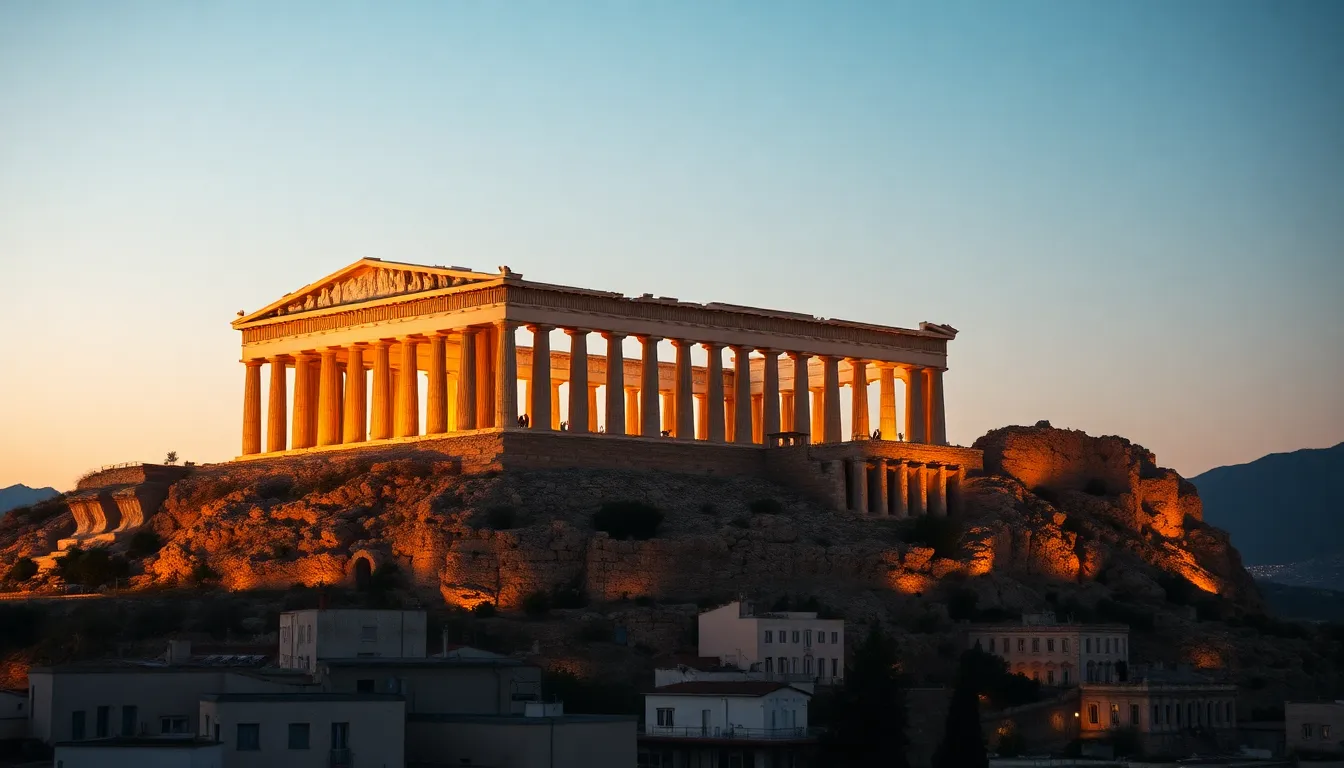
Day 5 is Athens. The center of it for a faith group is the Areopagus, Mars Hill, the rocky outcrop below the Acropolis where Paul stood and preached to the philosophers of Athens about the “unknown god,” recorded in Acts 17. You can stand on the same rock and read the passage aloud, with the Parthenon rising behind you exactly as it rose behind Paul. Visit the Acropolis and the ancient Agora where he debated daily. Few biblical sites let you place a chapter of scripture so precisely on the ground.
Day 6 is a day trip to Corinth, about ninety minutes from Athens. Paul spent eighteen months here and wrote letters to this community that became two books of the New Testament. Walk ancient Corinth, see the bema, the judgment seat where Paul was brought before the proconsul Gallio in Acts 18, and look up at the Acrocorinth above the ruins. Reading First Corinthians while standing in the city it was written to changes how your group hears it ever after.
Days 7 to 9: Northern Greece and Paul’s First European Steps
The trip now follows Paul’s route through northern Greece, the first place the gospel reached the European continent.
Day 7 travels toward Thessaloniki, the city of Paul’s letters to the Thessalonians, where he preached in the synagogue and stirred both belief and opposition, recorded in Acts 17. Walk the old city and see the early Christian and Byzantine churches that grew from that first mission.
Day 8 reaches Philippi and Kavala. Philippi is where Paul preached the first recorded sermon on European soil and baptized Lydia, the first European convert, by the river outside the city, in Acts 16. You can visit the riverside traditionally marked as that baptism site, and the ruins of the city where Paul and Silas were imprisoned and freed by an earthquake. Kavala, ancient Neapolis, is the port where Paul first set foot in Europe.
Day 9 is for the Meteora monasteries if your group wants the later church as well, the dramatic Eastern Orthodox monasteries perched on towering rock pillars, or a slower day to absorb northern Greece before the trip turns toward its close.
Days 10 to 12: The Greek Islands or Closing Greece
How you spend these days depends on your group. Many Pauline trips add a short Aegean cruise here, touching Patmos, where John received the Revelation, and Ephesus across the water in Turkey, where Paul taught for years. Others stay on the mainland and deepen the early church story.
Days 10 to 12 in the island version take your group to Patmos to see the cave of the Apocalypse where tradition holds John wrote Revelation, and the great monastery above it. The Aegean light and the sea passages give your group a rest in the rhythm of the trip without losing the thread, because these were Paul’s own waters. If you keep to the mainland, these days revisit Athens, allow a Sunday with a local congregation, and let the group reflect before departure.
Days 13 to 14: Return and Reflection
Day 13 returns toward your departure city, usually Athens, with the final afternoon kept open. After two weeks across two countries, your group needs a moment to gather the whole journey into one shape. I encourage leaders to hold a reflection session where each traveler names the single place that spoke to them, whether it was Mars Hill, the prison cell in Rome, or the river at Philippi. It takes half an hour and it binds the fortnight together.
Day 14 is departure. We handle the transfers so the last day is not spent on logistics. Your group flies home having walked the entire arc of Paul’s story, from his first European steps at Philippi to his final years under guard in Rome.
Adapting This Two-Week Route for Your Group
A fortnight gives real room to shape the trip. For groups focused tightly on Paul, we cut the islands and add more time in Corinth, Thessaloniki, and Philippi. For groups who want the broader church, we keep Meteora and the Byzantine sites and lean into the Orthodox tradition. For groups who want Rome to anchor both ends, we can fly into Rome, out through Greece, and reverse the order so the trip ends in Italy.
If two countries is more than your group has time for, our 10-day heritage itinerary for Italy stays in Italy, and the 7-day Christian heritage itinerary focuses on Rome and Assisi. For the full Italian sweep, see the 14-day complete Italy heritage itinerary. You can see how we structure these journeys on our Italy destination page.
One detail worth knowing as you plan: with fifteen or more participants, the group leader travels at no cost. On a trip this size, that matters for the conversation with your church, and it keeps the pastor who shapes the journey present throughout.
If following Paul across Italy and Greece is what your congregation is drawn to, I would welcome the conversation. You can learn more on our group heritage tours page.
FAQ: A Two-Week Italy and Greece Heritage Itinerary
Why combine Italy and Greece for a Pauline trip?
Because Paul’s story spans both. He preached across Greece, was arrested, appealed to Caesar, and was carried to Rome, where Acts leaves him under house arrest. Splitting the trip into one country tells half the story. Two weeks lets your group walk the whole arc, from his first European steps at Philippi to his final years in Rome.
Should we start in Italy or Greece?
Either works, and it depends on the story you want to tell. Starting in Rome shows where the journey ended before you trace where it began, which gives the Greek sites a sense of return. Starting in Greece follows the chronology forward to Rome. We build both directions and choose based on your group’s flights and how you want the narrative to land.
Which Greek sites are most important for following Paul?
The Areopagus (Mars Hill) in Athens where Paul preached in Acts 17, ancient Corinth where he spent eighteen months and the bema where he stood trial, Thessaloniki and Philippi in the north where the gospel first reached Europe and Lydia was baptized, and Kavala (ancient Neapolis) where Paul first landed on the continent. Those form the core of any Pauline route through Greece.
Can we add the Greek islands or Ephesus?
Yes. Many two-week Pauline trips include a short Aegean leg to Patmos, where tradition holds John wrote Revelation, and some reach Ephesus across the water in Turkey, where Paul taught for years. We can build the island days in or keep the trip on the mainland and deepen the early church sites instead, depending on your group’s interest.
How far in advance should we book a two-week group trip like this?
For a trip this size, twelve months of lead time is comfortable, and eighteen is better if it falls around Easter or a peak travel window. A fortnight across two countries needs hotel blocks, internal flights, and site access coordinated well ahead, and the longer runway also gives you time to build your group to the fifteen-person threshold.
If you want to talk through an Italy and Greece journey in Paul’s footsteps for your congregation, I would love to start that conversation. Every group brings a different focus, and the strongest version of this route is the one built around yours.
Contact us whenever you are ready.