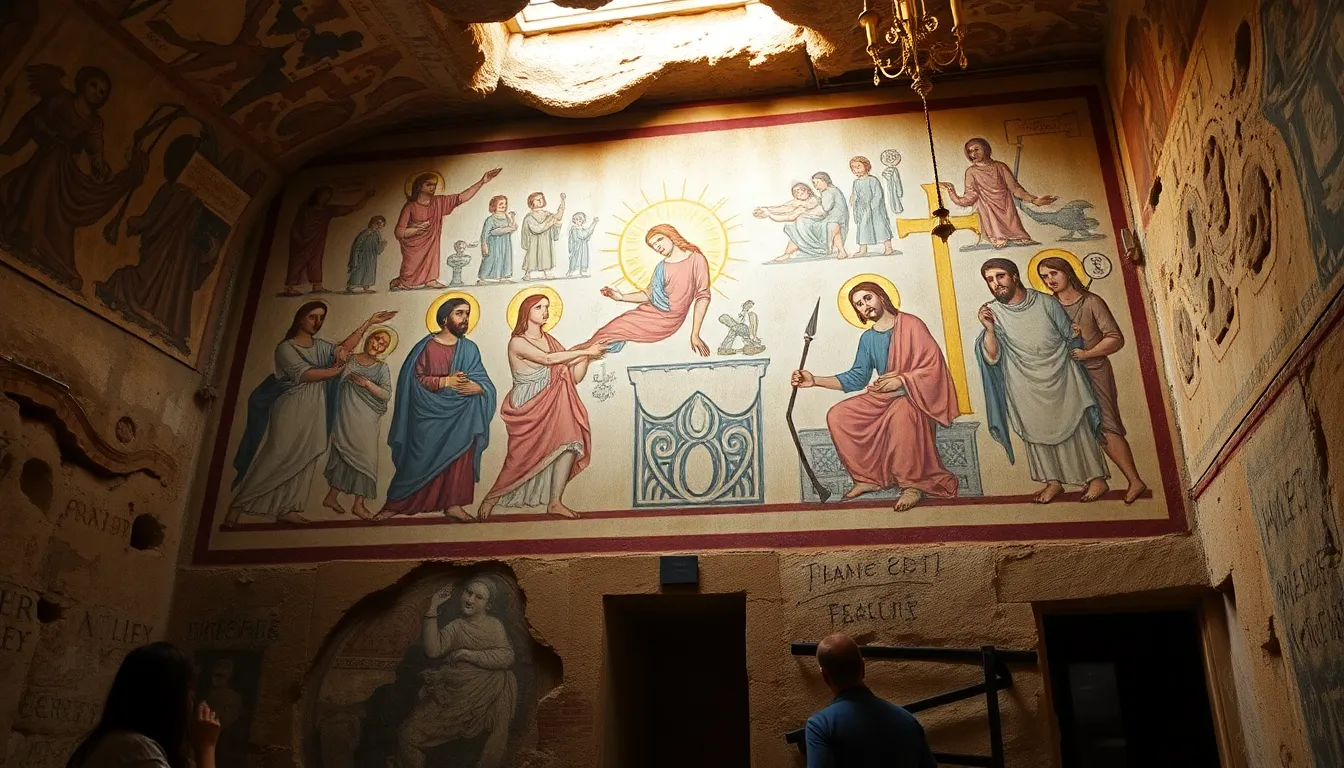
There is a version of Christian Rome that most tour groups see, and it is mostly marble. Grand basilicas, gilded ceilings, the soaring dome of St. Peter’s. It is magnificent, and it is also the church of power, built after Christianity won. But there is an older Rome underneath that one, literally below the streets, and it tells a different story. It is the church of the persecuted, the church that met in private homes and buried its dead in tunnels and worshiped at the risk of death. That is the church I want to show your group on this itinerary.
I have led study groups through early Christian Rome for many years, and what I have learned is that the most powerful sites are rarely the most famous. A small house church preserved beneath a later basilica moves people more than the largest cathedral. A faded fresco of a shepherd carrying a sheep, painted by a Christian in the third century in a tunnel where it would only be seen by other believers, says more about faith under pressure than any monument.
This route is built for Christian study groups, history-minded congregations, and pastors who want their people to encounter the faith in its first centuries, before it was legal, before it was powerful, when following Christ could cost you everything. It is heavy on context and reflection. Bring readers and bring patience, because the underground sites reward a group that slows down.
Days 1 to 2: The Catacombs and the Age of Martyrs
Two days underground and on the edges of Rome sets the foundation. The catacombs are the single most important early Christian sites in the city, and there are several worth seeing.
Day 1 goes to the Catacombs of San Callisto on the Appian Way, the largest and most important of Rome’s catacombs. Miles of tunnels on multiple levels hold the tombs of early Christians, including several early popes and martyrs. The Crypt of the Popes and the Crypt of St. Cecilia are the heart of it. What strikes every group is the simplicity of the early Christian symbols carved into the walls: the fish, the anchor, the Good Shepherd. These were a persecuted minority leaving signs that only fellow believers would read. Walking those narrow corridors, you understand that this faith began small, hidden, and at risk.
Day 2 continues with the Catacombs of San Sebastiano or Domitilla, and a visit to the broader Appian Way context. The Via Appia Antica itself, with its ancient paving stones and tombs, was the road along which Paul approached Rome and along which Christians traveled to bury and remember their dead. The Domitilla catacombs include an underground basilica and some of the oldest Christian frescoes anywhere. By the end of the second day, your group will have spent real time in the world of the early Roman church, where the line between faith and martyrdom was thin.
Day 3: House Churches and the Layers Beneath the Basilicas
This is the day that surprises people, and it is my favorite. Before the church had public buildings, it met in homes. Several Roman churches are built directly on top of these early house churches, and you can go down through the layers.
The Basilica of San Clemente is the best example in the world. At street level you have a twelfth-century basilica. Below it is a fourth-century church. And below that is a first-century Roman house with an early Christian meeting space and a pagan temple to Mithras right beside it. Descending through those three levels, you travel backward through time toward the world the first Roman Christians actually lived in, where their faith existed quietly alongside the cults of the empire.
In the afternoon, visit Santi Giovanni e Paolo or the church of Santa Pudenziana, both connected by tradition to early Christian households. The point of this day is to break the impression that the church began with cathedrals. It began in living rooms. For a study group, seeing the physical layers of that history is a lesson that no book delivers the same way.
Day 4: The Martyrs and the Sites of Witness
Rome is where many of the early church’s most important witnesses gave their lives, and this day traces that thread. The Mamertine Prison near the Forum is traditionally connected to the imprisonment of Peter and Paul. The lower cell is bare stone, and it gives a stark sense of what Roman confinement meant for those held there.
The Colosseum carries the popular association with Christian martyrdom, and while historians debate how many Christians actually died there, the broader Roman practice of executing believers in the arenas is real and worth confronting. We talk honestly about what the evidence supports and what is tradition. A study group deserves that honesty, and it makes the genuine sites land harder.
The Basilica of San Paolo Fuori le Mura, built over the traditional tomb of Paul, and the area connected to Peter beneath St. Peter’s Basilica anchor the day in the two apostles whose witness in Rome shaped everything that followed. The scavi tour beneath St. Peter’s, which descends to an ancient necropolis and the traditional site of Peter’s grave, is worth arranging in advance for groups that want the deepest layer of this story.
Day 5: The Turning Point, Constantine and the First Public Churches
The early church did not stay underground. In 313, Constantine’s Edict of Milan changed everything, and Christianity moved from the catacombs into the open. This day traces that turning point. The Basilica of San Giovanni in Laterano, St. John Lateran, was the first great public basilica of Rome, the cathedral of the city and the original seat of the popes. It marks the moment the church stepped out of hiding.
Standing in San Giovanni in Laterano after spending days in the catacombs creates a powerful contrast for a study group. You can feel the shift in the architecture itself, from the cramped, hidden tunnels to the wide, light-filled basilica. We talk about what was gained and what was lost in that transition, when a persecuted movement became an imperial religion. It is one of the most important conversations of the whole trip, and the sites make it concrete.
Day 6: Ravenna and the Early Christian Mosaics
For groups with an extra day, a trip to Ravenna deepens the early church story in a way nothing in Rome can match. Ravenna holds the finest early Christian and Byzantine mosaics in the world, in buildings from the fifth and sixth centuries. The Mausoleum of Galla Placidia, with its deep blue starry ceiling, and the Basilica of San Vitale, with its shimmering mosaics of the imperial court and biblical scenes, show the church at the height of its early artistic confidence.
Ravenna is where you see how the early church understood and depicted its own faith once it had the freedom and resources to do so. The Good Shepherd reappears here, but now in gold and color rather than scratched on a tunnel wall. For a study group that has followed the church from the catacombs forward, Ravenna is the visual culmination of the journey. It is a few hours from Rome, and it rewards the effort.
Shaping the Early Church Route for Your Group
This itinerary adjusts easily. Groups focused tightly on the persecution era can stay in Rome and go deeper into the catacombs and house churches in four or five days. Groups interested in the full arc, from hidden faith to imperial church to Byzantine art, should add Ravenna. If your community is studying the book of Acts or the early church fathers, we coordinate the readings to match the sites.
Some of the underground sites involve stairs and uneven footing, and the catacombs are not fully accessible to everyone. For groups with members who cannot manage the descents, we choose accessible alternatives, and our accessible Italy itinerary provides a gentler framework that still reaches the key early Christian heritage.
The group leader carries the teaching. This is a study trip, and the sites mean the most when a knowledgeable leader connects them to the texts and the history your group is exploring. We handle the access, including the catacombs and the scavi that require advance arrangement, and the on-the-ground logistics. You bring the teaching and the reflection.
With fifteen or more participants, the group leader travels at no cost. That is how we have always structured group heritage travel, because the leader’s teaching is what turns a series of sites into a coherent encounter with the early church.
To set this in the wider context, our Footsteps of Paul itinerary follows the apostle whose arrival in Rome began this story, and our 10-day Italy itinerary places the early church alongside the broader Jewish and Christian heritage of the country.
FAQ: An Early Church Itinerary in Italy
What are the best early church sites to see in Rome?
The essential sites are the catacombs of San Callisto, San Sebastiano, and Domitilla on the Appian Way, the layered Basilica of San Clemente where you descend through a fourth-century church to a first-century Roman house, and the Mamertine Prison connected to Peter and Paul. For the turning point when the church went public, San Giovanni in Laterano marks the first great basilica of Rome. Together these trace the church from persecution to legality.
Can you actually visit the catacombs as a group?
Yes. Several of Rome’s catacombs are open to guided groups, including San Callisto, San Sebastiano, and Domitilla. They involve walking through narrow underground corridors and some stairs, so we arrange guided access and brief your group on what to expect. The catacombs are among the most moving early Christian sites anywhere, because you stand in the actual tunnels where a persecuted community worshiped and buried its dead.
What is San Clemente and why does it matter?
San Clemente is a basilica in Rome built in three layers. At street level is a twelfth-century church, below it a fourth-century church, and below that a first-century Roman house with an early Christian space and a pagan temple beside it. Descending through these levels takes your group physically backward through the history of the early church, from the public basilica to the house where the first Roman Christians may have gathered. It is the clearest demonstration anywhere of how the church grew out of private homes.
Should we add Ravenna to an early church trip?
If you have an extra day, yes. Ravenna holds the finest early Christian and Byzantine mosaics in the world, in buildings from the fifth and sixth centuries. After following the church from the hidden catacombs forward, Ravenna shows how it depicted its own faith once it had freedom and resources, in shimmering gold and color. It is a few hours from Rome and serves as a visual culmination of the early church journey.
Is an early church itinerary suitable for a study group?
It is designed for one. This is a context-heavy, reflective trip built around the history and texts of the church’s first centuries, and the underground sites reward a group that slows down to read and discuss. We coordinate readings from Acts and the early fathers with the sites, and we provide knowledgeable guiding for the layered history. Groups studying the early church find that standing in these places makes the period real in a way no classroom can.
If you want your congregation to meet the church of the martyrs and the house churches, I would welcome that conversation. Start with our Italy destination page or see how our group heritage tours support study communities.
Contact us when you are ready to plan.