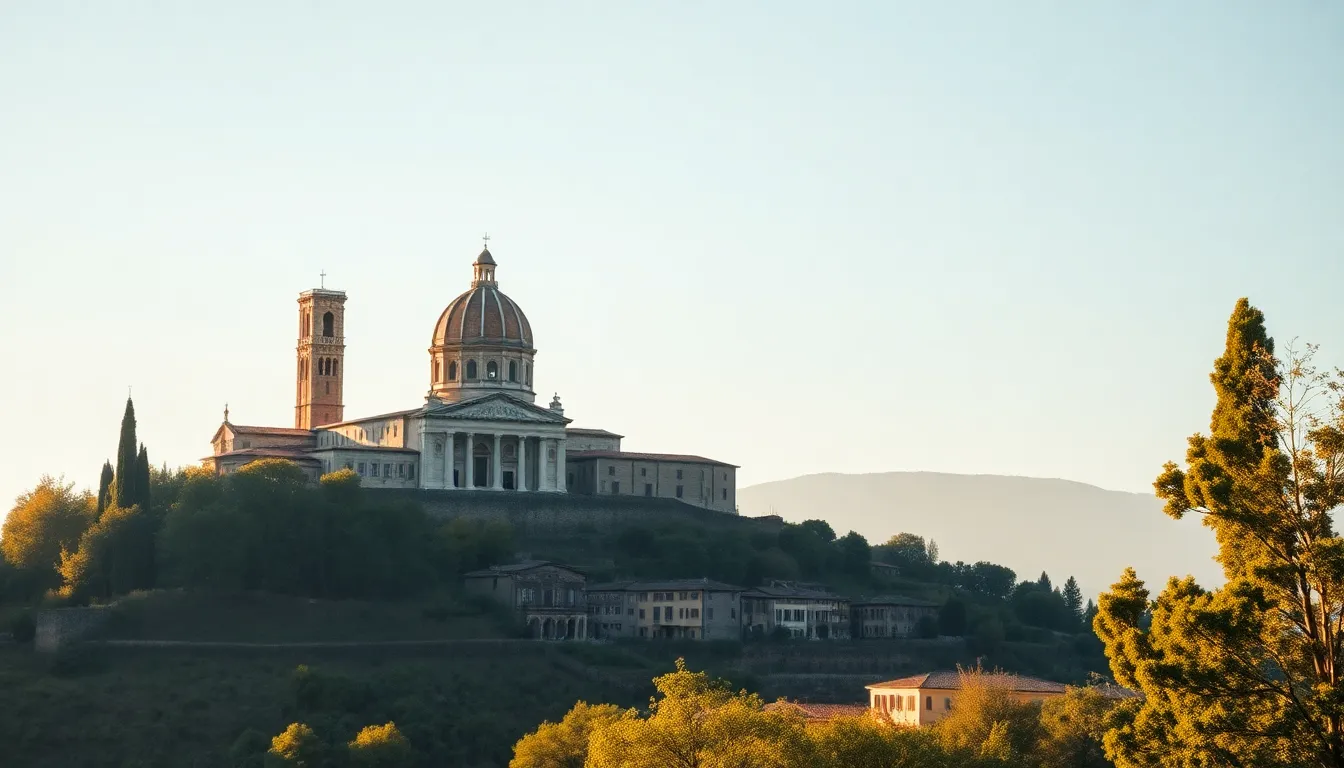
Of all the places I bring groups in Italy, Assisi is the one where people fall quiet without being told to. It happens on the approach, when the town first appears on its hillside, pink stone catching the Umbrian light. Something about the place lowers the volume. After the scale and noise of Rome, Assisi feels like an exhale, and for a faith group that is not a small thing. It is the reason I almost always build it into an Italy itinerary.
Assisi is a pilgrim town in the truest sense, shaped over eight centuries by two people who changed what it meant to live a life of faith: Francis and Clare. This guide walks you through the town, its basilicas, and what makes it work so well for a group that has come for heritage rather than sightseeing.
For the national picture, our Italy heritage travel guide sets the context. This guide is Assisi in focus.
The Story That Shaped the Town: Francis and Clare
You cannot understand Assisi without understanding the two figures whose lives are written into every street.
Francis was born here around 1181, the son of a wealthy cloth merchant. As a young man he had everything and walked away from it, famously stripping off his fine clothes in the public square to renounce his inheritance and live in poverty among the poor and the sick. The movement he started, built on simplicity, service, and a radical reading of the Gospel, spread across Europe and reshaped Western Christianity. For Christian groups of every tradition, his story lands, because it is about choosing faith over comfort in the most literal way a person can.
Clare was a young noblewoman of Assisi who heard Francis preach and followed the same path, founding an order of women devoted to poverty and prayer. She left her family’s home in the night to take up a life of simplicity, and the order she founded, later known as the Poor Clares, spread across Europe much as Francis’s did. Her story runs parallel to his, and the town holds both. Bringing a group through Assisi means walking the geography of two conversions, and for many groups the discovery that this town was shaped as much by a woman’s choice as by a man’s is itself a quiet revelation.
The Basilicas and Sacred Sites
Assisi is small, which is part of its gift. The major sites sit within a walkable town, and a group can experience them without the logistical strain of a larger city.
The Basilica of St. Francis
The Basilica of San Francesco is the heart of any visit and one of the most significant churches in the Christian world. It is built in two levels, an upper and a lower church, and Francis is buried in the crypt beneath. The upper basilica holds the famous fresco cycle attributed to Giotto, depicting the life of Francis in scene after scene. These frescoes have taught his story visually for seven centuries, and standing before them with a group that knows the narrative is a different experience than visiting cold. I always have groups read or hear the story before we go in.
A note for planning: the basilica is an active place of worship and pilgrimage, and modest dress is required. A guide who knows the etiquette keeps the visit smooth and respectful.
The Basilica of St. Clare
The Basilica of Santa Chiara holds Clare’s tomb and the original San Damiano crucifix, the cross that, by tradition, spoke to Francis and set his calling in motion. For groups, the two basilicas together tell the fuller story, the man and the woman whose parallel lives built this town’s identity.
San Damiano and the Porziuncola
Below the town walls sit two sites that often move groups most because they are simple and quiet. San Damiano is the small church Francis rebuilt with his own hands and where Clare later lived. The Porziuncola is the tiny chapel, now enclosed within a larger basilica on the plain below Assisi, that was the cradle of the Franciscan movement. These humble spaces, more than the grand basilica, capture what Francis was actually about. I often save them for the end, when a group is ready to feel the contrast between the marble above and the poverty below.
The Roman Layer Beneath the Pilgrim Town
Assisi is a pilgrim town now, but it was a Roman one first. The Temple of Minerva still stands in the main square, its columns intact, repurposed centuries ago into a Christian church. It is one of the best-preserved Roman temple facades in Italy, and it sits in the very square where Francis is said to have renounced his wealth.
That overlap is the whole story of Italy in one piazza. A Roman temple to a pagan goddess, turned into a church, standing where a medieval saint chose poverty over a merchant’s fortune. For a group, pausing in that square to hold all three layers at once, Roman, medieval, and living faith, is one of the quiet highlights of the trip.
Assisi sits in Umbria, a region of green hills and old hill towns that most heritage itineraries pass through too quickly. The landscape itself is part of the story. Francis preached to the birds and called the sun and moon his brother and sister, and when your group looks out over the Umbrian valley from the town walls, that vision of creation as kin stops being a quaint legend and starts to make sense. The land shaped the saint, and seeing it helps a group understand him.
Planning Assisi as a Group Leader
Assisi is one of the easier towns to manage, which makes it a relief in the middle of a busy Italy itinerary. A few things I tell leaders.
Plan a full day, ideally with an overnight. Many groups treat Assisi as a half-day stop from Rome or Florence, and it works, but the town transforms in the evening when the day-trippers leave. A group that stays overnight experiences a stillness that day visitors never see.
Mind the dress code. The basilicas require modest dress, shoulders and knees covered. Tell your group in advance so no one is turned away or embarrassed.
Build in reflection time. Assisi is not a place to rush. The sites are close together, so use the saved time for prayer, quiet, or a slow walk through the medieval streets. This is the stop where built-in reflection pays off most.
Watch the calendar. Assisi is a major pilgrimage destination, and feast days, especially the feast of St. Francis in early October, bring large crowds. We plan around these so your group has the access and space it needs.
A note many leaders value: with fifteen or more participants, the group leader travels free. The person who carries the teaching and the responsibility should not also carry the cost. See our group heritage tours page for how this works.
FAQ: Planning an Assisi Heritage Trip
Is Assisi worth an overnight, or is a day trip enough?
A day trip works and many groups do it from Rome or Florence. But Assisi rewards an overnight. When the day visitors leave in the late afternoon, the town becomes quiet and contemplative in a way that fits a faith group perfectly. If your itinerary allows even one night, the difference is real.
Does Assisi work for non-Catholic Christian groups?
Yes, strongly. The story of Francis, choosing radical simplicity and service over wealth, speaks across every Christian tradition. Protestant and evangelical groups connect deeply with his life, which is fundamentally about taking the Gospel seriously. The basilicas are encountered as heritage and story, framed by a guide for your group’s tradition.
What is the dress code for the basilicas in Assisi?
Modest dress is required, with shoulders and knees covered, as these are active places of worship and pilgrimage. It helps to tell your group before arrival so everyone is prepared. A light scarf or wrap is an easy solution for anyone caught out.
How does Assisi fit into a larger Italy itinerary?
Assisi sits in Umbria, between Rome and Florence, which makes it a natural stop on a route connecting the two. Many of our Italy heritage itineraries place Assisi as a calmer interlude between the intensity of Rome and the art of Florence. It gives groups a contemplative pause without adding much travel time.
When is the best time to visit Assisi with a group?
Spring and autumn offer the best weather and the most manageable crowds. Early October brings the feast of St. Francis, which is powerful but very busy. Summer is warm and crowded. Winter is quiet and atmospheric. We plan around the season your community can travel and around the pilgrimage calendar.
If Assisi belongs on your community’s journey, we would welcome the chance to talk it through. No pressure, no timeline, just a conversation about what this town could mean for your group. Contact us when you are ready, or explore our Italy heritage tours to see how we build them.