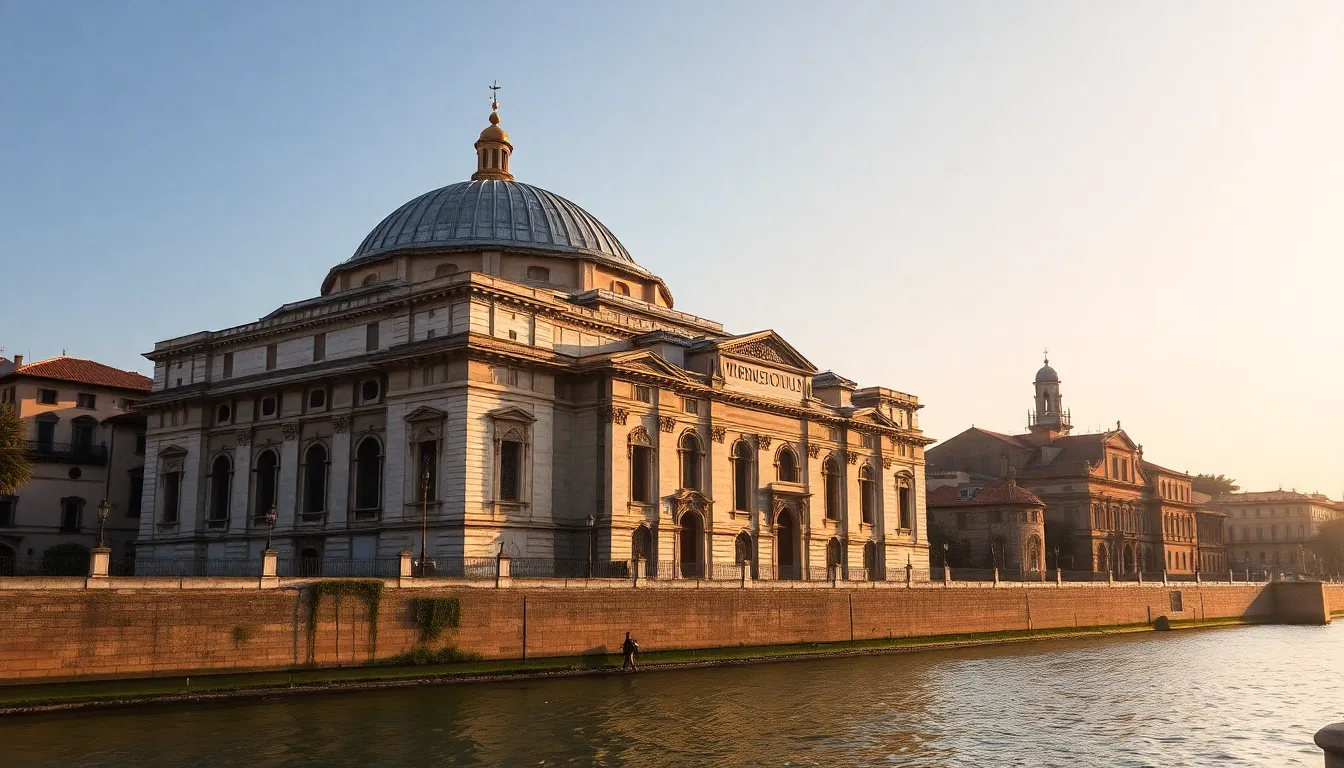
I get this question from rabbis almost every spring: can we do a real Jewish Italy in a single week, or do we need ten days to do it justice? The honest answer is that one week works if you commit to three cities and resist the urge to add a fourth. Italy holds more than two thousand years of Jewish life, longer than any other community in Europe outside the Land of Israel, and you cannot see all of it. But Rome, Florence, and Venice together tell the whole arc: the ancient community, the Renaissance flowering, and the birth of the Ghetto itself.
This is the route I build most often for congregational groups. It moves north, it keeps the travel days short, and it puts your community in front of the places where Jewish Italy actually happened, not a museum version of it.
Days 1 to 3: Rome, the Oldest Community in Europe
Rome gets three days because the Jewish story here is older than anywhere else you will stand all week. There has been a Jewish community in this city since the second century BCE, before the destruction of the Second Temple, before the Diaspora as most people understand it.
Day 1 I always start in the Jewish Ghetto, the small grid of streets near the Tiber where Jews were confined from 1555 until emancipation. Begin at the Great Synagogue of Rome, the one with the square aluminum dome you can pick out from across the river. The Jewish Museum of Rome sits inside the same building, and it carries you from antiquity through the Nazi deportation of October 1943, when more than a thousand Roman Jews were taken from these exact streets. Walk the Portico d’Ottavia afterward. Read the plaques set into the pavement. This is a community that never left, and your group should feel that continuity before anything else.
Day 2 goes underground to the Jewish catacombs. Most groups know the Christian catacombs. Fewer know that Rome holds Jewish ones too, at Vigna Randanini and Villa Torlonia, where the menorah and the shofar are carved into the walls beside Hebrew inscriptions. Access requires advance permission, which we arrange, and the visit is quiet and rare. In the afternoon, the Forum and Colosseum take on a different weight when you remember that the Arch of Titus, just steps away, depicts Roman soldiers carrying the Temple menorah out of Jerusalem. I bring every group to stand under that arch. For two thousand years, Roman Jews refused to walk beneath it. That refusal tells you everything.
Day 3 is flexible. Some groups use it for the Vatican, because the Jewish story and the Christian story in Rome are inseparable and many congregations want to see both. Others spend the morning back in the Ghetto with a community member, sharing a kosher lunch at one of the restaurants on Via del Portico d’Ottavia, then keep the afternoon open for reflection. If your group skews toward Jewish history specifically, the second option lands harder.
Days 4 to 5: Florence and the Renaissance Community
The train from Rome to Florence takes ninety minutes. By early afternoon on Day 4 your group is standing in front of one of the most striking synagogues in the world.
Day 4 belongs to the Great Synagogue of Florence, the Tempio Maggiore, with its green copper dome and Moorish interior that glows when the light comes through. It was built in the 1870s, after emancipation finally let Florentine Jews construct something visible and proud after centuries of confinement. The small museum upstairs tells the story of the community, including the flood of 1966 that damaged the building and the Holocaust years that nearly ended it. Spend real time here. Then walk into the old Jewish quarter near the Mercato Centrale, where the medieval community lived before the Ghetto was imposed in 1571.
Day 5 opens Florence up. The morning can hold the Uffizi or the Duomo for groups that want the Renaissance context, because the same century that produced Michelangelo also produced a remarkable Jewish intellectual life here, with Hebrew printing presses and scholars working alongside the Christian humanists. The afternoon is yours to wander the Oltrarno. Florence is a walking city, and a Jewish heritage week needs at least one unstructured afternoon where your community can absorb rather than march.
Days 6 to 7: Venice and the First Ghetto on Earth
The final leg goes to Venice, and it is the right place to end, because Venice is where the word “ghetto” was born.
Day 6 begins in the Ghetto Nuovo, established in 1516, the first time in history that Jews were legally confined to a single quarter. The name comes from the Venetian word for the iron foundry that once stood on the island. Look up, and you understand the whole story in a glance: the buildings here are the tallest in Venice, because a community fenced into one small campo could only grow upward. Five synagogues remain, tucked into the upper floors where they were kept out of street view, the Scuola Grande Tedesca, the Scuola Levantina, the Scuola Spagnola among them. The Jewish Museum of Venice runs guided visits into the synagogues, which you cannot enter on your own. Stand in the campo and find the bronze Holocaust memorial panels set into the wall. They list the names.
Day 7 is departure, but I never let the last morning go to waste. If there is time before transfers, take the vaporetto out to the Lido and visit the ancient Jewish cemetery, one of the oldest in Europe, where graves go back to the 1380s under the cypress trees. It is a fitting close. A week that started with the living community in Rome ends among those who came before. We handle the departure transfers from Venice so your group is not navigating water taxis on the final day.
Adapting This Week for Your Community
This route bends easily. If your congregation has a strong Sephardic background, we deepen the Venice portion around the Levantine and Spanish synagogues and the Marrano history. If you want more learning built in, we bring in local Jewish historians at each stop rather than general guides. If your group has members who keep strict kashrut, Rome and Venice both have reliable kosher options, and we plan the eating around them from the start rather than scrambling on the ground.
For groups that want the fuller picture, our 10-day heritage itinerary for Italy adds Assisi and more time in each city. If your congregation includes both Jewish and Christian travelers, the 7-day Christian heritage itinerary shows how the two traditions overlap, and many groups blend the two. You can see how we structure these journeys on our Italy destination page.
One thing worth knowing as you plan: with fifteen or more participants, the group leader travels at no cost. That is simply how we work. The rabbi or educator who shapes the trip is the reason it becomes more than sightseeing, and we have always built the economics around keeping that person present.
If a focused Jewish week through Rome, Florence, and Venice is what your community needs, I would welcome the conversation. You can learn more about how the group experience works on our group heritage tours page.
FAQ: A 7-Day Jewish Heritage Itinerary for Italy
Can you cover Jewish Italy in only 7 days?
Yes, if you keep it to three cities. Rome, Florence, and Venice together hold the ancient community, the Renaissance community, and the original Ghetto, which is the full arc of Jewish Italy. Adding a fourth city in a week means rushing all four. With seven days, depth in three places beats a glance at five.
Which Italian cities have the most important Jewish heritage?
Rome holds the oldest continuous Jewish community in Europe, dating to the second century BCE. Venice gave the world the word “ghetto” in 1516 and still has five historic synagogues. Florence has one of the most beautiful synagogues in Europe and a rich Renaissance-era Jewish intellectual history. Those three form the core. Padua, Ferrara, and Livorno are strong additions if your group has more time.
Are there kosher options for a group traveling this route?
Yes. Rome’s Ghetto has several reliable kosher restaurants on and around Via del Portico d’Ottavia, and Venice has kosher options near the Ghetto as well. For groups keeping strict kashrut, we plan meals and hotels around availability from the beginning, which is easier to do with enough lead time before the trip.
Can we visit the synagogues in Venice on our own?
No. The historic synagogues in the Venetian Ghetto are accessed only through guided visits run by the Jewish Museum of Venice, which we arrange in advance for your group. The campo, the museum, and the Holocaust memorial are open to walk, but entering the five synagogues themselves requires a booked guide.
Is this itinerary suitable for a mixed Jewish and Christian congregation?
It can be. Rome’s Jewish Ghetto and the Vatican are less than two miles apart, and the Day 3 flexibility lets you include Christian sites without breaking the rhythm. Many congregations travel as a blended group and shape the week so both traditions are honored. We help you balance the days based on who is actually in your group.
If you want to talk through a Jewish heritage week in Italy for your community, I would love to start that conversation. Every congregation arrives with a different background and a different focus, and the best version of this route is the one built around yours.
Contact us whenever you are ready.