I’ve been leading groups through Israel for over twenty years. And there are things that come up again and again, trips where I watch people get surprised by something I wish someone had told them before they landed.
This isn’t the official guide. It’s more like what I’d tell a friend over coffee if they said, “I’m thinking about taking my congregation to Israel. What should I know?”
So. Here’s what I’d say.
Israel Is the Size of New Jersey (And That Changes Everything)
Most people picture Israel as a large country. It isn’t. It’s smaller than most US states, and this matters practically because the geography is almost impossible to believe until you experience it.
In a single week, you can stand at the Mediterranean in Tel Aviv in the morning, drive east through the Judean hills, and float in the Dead Sea, which is the lowest point on earth, in the afternoon. On the same day. You can see the green rolling hills of the Galilee and the start of the Negev desert within a few hours of each other.
I still don’t entirely take this for granted, and I grew up here.
For group planning purposes, this means you don’t need to pick between Jerusalem and the Galilee. You can do both. You can do quite a lot, actually, as long as you don’t try to do all of it in five days. The distances aren’t what stops you. Rushing is what stops you.
Your Emotional Reaction Will Surprise You
Most people cry at the Western Wall. That’s the one people talk about most. But Yad Vashem takes more from people than they expect, and so does Bethlehem, and so does standing on the shore of the Sea of Galilee for the first time if you’ve been reading about it your whole life.
I want to say this plainly because I think it helps to hear it in advance: it’s okay to feel more than you planned for. A lot of people are embarrassed by this, especially men who didn’t expect to be moved. But there’s something about arriving in these specific places after a lifetime of hearing about them, praying about them, studying them in school or in church or in shul, that bypasses whatever defenses you brought with you.
One practical thing about Yad Vashem specifically: schedule it early in the trip, not at the end. People need time after it. It’s not the kind of place you visit and then immediately board a bus to the next site. Give your group room to be quiet afterward. If you can build in an afternoon with no agenda after Yad Vashem, do that.
Shabbat Is Not a Scheduling Inconvenience. It’s the Point.
I hear this a lot from group leaders doing trip planning: “We’re going to be in Jerusalem over Friday night, is that a problem?”
Not a problem. It’s actually kind of the best possible thing.
Shabbat starts Friday at sundown and ends Saturday night. Yes, most Jewish-owned businesses close. Yes, public transport in Jerusalem gets limited. Yes, you need to plan your Friday accordingly, because if you’re trying to get somewhere at 4pm on a Friday in Jerusalem, you’ll find things shutting down around you.
But here’s the thing most tour operators miss entirely: Friday evening in Jerusalem’s Old City, as Shabbat comes in, is unlike any other moment in the week. The streets empty out. People are walking to synagogue dressed in white. You can hear singing coming through stone walls. The city gets quieter and more itself, somehow. There’s something called Kabbalat Shabbat, the service that welcomes Shabbat, and if you’ve never experienced it in Jerusalem, you haven’t quite understood what Shabbat is.
Build it into your itinerary. Don’t schedule around it. When I work with group leaders, I always try to get them to think of Shabbat not as a complication but as one of the things they came for.
The Security Screening at Ben Gurion Is a Feature, Not a Bug
Israel has arguably the best airport security in the world. It’s also thorough and takes time.
Here’s what happens: before you even check your luggage, you go through a security interview. Someone asks you questions. Where are you staying, why are you visiting, who packed your bags, do you know anyone in Israel. The questions feel more personal than what you’re used to at other airports. They’re designed to be.
You’re also probably going to have your bags screened more than once. The whole process adds time, and 3.5 hours before your international departure from Ben Gurion is the standard recommendation, not something you should treat as optional.
Brief your group about this before they arrive. Tell them what to expect. People who know about the security process find it interesting. People who don’t know about it sometimes find it unsettling. The difference is just information.
One more thing: if anyone in your group has a passport with stamps from certain countries, or is traveling with religious materials or items that look unusual on an X-ray, allow extra time. Not because there’s a problem, but because extra questions may come up and it’s better to have the buffer.
Ein Karem Is Not on Most Itineraries. But It Should Be.
This is the section where I get to be a little personal, so bear with me.
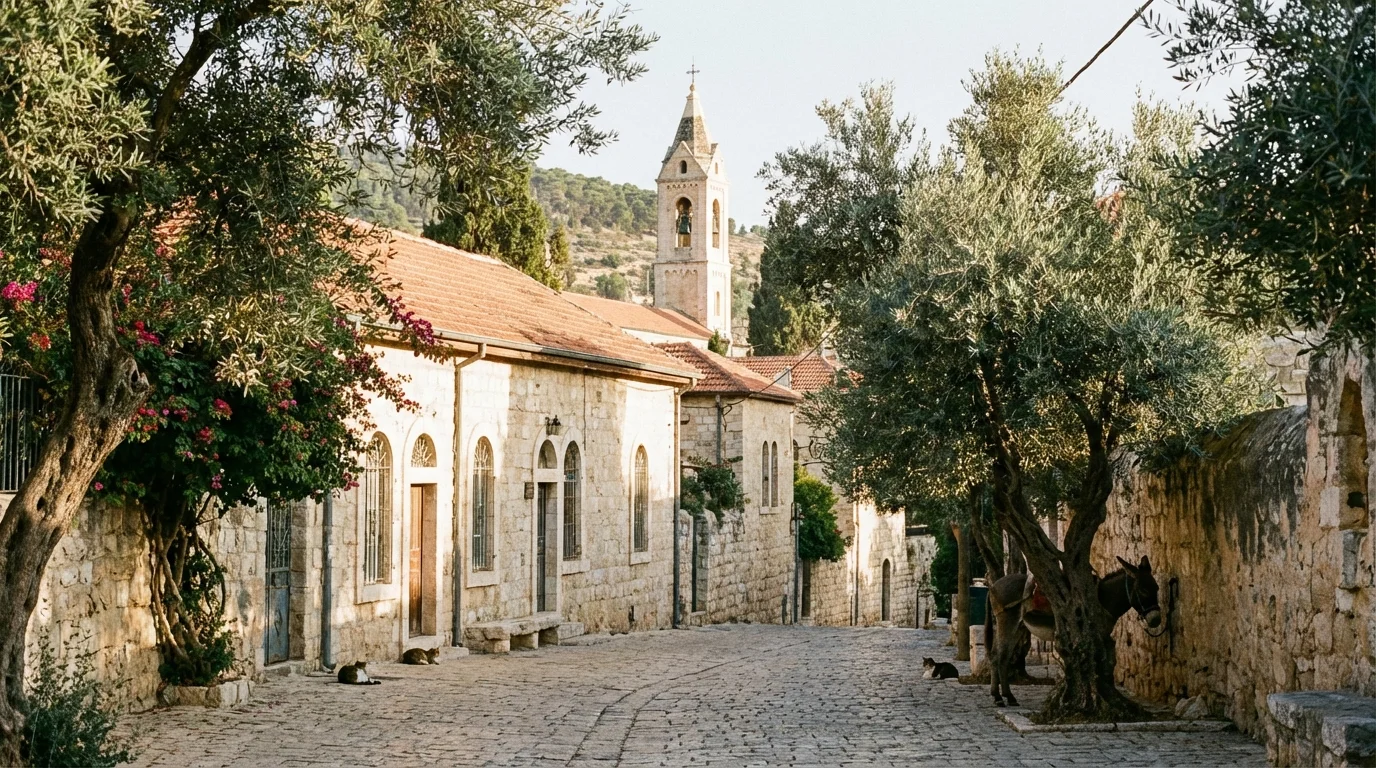
I was born in Ein Karem. It’s a small neighborhood in the hills just west of Jerusalem, and it’s where John the Baptist was born, and where Mary came to visit her cousin Elizabeth when they were both pregnant, and where you’ll find the Church of the Visitation and the Church of St. John the Baptist and a spring in the old village center that’s been there for centuries.
Most heritage tour itineraries don’t include it. I’m not sure why, exactly, probably because it’s not on the main road between the sites everyone knows, and so it gets skipped in favor of fitting in more of the standard list.
But here’s what I keep coming back to: it’s almost always quiet. Even when the rest of Jerusalem is crowded, Ein Karem is quiet. The stone houses and the narrow lanes and the gardens feel like a different world, which is maybe why I love it and why I always recommend it.
For Christian pilgrims especially, this place has enormous significance. The Visitation, one of the most tender stories in the New Testament, happened here. Elizabeth and Mary. Two women, both unexpectedly pregnant, meeting in a village in the Judean hills. The church built on that spot has Byzantine mosaics and a courtyard that is genuinely lovely.
I include Ein Karem in almost every itinerary I design, because it’s mine in a way that’s hard to explain, and because I’ve watched people respond to it in a way they didn’t expect. There’s something about a place that isn’t famous that lets you actually be there.
The Dead Sea Is Not a Beach. Plan Accordingly.
People picture the Dead Sea as a beach experience and it’s not, really. There’s no swimming. You walk in and the water holds you up like you’re lying in a hammock. You float on your back and you cannot sink. It’s genuinely strange and wonderful and a little ridiculous.
Here are the things people find out the hard way:
The shore is covered in salt crystals. They are sharp. Flip-flops are not optional. Bring them.
The water will sting any cuts, any shaving irritation, any skin that isn’t intact. You’ll know within seconds if you have a nick somewhere you forgot about.
Don’t get the water in your eyes. Just don’t. If you do, rinse immediately with fresh water, which should be available near the shoreline.
Leave your rings and watch and any metal jewelry at the hotel. The salt corrodes metal quickly, and people have ruined things they cared about because they forgot this.
The mud is real. People coat themselves with it and it does feel good on the skin. Embrace it. Everyone at the Dead Sea looks equally ridiculous. That’s part of the experience.
Don’t wear a swimsuit you care about. The salt is hard to wash out.
Oh, and sunscreen before you get in, not after. The water doesn’t cooperate with applying sunscreen once you’re wet.
Your Guide Makes or Breaks This Trip
I know I’m a guide saying this, so take it with whatever grain of salt you like. But I mean it.
There’s a difference between a guide who walks your group from site to site and reads from the official historical description, and a guide who helps you understand why any of it matters, what it felt like to the people who built it or prayed there or lived through it, and who pays attention to the people in your group rather than just the schedule.
A great guide notices when someone needs a moment. They give it to them. They don’t rush the group past a place that’s clearly landing hard with people because the bus departs in twenty minutes. They read the room.
Heritage Tours works specifically with guides who combine historical knowledge with what I’d call spiritual sensitivity. Not in a religious sense, necessarily. More in the sense of understanding that people come to Israel carrying something, and that a good guide helps them put it down in the right place.
That’s not something you can find on a Tripadvisor booking. It’s the difference between a trip you went on and a trip you’ll still be talking about in ten years.
Israel Is Smaller, Safer, and More Surprising Than You Think
A few things I enjoy telling people because they reliably produce the “wait, really?” reaction:
Israel has more museums per capita than any other country in the world. Which probably doesn’t surprise you once you’re there, because everything in this land is a layer of history, but still. It’s a remarkable density of things worth seeing.
The Judean date palm went extinct approximately two thousand years ago. In 2005, archaeologists germinated a seed that had been recovered from an excavation at Masada. That tree grew. It’s called Methuselah. Biblical agriculture, literally growing again today from a two-thousand-year-old seed. I still find this remarkable.
Tel Aviv’s White City is the largest concentration of Bauhaus buildings in the world. UNESCO listed. When German Jewish architects fled the Nazi regime in the 1930s, many came to Tel Aviv and built an entire neighborhood in the International Style they’d trained in. It’s extraordinary urban architecture and most heritage travelers don’t know it’s there.
And this one I just like to say out loud: you can float in the Dead Sea and pray at the Western Wall in the same day. That’s not a travel brochure line. It’s just true.
Frequently Asked Questions
How far in advance should we book a group heritage trip to Israel? Six to twelve months is ideal for groups. Popular dates around Jewish holidays and Easter book up well in advance. Waiting until a few months out is possible but limits your options significantly, especially for certain hotels and guide availability.
What’s the best group size for a heritage trip? Somewhere between eight and twenty people tends to work well. Smaller than that, and you lose some of the communal experience that makes a group pilgrimage meaningful. Larger than about twenty-five, and it becomes harder to have real moments at sites rather than just moving crowds through checkpoints.
Do we need a separate guide for Christian sites and Jewish sites? Not necessarily. The best heritage guides in Israel know both traditions deeply. What matters more than any specialization is whether your guide is genuinely curious and knowledgeable about your group’s specific reasons for coming. That’s a conversation to have when you’re choosing someone.
Is a group trip better than individual travel for a heritage journey? For most people, yes. There’s something about experiencing these places alongside others who share your faith or your roots or your reason for coming that amplifies the experience. That said, some people need more solitude to process what they’re feeling, and building in individual time within a group itinerary is usually a good idea.
How do we handle members of our group who have different physical abilities? This needs planning. Some sites, like the Masada cable car, have accessible options. Others, like parts of the Old City of Jerusalem with its uneven stone streets and steps, require more consideration. A good heritage tour operator will build an itinerary that works for everyone, not a one-size-fits-all itinerary that leaves some people behind.
For more on what Heritage Tours offers in Israel, visit our Israel destination page.
Your first time in Israel only happens once. Dina Aharon was born in Ein Karem, Jerusalem, and she has been leading people through these places for over 20 years. Reach out, and she’ll help you plan something worth the journey.