Seven days in Israel is enough time to go deep, if you plan the right way.
This isn’t a tourist checklist. It’s a heritage itinerary built around what matters to faith communities: the Western Wall at dawn, the quiet of Ein Karem, the view from the Mount of Olives before the rest of the world wakes up.
It covers Jerusalem, the Dead Sea, Galilee, Safed, Tel Aviv, and Jaffa. It works for groups of 15 or groups of 150. Use it as a foundation, the details are what we customize together.
Before You Start: Planning Notes for Group Leaders
A few things worth knowing before you look at the daily breakdown.
Group size affects everything. Bus logistics, hotel meal arrangements, site entry timing, and guide availability all scale differently at 20 people versus 80. Groups above 40 generally need two buses and staggered entries at major sites.
Allocate more time than you think. This is the most common mistake in group heritage travel. You will want to linger at the Kotel. Your group will need time to absorb Yad Vashem. Four well-paced stops almost always beats six rushed ones.
Meals are part of the itinerary. A Shabbat dinner in Jerusalem, a lunch by the Dead Sea, dinner overlooking the Sea of Galilee, these aren’t just logistics. Plan them intentionally.
This itinerary assumes Jerusalem for nights one through four, Tiberias or Safed for nights five and six, and a Tel Aviv area hotel on night seven.
Day 1: Arrival and First Evening in Jerusalem
Fly into Ben Gurion Airport, outside Tel Aviv. The drive to Jerusalem is about one hour. Check in, get everyone settled. This is not the day to push hard.
If you’re arriving on a Friday: Jerusalem shifts into Shabbat at sunset, and the Old City in the hour before that is extraordinary, families walking to synagogue, a kind of gathering stillness. If your schedule allows, a short walk to the walls just before sunset is worth doing.
For most weekday arrivals: after check-in, a short walk to see the Old City walls from the outside. The Jaffa Gate at night, lit against old stone, is a good introduction to what the next six days will hold. Rest early.
Day 2: Jerusalem: The Old City
The most significant day of the trip. Give it the time it deserves.
Morning: Western Wall (Kotel)
Arrive by 7:30-8am, before the tour groups arrive in volume. The Kotel in the morning is a different experience from the Wall at midday. Allow 45-60 minutes. Jewish groups will want time for morning prayers. Christian and interfaith groups often find it unexpectedly moving regardless of background.
Jewish Quarter
Key stops: the Cardo (the Roman-Byzantine main street, partially excavated, 2nd century stone under your feet), the Hurva Synagogue, and the Broad Wall, a section of King Hezekiah’s 8th-century BCE fortification uncovered after 1967.
Via Dolorosa and the Church of the Holy Sepulchre
For Christian groups, this is the emotional center of the day. Walking the 14 Stations of the Cross through the narrow Muslim Quarter streets, with the sounds and smells of the market around you, affects people in ways they don’t always anticipate.
The Church of the Holy Sepulchre is at the end. Plan 90-120 minutes minimum. Queues for the Edicule can be long. Your guide will know the best approach.
Afternoon: Armenian Quarter and Zion Gate Area
The Armenian Quarter is the quietest of the four Old City quarters. From Zion Gate: King David’s Tomb on Mount Zion, and one floor above it, the Room of the Last Supper (the Cenacle). Both in the same building, its own reminder of how layered Jerusalem is.
Day 3: Mount of Olives, Ein Karem, and Yad Vashem
Morning: Mount of Olives at Sunrise
If you can get your group to the overlook at sunrise, do it. The view of the Old City across the Kidron Valley, the Dome of the Rock, the walls, the Temple Mount, the ancient cemetery on the hillside, is one of those images people carry for decades.
After sunrise, walk down to the Garden of Gethsemane at the base of the mount. The ancient olive trees there are real, some probably over a thousand years old. For Christian groups, this is a place to slow down.
Mid-Morning: Ein Karem
Drive to Ein Karem, about 20 minutes from the Old City. This is a small village that most tour itineraries skip, and that’s a mistake.
Ein Karem is where John the Baptist was born, according to Luke. It’s also where Mary visited Elizabeth. The Church of the Visitation and the Church of St. John the Baptist are both beautiful, and the village is quiet, stone houses, gardens, a pace unlike the Old City.
Dina Aharon grew up in this village. When she leads groups here, she walks them through streets she walked as a child. For any group that has time, this is the one site she recommends above all others. It’s almost always quiet, and that combination, Biblical significance, personal history, village calm, tends to affect people in a way they don’t fully expect.
Afternoon: Yad Vashem
Allow three hours minimum. Some groups need four.
Don’t schedule Yad Vashem as the last stop on the last day. People need time to process what they see there, and that’s harder when they’re about to board a plane. Mid-trip, afternoon with an evening ahead, is usually better.
The Children’s Memorial is often the most affecting part, a dark room, one candle reflected endlessly in mirrors, a recorded voice reading children’s names. Brief your group before they enter.
Day 4: Dead Sea and Masada
Early Morning: Masada
Leave Jerusalem by 6:30am. Masada is Herod’s palace-fortress, built on an isolated rock plateau above the Dead Sea. The site is famous for the 73 CE siege, when Jewish rebels held out against Rome for months before the end came. For Jewish groups, this is often the most emotionally significant non-Jerusalem stop on the entire trip.
Two ways up: cable car (from 8am) or the Snake Path hike (45 minutes). There’s also a predawn sunrise hike, leaving at 4:30am. Demanding, but extraordinary.
At the top: Herod’s Northern Palace, Roman mosaic floors, one of the oldest synagogues ever found, and an unobstructed view of the Dead Sea and desert.
Lunch near the Dead Sea, then hydrate before the swim.
Afternoon: Dead Sea Float
The salt concentration is so high that you genuinely cannot sink. Bring flip-flops (salt crystals cut bare feet), leave jewelry at the hotel (salt destroys metals), don’t shave that morning, and do not get water in your eyes. Mud baths are available at most resort beaches. Allow 90 minutes.
Optional on the return: Qumran
Where the Dead Sea Scrolls were discovered in 1947, manuscripts dating back over 2,000 years, some of the oldest Biblical texts ever found. About 45 minutes from Ein Bokek on the way back to Jerusalem.
Day 5: Galilee: Tiberias and the Sea of Galilee
Drive north from Jerusalem to the Sea of Galilee, roughly two hours.
Capernaum
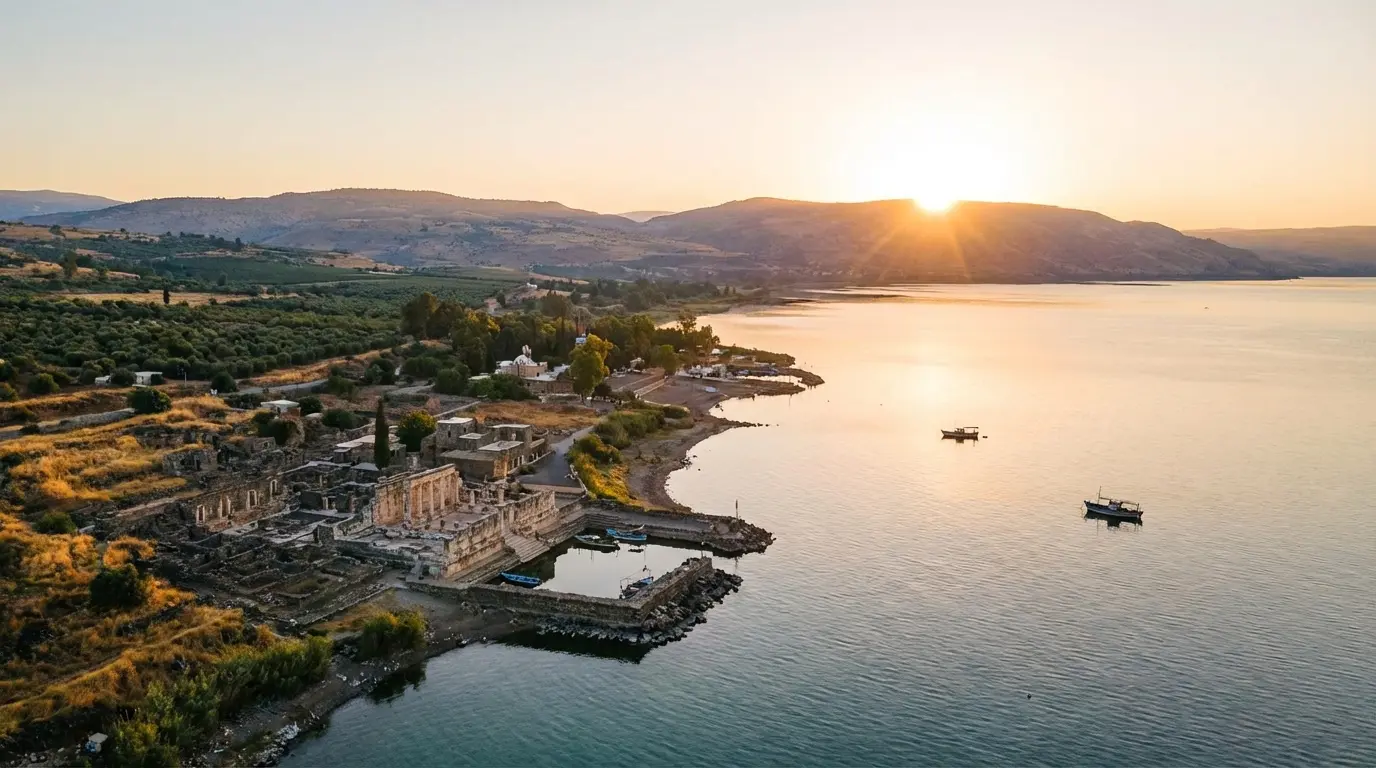
Jesus made Capernaum his base in Galilee. The site has significant archaeological remains: a 4th-century synagogue built over the earlier one where Jesus reportedly taught, and the remains of a house traditionally identified as Peter’s. Even for visitors without religious investment, the archaeology is compelling. Allow 45-60 minutes.
Tabgha
A short drive from Capernaum, traditional site of the Multiplication of Loaves and Fishes. A Benedictine monastery, and it has something increasingly rare in Israeli heritage sites: actual quiet. The mosaic floor of fish and a bread basket is original and extraordinary.
Mount of Beatitudes
The hilltop where Jesus delivered the Sermon on the Mount. Panoramic view of the lake below. For Christian groups, this is often the most spiritually significant stop in Galilee. Allow time to sit.
Jewish Sites in Tiberias
Tiberias is one of Judaism’s four holy cities. The Tomb of Maimonides (the Rambam) is in the center of the city. The Tomb of Rabbi Akiva is also here. Both are meaningful stops for Jewish groups, even briefly.
Stay for the Kinneret at sunset if you can. The Sea of Galilee at dusk, with the Golan hills on the far shore, is one of those views that seems almost too beautiful to be real.
Check in to your hotel in Tiberias or Safed.
Day 6: Safed and Northern Sites
Morning: Safed (Tzfat)
Safed is one of Judaism’s four holy cities and has been a center of Kabbalah since the 16th century. Some of the most important Kabbalistic texts were written here. Narrow stone alleyways, ancient synagogues, an artists’ quarter that grew out of the mystical tradition.
Walk slowly. There’s something about Safed that resists being rushed.
Key stops: the Ari Synagogue, where Rabbi Isaac Luria, probably the most influential figure in Kabbalistic history, prayed and taught; the Beit Yosef Synagogue, connected to Rabbi Joseph Karo, author of the Shulchan Aruch; and the artists’ quarter, where galleries draw on the mystical themes of Kabbalah. Allow two hours, possibly more.
Afternoon Options
Option A (Jewish groups): Mount Meron About 20 minutes from Safed, home to the tomb of Rabbi Shimon bar Yochai, reputed author of the Zohar. Usually quiet on weekdays. For groups with Kabbalistic or mystical interest, worth the drive.
Option B (Christian or mixed groups): Tel Shiloh Where the Tabernacle and the Ark rested for hundreds of years before Jerusalem. Hannah prayed here. Active excavations, almost no crowds, a striking contrast to the major Jerusalem sites.
Optional: Zippori (Sepphoris) A major Jewish city in the 1st-2nd centuries CE, where the Mishnah was compiled. Extraordinary Roman-era mosaic floors, including the “Mona Lisa of the Galilee” portrait, a picture of daily life in the Galilee that the pilgrimage sites don’t provide.
Day 7: Tel Aviv, Jaffa, and Departure
Morning drive south from Galilee toward Tel Aviv and Ben Gurion Airport.
Old Jaffa (Yafo)
One of the oldest port cities in the world, in the book of Jonah, mentioned in connection with Solomon’s Temple, where Peter stayed according to Acts. Today part Arab, part Jewish, with galleries, restaurants, and a flea market on weekends.
Walk the old port and the hilltop above it. Visit St. Peter’s Church. Stand at the tip and look out over the Mediterranean. The Jaffa flea market (Shuk HaPishpeshim) is worth a stop on Friday or Saturday mornings: antiques, Judaica, street food, real life.
Tel Aviv White City
Tel Aviv has the largest concentration of Bauhaus and International Style architecture in the world, some 4,000 buildings put up by European Jewish architects in the 1930s. UNESCO listed.
This doesn’t need to be a formal tour. A 30-40 minute walk through Rothschild Boulevard gives a sense of it. It’s a reminder that Israel is also a modern urban place, not only ancient and Biblical. Some groups find that shift valuable before heading home.
Transfer to Ben Gurion Airport
About 20-30 minutes from central Tel Aviv. For evening flights, a beach walk in Tel Aviv is a fine way to spend the afternoon. The Mediterranean, the promenade, the city behind you, different from everything else the week has held, and not a bad final note.
What This Itinerary Doesn’t Include (And Why)
Seven days means making choices. Here’s what’s not in this itinerary and how to add it.
Bethlehem: Church of the Nativity, city of David and Ruth. Add as a morning extension on Day 3, before Ein Karem. Allow 2.5-3 hours. Bethlehem is in the Palestinian Authority; group entry is logistically smooth with an experienced guide.
Hebron: Site of the Cave of Machpelah, traditional burial place of Abraham, Isaac, Jacob, Sarah, Rebecca, and Leah. Not right for every group, but powerful for those drawn to the Biblical patriarchs. Add as a half-day from Jerusalem.
Negev and Ramon Crater: The Negev desert is massive, quiet, and unlike anything in the north. Ramon Crater is the world’s largest erosion crater. For groups that want a wilderness element, extend to 8-9 days.
Jordan extension: Petra, Wadi Rum, and the Jordanian sites pair well with an Israel itinerary. A 2-3 day extension through the Allenby Bridge is logistically manageable. Ask Dina, she knows the route.
This itinerary covers the core. Extensions depend on your group’s interests, season, and what you’re trying to accomplish. That conversation is where the real planning begins.
Frequently Asked Questions
Is this suitable for older travelers? Mostly yes. Masada has a cable car. The Old City’s stone streets are uneven, which matters for anyone with significant mobility limitations. Yad Vashem is largely accessible. The Mount of Olives sunrise is optional. Communicate any mobility considerations early.
How many people can this handle? Anywhere from 12 to 200+, though larger groups need split buses and staggered site entries. The structure holds at most sizes.
Can we customize for our denomination or tradition? Absolutely. Jewish congregations typically want more time at the Kotel and Safed. Christian groups often expand Day 2 and Day 5. Interfaith groups frequently find Day 3’s combination of Ein Karem and Yad Vashem particularly meaningful.
What’s the best season? Spring and Autumn. See our full seasonal guide. Summer is possible but requires early starts. Winter is manageable if you’re not relying heavily on outdoor sites.
Do we need a local guide? For group heritage travel: yes, strongly. Israel is not a country where the significance of what you’re seeing is obvious without context. The right guide makes the trip cohere, and handles the logistics that would otherwise fall on you.
For more on what Heritage Tours offers in Israel, visit our Israel destination page.
Thinking about bringing your congregation to Israel? Dina Aharon was born in Ein Karem, Jerusalem. She’s been leading heritage journeys here for over 20 years. Reach out, she’ll personally help you plan the trip.