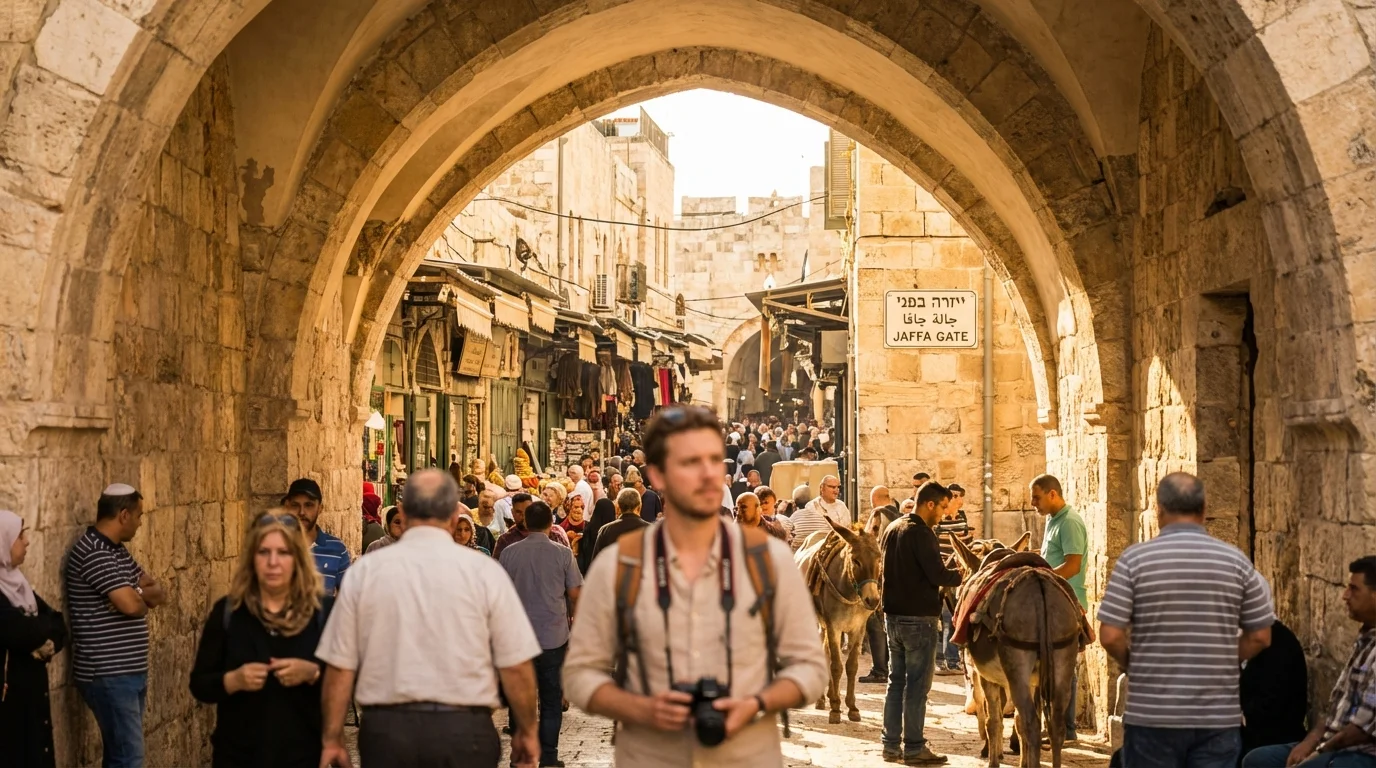
Israel is not a vacation. That’s the most honest thing I can tell you before we get into visas and packing lists.
People go to Hawaii for a vacation. They go to Paris for food and beauty and long afternoons in a café. Israel is something different. It’s a heritage journey. And the reason that distinction matters is that you arrive differently when you understand what kind of trip you’re actually taking.
Whatever your faith background, whatever your reason for going, arriving in Israel for the first time feels different from arriving anywhere else. I’ve watched it happen with group after group over the past twenty years. People walk off the plane at Ben Gurion expecting to feel normal, and then something changes. The land is just… different. It earns that, I think.
So let’s start there, with what kind of trip this actually is. And then we’ll get into the practical details.
Before Anything Else: What Kind of Trip Is This?
For Jewish Heritage Travelers
Many Jewish travelers come to Israel with something specific in mind: Yad Vashem, the Western Wall, Safed, the four holy cities (Jerusalem, Safed, Tiberias, Hebron). Some are tracing family roots, looking for the village their grandparents came from, the name on a gravestone somewhere in the Galilee. Some are here because their parents or grandparents never got to come, and they feel that weight.
All of that is real and worth acknowledging before you arrive. If you’re carrying something into this trip, give yourself permission to put it down and feel whatever you feel when you get there. You probably won’t know in advance what that will be.
For Christian Pilgrims
“Walking where Jesus walked” is the phrase people use, and it’s true, but it’s hard to know what it actually means until you’re standing on the shores of the Sea of Galilee or in the Garden of Gethsemane early in the morning before the crowds arrive. Most people feel more than they expected to. Many feel surprised by that.
The New Testament isn’t just a text here. It’s geography. And there’s something about reading a passage you’ve known your whole life and then standing in the actual place it happened that does something to you. I can’t explain it exactly. It just does.
For Families Tracing Roots
This is increasingly common, and honestly one of my favorite kinds of trip to help plan. Third and fourth generation Americans, Canadians, Australians who want to understand where their family actually came from. Ein Karem. Safed. Specific towns in the Galilee and Judea that most tour groups don’t visit because they’re not on the standard itinerary.
Tracing roots takes a bit more research and local knowledge, but those connections are usually findable. Heritage Tours specifically helps with this, because it’s the kind of work that requires knowing the land, not just the map.
Practical Essentials
Visa: If you hold a US, Canadian, Australian, or most European passports, you don’t need a visa for Israel. You can stay up to 90 days on a tourist entry. Just make sure your passport is valid for at least six months beyond your travel dates, because some airlines and entry points will flag it if it’s cutting close.
Currency: The New Israeli Shekel (NIS). In cities and anywhere tourist-facing, credit cards work fine. For markets, smaller shops, and street food, bring some cash. ATMs are easy to find. The exchange rate fluctuates, but roughly 3.5-3.7 NIS to the US dollar in recent years.
Language: Hebrew and Arabic are the official languages. English is spoken almost everywhere you’ll actually visit. In the Old City of Jerusalem, the markets, the hotels, the restaurants, the major sites, you’ll be understood. You probably won’t need a phrase book, though people appreciate it when you try.
Getting to your hotel from the airport: The main airport is Ben Gurion International, outside Tel Aviv. Taxis and ride apps (Gett works well in Israel) are easy from arrivals. If your group is arriving together, a private transfer or shuttle makes more sense and is worth arranging in advance.
Dress code at religious sites: This applies to everyone regardless of gender or faith. Covered shoulders and covered knees are required at the Western Wall, the Church of the Holy Sepulchre, mosques on the Temple Mount, and most major religious sites. Bring a light scarf or a layer you can tie around your waist. Women: a scarf is useful at the Western Wall. Men: kippot (skullcaps) are provided at the Western Wall entrance, so you don’t need to bring one, but you can.
Shabbat: Friday afternoon through Saturday night, when the sun goes down. Most Jewish-owned businesses close. Public transport in Jerusalem and other cities becomes limited. This catches a lot of first-time travelers off guard because they’re trying to plan activities for Saturday and running into closed doors.
Here’s the better frame: don’t plan against Shabbat. Plan around it. Kabbalat Shabbat in Jerusalem’s Old City on a Friday evening, when the streets quiet down and the synagogues fill and you can hear singing coming through stone walls that have stood for centuries, is something you will not find on any other night of the week. That’s not a scheduling inconvenience. That’s part of the trip.
Getting Around (And Why You Want a Local Expert)
Uber works in parts of Israel. Gett is the main app. Taxis are metered and available. Public buses and the Jerusalem light rail are easy to navigate once you know them.
But for a heritage trip, and especially for a group, there’s a real difference between having transportation and having a guide who understands why you’re going somewhere. Google Maps can get you to the Garden of Gethsemane. It cannot tell you which hour of the morning the light comes through the olive trees in a way that makes the place feel still, or explain the layers of history underneath the site you’re standing on, or notice that someone in your group needs a moment and quietly step back.
A local heritage guide is not a luxury on this kind of trip. It changes what the trip actually is.
What to Expect at the Major Sites
Western Wall
The security checkpoint at the Western Wall entrance is thorough but moves quickly. Bags go through a scanner. Dress code is enforced at the entrance: covered shoulders, covered knees. The plaza is divided into two sections, men on the right, women on the left. Prayer notes (small pieces of paper with prayers written on them) can be tucked into the cracks of the Wall, as visitors have done for generations. You don’t need to be Jewish to approach the Wall. People of all faiths come here.
Expect it to feel busy, especially midday. If you can visit early morning or close to sundown, you’ll have a different experience.
Church of the Holy Sepulchre
This is one of the most significant sites in Christianity, and also one of the most densely visited. Crowds are real, especially midday and especially on weekends. The Edicule (the shrine built over the tomb) often has a queue of 45 minutes or more. It’s worth it, but come prepared to wait.
Several different Christian denominations share the church and have specific areas under their jurisdiction. It’s complex and historically layered in a way that a good guide can help you understand and that you’ll miss entirely if you’re just following a map.
Masada
Herod’s fortress on a desert plateau above the Dead Sea, where nearly a thousand Jewish rebels chose death over Roman capture in 73 CE. It’s one of the most dramatic sites in Israel, and probably the most physically demanding.
The sunrise hike takes about 45 minutes up the Snake Path before dawn and is, honestly, extraordinary if your group is up for it. You arrive at the top as the sun comes over the Judean desert and the Dead Sea glitters below you. If anyone in your group has mobility concerns, the cable car operates from about 8am and gets you to the same place with less effort.
Bring more water than you think you need. It’s hot.
Dead Sea
The lowest point on earth, and genuinely one of the stranger physical experiences you can have. You don’t swim in the Dead Sea. You float, on your back, without effort, because the salt concentration is so high that the water holds you up.
What to bring: flip-flops (the salt crystals on the shore are sharp on bare feet), old clothes or a swimsuit you don’t mind getting salty, cash for renting towels if you don’t bring your own. The mud along the shoreline is real and people genuinely use it on their skin.
What not to bring: anything metal you care about. Rings, watches, bracelets. The salt corrodes them quickly. Leave them at the hotel.
One important note: don’t get the water in your eyes. It stings badly. And if you have any cuts or shaving irritation, you’ll know within about thirty seconds of getting in.
The Part Nobody Writes About: Your Emotional Reaction
Most people who visit Israel for the first time cry at least once. At the Western Wall. At Yad Vashem. In Bethlehem. In the Garden of Gethsemane. It doesn’t matter whether you’re religious or not, whether you’ve been preparing for this trip for years or booked it six weeks ago.
Something about being in these specific places after a lifetime of reading about them, praying about them, studying them, or inheriting them from parents and grandparents who never got to come, is simply overwhelming. It creeps up on you. It’s not always at the moment you expect.
I want to give you permission for that before you arrive. This is not just sightseeing. You’re allowed to feel what you feel. And if you’re leading a group, it’s worth telling them the same thing.
Yad Vashem specifically, Israel’s Holocaust memorial and museum, takes more from people than they plan for. Schedule it early in your trip if you can, not at the end. People need time to sit with what they’ve seen. Rushing through it and then catching a flight home the next morning is not the way.
5 Mistakes First-Time Heritage Travelers Make
1. Overloading the itinerary. The most common one by far. People try to see everything in five days and end up seeing nothing deeply. Better to visit fewer places and actually be present in each one. A week in Israel where you spend real time at three or four significant sites is worth more than a sprint through twelve of them.
2. Treating Shabbat as an obstacle. Already covered above, but worth repeating. The people who work around Shabbat miss the point. The people who build a Shabbat experience into their trip remember it as one of the best parts.
3. Not leaving quiet time at major sites. Yad Vashem rushed is Yad Vashem missed. The Western Wall in ninety seconds is just a wall. These places need your attention. Build pauses into the schedule.
4. Booking without a local expert guide. This comes up again and again because it matters that much. There’s a lot of good information about Israel available online. None of it replaces a person who knows the land, knows the context, and knows when to talk and when to be quiet.
5. Going with a generic tour operator instead of a heritage specialist. The difference in depth is real. A general tour company will take you to the major sites and give you the Wikipedia version. A heritage-specialist guide will help you understand why any of it matters and what it means to you specifically, given who you are and why you came.
Making the Most of Your First Visit
If I had to distill twenty years of guiding people through Israel into one piece of advice, it would be this: come with fewer expectations about what you’ll see, and more openness to what you’ll feel.
The sites are extraordinary. But the thing people talk about years later is usually smaller than that. A conversation at the Wall. The sound of a shofar echoing through stone streets. The view from Masada at dawn. A moment in Ein Karem where the world got quiet for a second and something felt different.
Build space for those moments. They’re the ones that stay.
Frequently Asked Questions
Is Israel safe to visit? Safety conditions vary and it’s worth checking your government’s current travel advisory before booking. For heritage travelers visiting the main religious and historical sites, many people travel without incident. A knowledgeable local guide will always be aware of current conditions and adjust accordingly.
How many days do I need? A minimum of seven to ten days is genuinely better than five. You can see a great deal in five days, but you won’t absorb much. Ten to fourteen days is ideal for a heritage trip that covers Jerusalem, the Galilee, the Dead Sea region, and a day or two in Tel Aviv.
What time of year is best? Spring (March to May) and fall (October to November) are generally the most comfortable weather-wise. July and August are very hot and very crowded. December is cool and manageable, and Jerusalem in particular is beautiful during the Jewish holiday season and Christmas. Avoid visiting during major Jewish holidays if you want everything open and accessible, or plan specifically around them if you want to experience them.
Do I need travel insurance? Yes, and make sure it covers medical evacuation. Standard advice for any international trip, but worth emphasizing here.
Can I visit as a non-Jewish or non-Christian traveler? Absolutely. Israel’s major heritage sites are open to people of all faiths. The Western Wall, the Church of the Holy Sepulchre, Masada, Yad Vashem, the markets of the Old City — none of them require a specific religious affiliation. You just need curiosity and appropriate respect for the dress codes and customs at each site.
For more on what Heritage Tours offers in Israel, visit our Israel destination page.
Your first time in Israel only happens once. Dina Aharon was born in Ein Karem, Jerusalem, and she has been leading people through these places for over 20 years. Reach out, and she’ll help you plan something worth the journey.