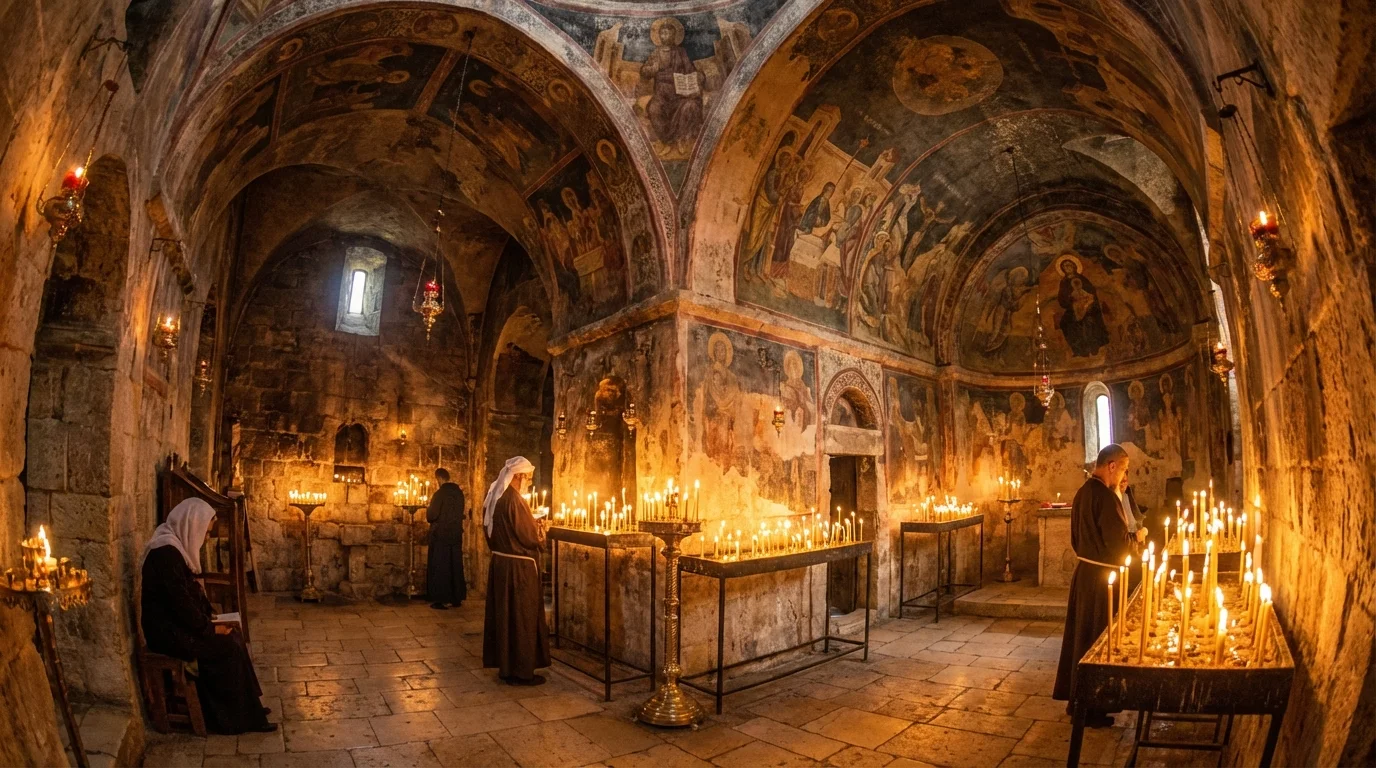
Something happens when people arrive in Israel. I’ve watched it happen hundreds of times and I still don’t have the right words for it. People step off the plane having studied the texts their whole lives. They think they know what they’re walking into. And then they get here, and it’s different.
I was born in Ein Karem, Jerusalem. My grandfather was a Chief Rabbi. I’ve been leading heritage journeys here for over twenty years. And I still notice it every time: the moment someone realizes that what they’ve believed their whole life is also a place. Real, physical, dust on the roads and prayers rising from three directions at once.
This guide is for spiritual leaders organizing group trips. You need to know what to expect practically and emotionally, because nothing in the reading quite prepares you for the real thing.
Why Israel Hits Differently (The Honest Version)
In most places, faith is something you bring with you. Here, faith is embedded in the geography. You’re not visiting a historic landmark. You’re walking inside the living text.
Jerusalem’s Old City fits inside many American university campuses. But inside that one square mile, three of the world’s major religions have sites of absolute centrality: the Western Wall and Temple Mount, the Church of the Holy Sepulchre, the Dome of the Rock. They’re not next to each other in a park. They overlap. They share walls. There’s nowhere else on earth like it.
You can’t fully prepare your congregation for that weight. What you can do is give them permission to feel whatever they feel, and time to sit with it.
Sites Sacred Across Traditions
Jerusalem’s Old City: Where Three Faiths Share One Square Mile
Four quarters: Jewish, Christian, Muslim, Armenian. Walk from one to the next and you feel the shift, architecture, sound, smell. Hebrew prayers in one alley, church bells and incense in the next. The stones are worn smooth from thousands of years of feet.
Go early, before 7am if you can. The alleyways are yours then, and what’s already extraordinary becomes something else entirely.
The Western Wall: What to Expect When You Get There
Practical first: security bag check at the entrance, modest dress required, kippot provided for men. Men and women pray at separate sections. The women’s section is smaller, worth mentioning in advance.
People approach the Wall and pray. Some press notes into the cracks in the stones. Some stand very still. Some weep. It is not a performance space. It is a place of real prayer for real people, many of whom have waited their whole lives to be here.
Some groups arrange morning prayers before the crowds, around 7am. The prayer carries differently in the quiet. If you can arrange it, do.
Prepare your group for the possibility that they’ll feel more than they expect. I’ve seen stoic people break down at the Wall. There’s no correct response.
The Church of the Holy Sepulchre: All the Feelings at Once
The site Christians believe holds both Golgotha and the tomb of the resurrection. For most Christian pilgrims, this is the center of everything.
Multiple denominations share this space: Greek Orthodox, Roman Catholic, Armenian Apostolic, Coptic, Ethiopian, Syriac Orthodox. The result is a layered, patchwork quality, different chapels, different smells, different lighting. Dark, ancient, incense-heavy.
The Edicule, the chapel over Jesus’ tomb, can have a queue of one to two hours. Mid-week visits are easier than Sundays.
Some groups find the church immediately transformative. Others find the crowds and competing liturgies jarring. Both are valid. Sit somewhere quiet inside for fifteen minutes. Let the place work on you.
Specifically for Jewish Travelers
Yad Vashem: Come With Time, Not a Schedule
Groups who move through Yad Vashem in ninety minutes miss it. Plan at minimum two and a half hours.
The Children’s Memorial alone deserves thirty minutes. A single candle reflected into what looks like a universe of stars, a voice reading the names and ages of children who died in the Holocaust. Some people need to step outside afterward and breathe. Build in time before moving to the next site.
Brief your group before they arrive, not to diminish the impact, but to give them a framework. The experience moves from history into the personal in ways that can feel sudden.
Safed: The Kabbalist’s City That Still Hums
Safed (Tzfat) sits in the Galilee hills at an elevation where the air genuinely changes, cooler, cleaner, the light somehow softer.
In the sixteenth century, Rabbi Isaac Luria, Rabbi Joseph Karo, and Rabbi Moses Cordovero were all here at the same time. That convergence is something you feel walking through the stone alleyways, narrow and cool, flagstone underfoot, old blue and white paint on the walls. Small synagogues in continuous use for centuries. On a Saturday morning, prayer floats out of multiple buildings at once, layering into something that feels ancient and alive.
Artists live here because of what one of them once told me is “something in the air.” Give your group time here without an agenda.
Cave of Machpelah in Hebron
Where Abraham purchased the first plot of land in Canaan, and where Abraham, Isaac, and Jacob, along with Sarah, Rebecca, and Leah, are traditionally buried. The oldest Jewish sacred site still in continuous use.
Hebron is complicated, and I won’t smooth that over. But the site itself is extraordinary. Standing at the Cave of Machpelah you are as close as you’ll ever get to the very beginning of the story. Prepare your group for the complexity. Then go.
Specifically for Christian Pilgrims
The Sea of Galilee Circuit
The Kinneret is where Jesus taught, called the disciples, calmed the water, fed the multitudes. The hills around the lake look much as they did two thousand years ago. The main sites, Capernaum, the Mount of Beatitudes, Tabgha, sit within thirty minutes of each other. A full circuit can be done in a long day.
The lake at dawn is worth losing sleep over.
Bethlehem and the Church of the Nativity
Bethlehem is in the West Bank, which means crossing a checkpoint. For tourist groups it’s generally straightforward, fifteen to twenty minutes. Tell your congregation in advance so it doesn’t catch anyone off guard.
The Church of the Nativity is one of the oldest continuously operating churches in the world. The Grotto of the Nativity has a silver star marking the birthplace. Go in the morning for shorter queues and better light.
The Via Dolorosa: Crowd or Quiet?
On a busy afternoon, you walk the Via Dolorosa between tourists, vendors, and locals going about their day. The markets continue alongside the stations of the cross. Some pilgrims find this jarring, others find it honest. If your group needs contemplative silence, go before 8am. The Friday afternoon Franciscan procession, which happens weekly year-round, is a different experience entirely. Choose intentionally.
The Quiet Moments Nobody Photographs
These are the things people come back talking about. Not the checklist items. The things that stay.
The thirty seconds of silence at Yad Vashem before anyone moves. The weight of where you are, just present in the air. I’ve watched that happen with group after group and it never gets ordinary.
Kabbalat Shabbat prayer echoing off Jerusalem’s stone walls on a Friday evening. If you’re near the Old City when Shabbat comes in, stop and listen. The city shifts.
A sunrise at Masada, before the cable car starts running. The fortress above the Dead Sea, the morning haze below, the whole impossible landscape to yourself.
The walk down from the Mount of Olives, before the tour buses, with the view of Jerusalem across the Kidron Valley. The dome and the gold of the Temple Mount in the early light. No photograph captures it.
How to Prepare Spiritually Before You Arrive
Practical preparation matters. But spiritual preparation matters at least as much.
For Jewish travelers: read Psalms 122 and 126 before the trip. The longing in those texts lands completely differently once you’re standing in the city they describe.
For Christian pilgrims: read the relevant Gospel passages before each site. The Sermon on the Mount before the Mount of Beatitudes. The Passion narrative before the Via Dolorosa. You’ve read these many times, but reading them knowing you’ll stand in these places changes something.
For everyone: tell your congregation that they will likely feel more than they expected. Some people cry. Some go quiet. Some feel nothing in the moment and then, three days later, start crying and don’t know why. All of it is fine.
Frequently Asked Questions
What counts as modest dress at sacred sites? Covered shoulders and knees for both men and women. Kippot provided for men at the Western Wall. Some Christian churches provide scarves at the entrance. At Muslim sites, remove shoes before entering prayer areas. When in doubt, bring a shawl, it solves most situations.
What time of year is best for faith travel? Spring (March to May) and fall (October to November) are most comfortable. Summer is hot and crowded. December brings Christmas pilgrims to Bethlehem, extraordinary atmosphere, significant crowds.
Can all these sites be visited on one trip? Most of them, yes. Israel is small. You can drive from the Sea of Galilee to Jerusalem in two hours. A well-planned eight to ten day itinerary reaches most of the sites here.
Is it safe to bring a congregation? Yes. Heritage Tours has been operating here for over twenty years and safety is the first thing we plan around. We always have the current situation in mind when building itineraries.
Can non-Jews pray at the Western Wall? Yes. The Wall is open to all visitors. The only requirements are modest dress and, for men, a head covering (provided at the entrance).
For more on what Heritage Tours offers in Israel, visit our Israel destination page.
Thinking about bringing your congregation to Israel? Dina Aharon was born in Ein Karem, Jerusalem. She’s been leading heritage journeys here for over 20 years. Reach out, she’ll personally help you plan the trip.