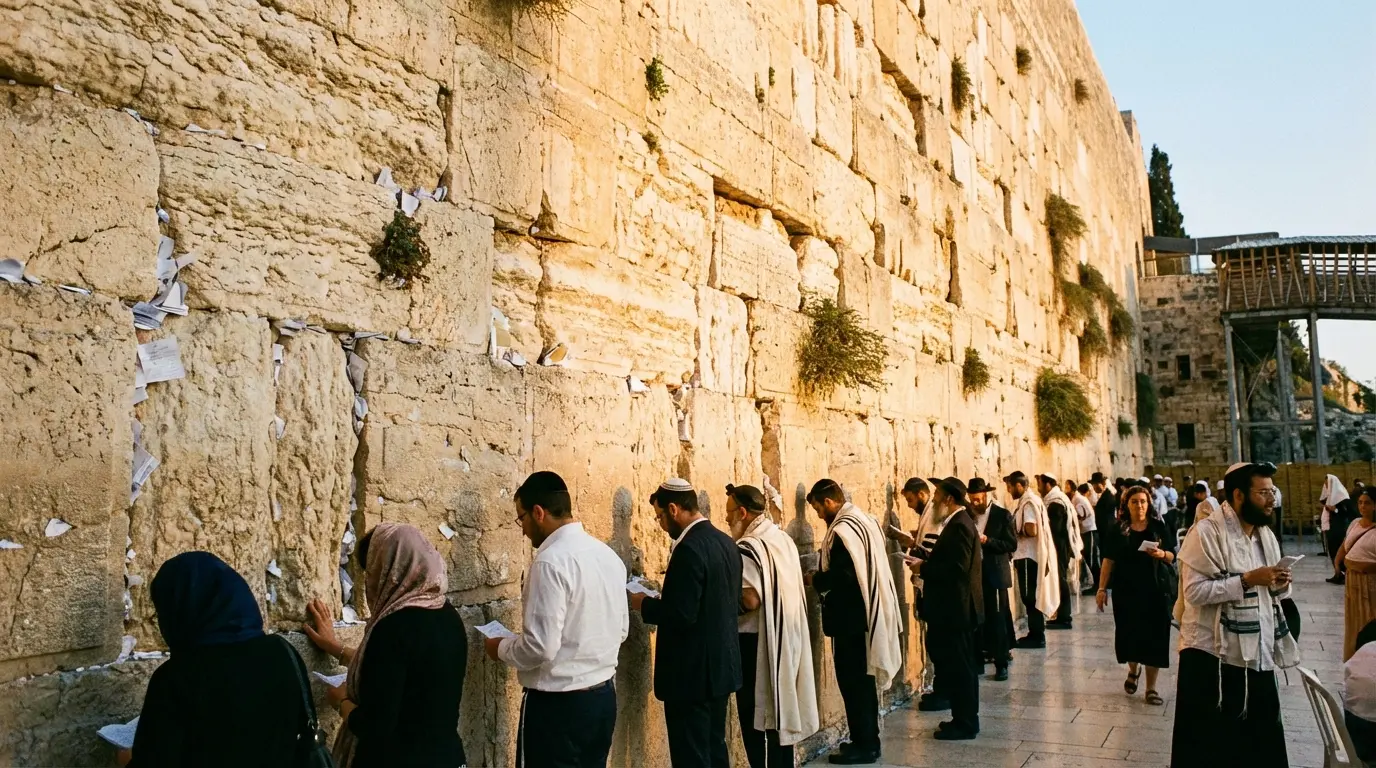
There’s something that happens to people the first time they stand at the Western Wall. I’ve watched it happen hundreds of times over twenty years of guiding heritage journeys. You plan your words carefully on the flight over. You think you know what you’ll feel. And then you get there, and none of that matters, because what you feel is something closer to recognition than awe. Like you’ve been here before, even if you haven’t. Like this place was waiting.
I grew up in Ein Karem, Jerusalem. My grandfather was a Chief Rabbi. The land of our ancestors wasn’t a concept I learned from books, it was the street I walked to school on, the stones under my feet, the stories my grandfather told before Shabbat. So when I help congregations plan Jewish heritage journeys, I’m not offering a tour package. I’m offering a homecoming.
This guide covers the sites that matter most. Not every site in Israel, the country is too rich for that. But the ones that carry the weight of our collective memory, and the ones that deserve more attention than they typically get.
The Four Holy Cities: A Short Explanation
Traditional Judaism identifies four cities as holy above all others: Jerusalem, Safed (Tzfat), Tiberias, and Hebron. For a congregation planning a Jewish heritage journey, these four form the spine of any meaningful itinerary.
Jerusalem
Jerusalem is where everything converges. The Western Wall, the Kotel, is the holiest accessible site in Judaism, the last remaining portion of the outer wall of the Second Temple. People write notes and press them into the cracks. They weep. They pray silently. They stand very still. Give your group unstructured time here. Don’t rush them.
The Old City’s Jewish Quarter was rebuilt after 1967, but beneath its paving stones are layers going back thousands of years. The Cardo, the main Roman street, is partially excavated and visible right there as you walk. Mount Zion holds King David’s traditional tomb, and the view from there toward the Temple Mount carries a weight that’s hard to describe without sounding like a brochure.
Yad Vashem sits on the western slopes of Mount Herzl. I’ll say more about it below, but understand that it belongs on every Jewish heritage itinerary without exception. It’s not a detour. It’s essential.
The Temple Mount itself is contested and complex. Non-Muslim visitors can access it during limited hours, though prayer is restricted. How your group engages with this is a deeply personal decision. I always say: go. Stand there. You don’t have to say anything.
Safed (Tzfat)
In the Galilee hills, at an elevation high enough that the air feels different, sits Tzfat. It is the mystical capital of the Jewish world, the city where Kabbalah was not just studied but lived and codified in the sixteenth century. Rabbi Isaac Luria, known as the Ari, is buried here. Rabbi Joseph Karo, who wrote the Shulchan Aruch, lived and taught here. The Etz Chaim Synagogue, which dates to 1742 though the community is far older, still holds services.
I’ll write more about what Tzfat actually feels like in a later section. For now, know that it belongs on every Jewish heritage journey, and that most first-time visitors are not prepared for how deeply it affects them.
Tiberias
On the western shore of the Kinneret, what the world calls the Sea of Galilee, Tiberias has been a center of Jewish scholarship since the second century. The Jerusalem Talmud was compiled here. Rabbi Yohanan bar Nafcha taught here.
Two tombs draw Jewish pilgrims specifically: the tomb of Maimonides (the Rambam), the great medieval philosopher and physician whose influence on Jewish thought cannot be overstated, and the tomb of Rabbi Akiva, one of the greatest sages of the Talmudic period, who was martyred by the Romans. The Kinneret itself is quietly beautiful and holds its own significance, the waters of Israel, still and blue in the early morning.
Hebron
Hebron requires honesty. It is ancient, it is sacred, and it is complicated in ways that can’t be smoothed over.
The Cave of Machpelah is where Abraham purchased the first plot of land in Canaan and where he, Isaac, and Jacob, along with Sarah, Rebecca, and Leah, are traditionally buried. It is, by most accounts, the oldest Jewish sacred site still in continuous use. There is a structure over the cave that has been, over the centuries, a Jewish tomb complex, a Byzantine church, a Crusader church, and a mosque. Today it is divided, with sections accessible to Jewish and Muslim worshippers separately.
To visit Hebron is to feel the full weight and complexity of this land. Some groups find it transformative. Others find it difficult. I think both responses are appropriate. Our connection to this site is real and deep. So is the reality of the current situation there. Your group will have questions. Prepare to sit with the questions rather than resolve them.
Sites of Jewish Memory You Shouldn’t Skip
Yad Vashem
Budget a full day. Not three hours. A full day.
Yad Vashem is Israel’s official memorial to the Holocaust, six million names, millions of stories, photographs of communities that no longer exist. The main exhibition takes you through the rise of Nazi Germany and the systematic destruction of European Jewry with a combination of historical rigor and profound personal humanity. The Children’s Memorial, which commemorates the 1.5 million Jewish children killed in the Shoah, is an underground chamber where 5,000 candles are reflected in mirrors until they become what looks like an infinite sky of light.
Come early. Leave late. Brief your group before they enter, not to prepare them emotionally (nothing fully prepares a person for this), but to remind them why you’re all here together and what this moment means for your community.
The Avenue of the Righteous Among the Nations, lined with trees planted in honor of non-Jews who risked their lives to save Jews, is often overlooked in the rush to see the main museum. Don’t overlook it.
Beit She’an
Most tour itineraries skip Beit She’an. That’s a mistake.
One of the best-preserved Roman-Byzantine cities in the world, Beit She’an sits at the junction of the Jezreel and Jordan Valleys. But its Jewish significance goes deeper than the Roman ruins. This is where the Philistines hung the body of King Saul after the battle of Mount Gilboa. It is mentioned repeatedly in the Tanakh. The city’s Jewish community flourished here through the Byzantine period, and the remains of ancient synagogues are still visible.
Walking through Beit She’an with your congregation, with the hills of the Jordan Valley in the distance, gives a sense of the biblical geography that is hard to achieve anywhere else in Israel.
Beit Shearim
Here is a site that almost nobody puts on their itinerary, and I genuinely don’t understand why.
Beit Shearim is a UNESCO World Heritage Site in the Lower Galilee that contains one of the most extraordinary collections of Jewish catacombs in the world. Dating from the 2nd through 4th centuries CE, these burial caves were the resting place for rabbis and sages from across the Jewish world, from Babylon, from Arabia, from as far as South Arabia. The inscriptions on the tombs are in Hebrew, Aramaic, Greek, and Palmyrene. Rabbi Judah HaNasi, the compiler of the Mishnah, is believed to be buried here.
The catacombs are beautifully preserved. The carved stone doors, the inscriptions, the sense of standing in a place where the sages of our tradition were brought to rest, it is moving in a way that is different from Yad Vashem, different from the Kotel. Quieter. More intimate.
If you can add one stop that most groups miss, make it Beit Shearim.
Jewish Mysticism in Safed: What to Expect
Let me try to describe what it’s actually like to walk through Tzfat’s old city at dusk.
The streets are narrow, sometimes barely wide enough for two people to pass. The stone is pale and old and catches the late light in a way that makes everything look slightly luminous. There are synagogues tucked into corners that you’d miss if you weren’t looking. There are artists’ studios. There is a cat sitting on an ancient wall. There is the smell of something being cooked somewhere, and the sound of someone praying in a building you can’t quite locate.
And there is something else. Something that’s hard to name without sounding mystical in a way that might make you uncomfortable, but I’ll say it anyway: there is a quality to the air in Tzfat’s old city that feels different from other places. It’s not quiet exactly, the city is alive. But it feels held, somehow. Like the centuries of prayer and study and intention that happened in these streets left something behind.
The Ari Synagogue, actually two synagogues, the Sephardic and the Ashkenazic, both dedicated to Rabbi Isaac Luria, are sites of active pilgrimage. Kabbalah, the body of Jewish mystical tradition, was systematized here in the sixteenth century. Rabbi Luria’s approach to prayer, to the structure of the universe, to the nature of the soul, still shapes how millions of Jews pray today. Standing in the synagogue where he prayed is not nothing.
For congregations with a connection to Jewish spirituality or mysticism, Tzfat deserves at least a full day. For congregations less familiar with Kabbalah, the city still offers something real and lasting, a sense that the Jewish tradition is deeper and more layered than even many Jews realize.
Planning a Jewish Heritage Tour: What Actually Matters
If you’re a rabbi or synagogue leader thinking about organizing a heritage journey, you probably have a list of questions. Some of the most common ones I hear:
How long should the trip be? Honestly, ten to fourteen days is the right range for a meaningful Jewish heritage journey. You can do it in eight days, but you’ll feel the rush. Fourteen days lets the group breathe, lets unexpected conversations happen, lets people sit in places longer than the schedule requires.
How many sites is too many? More than most tour operators will tell you. The temptation is to pack the itinerary. Resist it. Your congregation will remember the hour they spent at the Kotel as the sun went down, not the extra site you squeezed in before dinner. Leave margin. Build in time for people to just be somewhere.
When should we go? Spring (March through May) and fall (September through November) are the best times climatically. Passover and the High Holidays bring their own spiritual weight if you want to time the trip around them, but book early. Those windows fill up twelve to eighteen months ahead.
What about the political situation? Israel is a complex and contested place, and anyone who tells you otherwise is not being fully honest with you. But millions of people visit safely every year, and a well-planned heritage journey with experienced local guides manages this carefully. Your group will have questions and feelings about what they see. That’s appropriate. Part of my job is helping leaders prepare to hold those conversations with their congregations.
Will the group be physically able to handle it? Most heritage sites involve some walking on uneven terrain. The Old City of Jerusalem in particular requires comfortable shoes and a willingness to navigate stairs. For groups with mobility concerns, we plan routes and alternatives carefully. Nobody should feel left behind.
Frequently Asked Questions
Do I need to speak Hebrew to lead a heritage tour? No. Almost everyone you’ll interact with, at hotels, sacred sites, restaurants, speaks English. Your guides will be fluent. What matters is your connection to the material, not the language.
Can we include Shabbat in the itinerary? Absolutely, and honestly, I’d encourage it. Shabbat in Jerusalem, walking to the Kotel Friday evening, the feeling of the city quieting, is something your congregation will talk about for years. We plan around it.
Is it appropriate to combine a Jewish heritage tour with visits to Christian sites? Many groups do, and there’s good reason for it. Masada, the Dead Sea, many sites in the Galilee, these carry significance across traditions. But a Jewish heritage journey has its own integrity, and trying to cover everything in one trip sometimes dilutes the experience. My advice: go deep rather than wide.
What is the group size for a congregational journey? Anywhere from ten to forty participants works well. Smaller groups allow for more personal experiences at sacred sites. Larger groups carry their own energy and community feeling. There’s no wrong answer.
For more on what Heritage Tours offers in Israel, visit our Israel destination page.
Thinking about bringing your congregation to Israel? Dina Aharon was born in Ein Karem, Jerusalem. She’s been leading heritage journeys here for over 20 years. Reach out, she’ll personally help you plan the trip.