Most groups who visit Israel come home having seen the same twelve or fifteen places. The Western Wall, the Old City, the Sea of Galilee, maybe Masada. And those places are extraordinary, genuinely. I’m not going to tell you the famous sites are overrated, because they’re not. But Israel has layers that most standard itineraries never reach, and some of those layers are, honestly, the ones that stay with people longest.
This post is for group leaders who want more than a highlights tour. The leaders who are asking themselves: what does this land have to offer that my congregation hasn’t already seen in documentary footage? What will actually surprise them? What will reach them in a place that a thousand photographs of the Western Wall at sunset can’t quite touch?
The answer is that Israel has dozens of sacred places, ancient places, places of profound historical and spiritual weight, that sit almost entirely empty on most days. No lines, no tour bus traffic, no recorded audio guides. Just the site itself, and your community, and the silence that lets something actually happen.
Why the Famous Sites Are Famous (And Why That’s Not Enough)
The famous sites became famous for real reasons. The Western Wall is genuinely one of the most charged spiritual spaces on earth. The Church of the Holy Sepulchre contains layers of Christian history going back to the fourth century. These places deserve the attention they get.
But the nature of fame changes an experience. When you’re surrounded by thousands of other visitors, when security lines stretch around the block, when you have twelve minutes at a site before the next group arrives, something gets lost. The contemplative dimension, the sense of your congregation actually inhabiting a place rather than passing through it, becomes very difficult to access.
There’s also a quieter problem. When your community already knows what to expect from a site, from the photographs and the films and the videos, the experience of arriving there can feel strangely familiar rather than genuinely new. The mind registers it as recognition rather than revelation. That’s not always a bad thing, but it means you need other places too. Places where the visual and emotional experience is genuinely unexpected.
The sites I’m describing below are the ones where I’ve watched people go quiet in ways I don’t often see at the famous locations. They’re the places I find myself returning to with groups again and again, not because they’re on some list, but because they actually work.
Ein Karem: Where Heritage Tours Begins (Dina’s Story)
I grew up in Ein Karem. I want to say that plainly, because it shapes everything I’m about to tell you.
Ein Karem is a small village on the western outskirts of Jerusalem. Most people who visit Jerusalem don’t know it exists. Those who do know of it probably know it as the traditional birthplace of John the Baptist, the site of the Church of the Visitation and the Church of St. John the Baptist. And yes, those are beautiful places worth visiting.
But what I want you to understand is that Ein Karem is a living village. It was a living village when I was a child running through its streets, and it’s a living village now. The stone houses are old. The olive trees are older. The light in the late afternoon, falling across the terraced hillsides, is unlike the light anywhere else I’ve been in the world, and I’ve been to many places.
I have memories of this place that I can’t fully translate into words. The smell of the jasmine that grew outside my grandfather’s house. The sound of the church bells on Sunday morning coming through an open window. The sense, which I had even as a child and didn’t have language for, that this particular piece of ground had been prayed over and wept over and celebrated on for a very long time, and that the weight of all that human experience was somehow still present.
When I bring groups to Ein Karem now, the reaction is almost always the same. People slow down. They stop taking photographs for a while. They just walk, and look, and feel whatever it is they feel. For Christian groups, the connection to John the Baptist’s story, to the Visitation of Mary to Elizabeth, is obviously profound. But I’ve brought Jewish groups here too, and secular groups, and they feel it as well. Something about the place itself, not just its religious significance, gets through.
Most tour itineraries skip Ein Karem completely. I’ve never understood that.
Shiloh: Where the Ark Rested Before Jerusalem
If you’ve read the books of Joshua and Samuel, you’ve read about Shiloh. This is where the Tabernacle stood after the Israelites entered Canaan. The Ark of the Covenant rested here for roughly 369 years, making Shiloh the spiritual center of ancient Israel for several centuries before David brought the Ark to Jerusalem and Solomon built the Temple.
Hannah prayed for a child here, and the prophet Samuel was dedicated to service here as a boy. The biblical narrative gives Shiloh an importance that’s hard to overstate, and yet it’s almost never on standard heritage tour itineraries.
The archaeological site is well-maintained, and the remains give a real sense of the scale and layout of an ancient Israelite settlement. For groups with a deep connection to the Hebrew Bible, standing on the ground where the Tabernacle stood, and trying to imagine what it looked like when the tribes gathered here for the festivals, is an experience that doesn’t translate into images or descriptions. You have to be there.
It’s in the West Bank, which is why some itineraries avoid it. But it’s accessible, it’s safe for group travel, and for the right congregation, it’s one of the most meaningful hours they’ll spend in Israel.
Zippori: The “Mona Lisa of Galilee” and a Roman-Jewish World
Zippori (the Romans called it Sepphoris) was, in the first century of the common era, the largest and most important city in the Galilee. It sat near Nazareth, close enough that historians believe Jesus almost certainly walked through it as a young man. And yet it’s almost entirely absent from standard tour itineraries.
The archaeological site is stunning. A Roman theatre. Ritual baths. A crusader-era tower. And then, beneath a purpose-built protective structure, one of the most extraordinary artifacts I’ve seen anywhere in Israel: the mosaic floor of a Roman dining room from the third century, depicting scenes from the life of Dionysus and, at its center, a portrait of a woman of such subtle beauty and technical skill that she’s been called the Mona Lisa of Galilee.
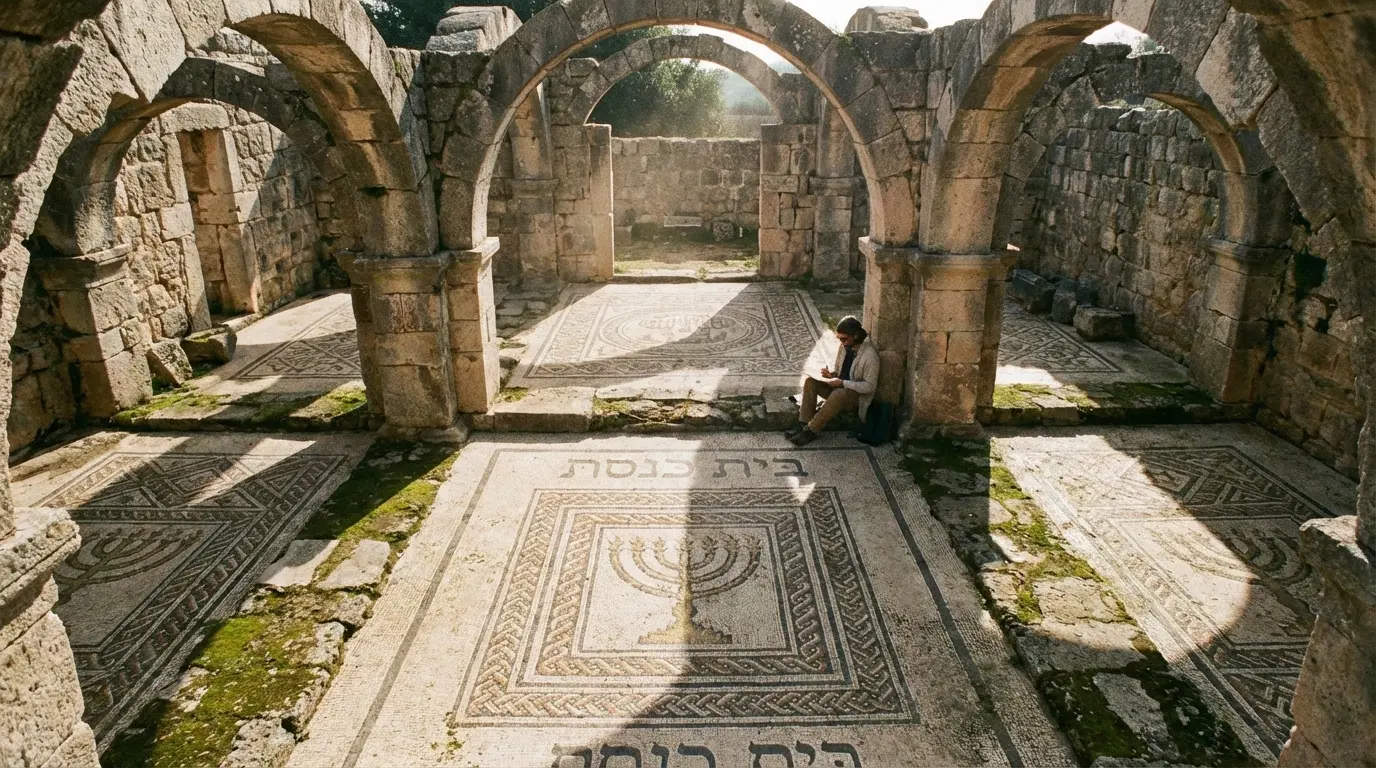
In the same site, a short walk away, is a Byzantine synagogue floor with a complete zodiac mosaic, including depictions of the twelve signs arranged around the sun god Helios. The combination of Roman, Jewish, and later Christian layers at Zippori is genuinely unusual, and the site rewards a slow visit with an informed guide who can help your community understand what they’re looking at.
If your group is spending any time in the Galilee, and if you care about the first-century world in which both rabbinic Judaism and early Christianity took shape, Zippori is probably the site I’d most want you to see that you probably haven’t planned for.
Mount Meron: The Kabbalist’s Mountain
Mount Meron is the highest peak in the Galilee, and at its base lies the tomb of Rabbi Shimon bar Yochai, the second-century sage traditionally credited with authoring the Zohar, the foundational text of Jewish mysticism and Kabbalah.
Once a year, on the holiday of Lag B’Omer, Mount Meron draws one of the largest gatherings in Israel. Hundreds of thousands of pilgrims come to mark the anniversary of Rabbi Shimon’s death, which is observed as a celebration of spiritual light rather than a day of mourning. Bonfires burn all night. Music plays. The mountain is transformed into something that feels both ancient and completely alive.
But outside of Lag B’Omer, Mount Meron is often quiet. And that quiet is its own kind of gift. The tomb complex is atmospheric in a way that the more tourist-heavy sites in Israel sometimes aren’t. For groups with any connection to Jewish mysticism, to Kabbalah, or simply to the long tradition of Jewish longing and spiritual seeking, spending time here can be deeply affecting.
The mountain itself, covered in pine forests, with views across the Galilee that on a clear day can reach the Mediterranean, is beautiful in a way that feels less curated and more genuinely natural than many heritage sites. That matters.
Tabgha: The Quiet Shore Where the Miracle Happened
On the northwestern shore of the Sea of Galilee, a Benedictine monastery sits at a site traditionally identified as the location of the miracle of the loaves and fishes, where the Gospels describe Jesus feeding a multitude with five loaves of bread and two fish. Mosaic floors from a fourth-century Byzantine church, discovered by archaeologists and preserved inside the current monastery church, depict fish and loaves in a style of quiet, almost humble artistry that matches the story itself.
What makes Tabgha unusual is its atmosphere. The site is generally peaceful and unhurried. The monastery keeps it well, and the Benedictine community’s presence gives the place a quality of lived prayer rather than historical preservation. The shore of the Sea of Galilee here is genuinely beautiful, with reeds growing at the water’s edge and the hills of the Golan rising on the opposite shore.
For Christian groups, this is often one of the most emotionally resonant stops on the entire journey, partly because of what happened here and partly because of how the site is maintained. It’s quiet in a way that makes prayer feel natural rather than staged. I find myself recommending it to almost every Christian group I work with, and I don’t think I’ve ever had anyone tell me afterward that it wasn’t worth the detour.
The Underground World: Bet Guvrin’s 3,500 Caves
Bet Guvrin is a UNESCO World Heritage Site in the Judean foothills, and it’s one of the strangest and most surprising places in Israel. Beneath the surface of an otherwise unremarkable landscape, approximately 3,500 underground chambers have been carved into the soft chalk rock over thousands of years. Bell-shaped caves that were used as cisterns, olive oil presses, columbaria (structures for housing pigeons, which were an important agricultural resource), and burial chambers from multiple historical periods.
The experience of walking into these underground spaces, some of them large enough to hold a crowd, others intimate and dim and carved with ancient inscriptions, is genuinely unlike anything else in Israel. There’s something about the subterranean quality of it, the sense of descending into a world that was built layer by layer over centuries, that changes how people think about the relationship between past and present.
It’s also, honestly, an adventure. Groups that include younger participants, or communities that want a heritage experience that isn’t entirely focused on standing and listening, tend to love Bet Guvrin. You can actually enter the caves, move through them, explore. The history is present in the physical experience, not just in what a guide tells you.
Chorazin: The Forgotten Village of the Evangelical Triangle
The “Evangelical Triangle” is a term sometimes used for the three towns around the Sea of Galilee where the Gospels place most of Jesus’s ministry: Capernaum, Bethsaida, and Chorazin. Capernaum is relatively well-known and regularly visited. Chorazin, despite being mentioned by name in the Gospels (Jesus speaks of it directly in Matthew and Luke), is almost entirely overlooked.
The ruins of an ancient basalt synagogue at Chorazin date to the third or fourth century and are substantial enough to give a real sense of what a Galilean Jewish community of that period looked like. The black volcanic stone is striking, different from the limestone of Jerusalem or the chalk of the Judean foothills. And the site is almost never crowded, which means your community can actually spend time there without being hurried.
For Christian groups doing a Galilee-focused pilgrimage, adding Chorazin to the itinerary alongside Capernaum gives a more complete sense of the region and its communities. And for anyone interested in the transition period of Jewish life in the centuries after the Temple’s destruction, the synagogue at Chorazin is a meaningful place to spend an hour.
How to Visit These Sites (Without Going Alone)
Most of these places are perfectly accessible to independent travelers, and I don’t want to suggest otherwise. But there are a few honest reasons why visiting them with an experienced guide, someone who knows the sites deeply and can help your community engage with what they’re actually seeing, makes a significant difference.
The first is simply context. A mosaic floor from the third century means something different when you understand the community that commissioned it, the artists who made it, and the way it connects to the broader story of Jews and Romans and Christians living in complex proximity. The caves at Bet Guvrin are interesting as physical spaces, but they’re genuinely moving when you understand how they were built and used across multiple civilizations over centuries. Context is the difference between seeing and understanding.
The second is pacing. Groups that try to visit six or seven of these sites in a single day tend to arrive home exhausted rather than enriched. The sites I’ve described above reward slowness. They reward the half-hour spent sitting with what you’ve seen before moving to the next thing. A good guide helps your group find that pace and protect it.
The third is logistics, though I’d rather focus on the experience than the practical side. Getting to some of these sites, particularly Shiloh and some of the Galilee locations, requires knowing the roads and the access arrangements. It’s manageable, but it’s one more thing you shouldn’t be carrying if your job is to be the spiritual leader of your community’s journey.
Frequently Asked Questions
Can we visit all of these sites in one trip?
Probably not all of them, and I’d actually advise against trying. A heritage journey works best when there’s room to breathe, to sit with what you’ve seen, to let your community process the experiences before moving to the next one. Depending on your trip length and your community’s interests, I’d suggest choosing four or five of these sites to weave into an itinerary alongside the major landmarks. Which ones depends on your congregation’s tradition, what matters most to them, and what kind of experiences you’re hoping to create together.
Are these sites appropriate for congregations of all ages?
Most of them, yes, with some variation. Bet Guvrin involves some physical exploration that younger and more active participants love, and it might require more help for members with mobility concerns. Mount Meron involves some walking on uneven ground. Tabgha and Ein Karem are gentle and accessible. Zippori has a fair amount of walking across an open archaeological site. Shiloh has a well-maintained visitors’ area. I’d encourage you to be specific with your guide about the physical range of your group, so the itinerary can be built accordingly.
How do I explain these “lesser-known” sites to my congregation in advance?
Honestly, a bit of mystery works in your favor here. If you tell your community “we’re visiting the Mona Lisa of Galilee, a mosaic portrait from the third century that archaeologists say is one of the most beautiful ancient artworks ever found in Israel,” most people will be curious and engaged. You don’t need to over-explain. A sense that there’s something unexpected and special coming is often enough.
Are these sites religiously appropriate for both Jewish and Christian groups?
Some are more specifically oriented to one tradition (Shiloh and Mount Meron are primarily meaningful within Jewish heritage; Tabgha and Chorazin are specifically connected to the Christian Gospels), but most have significance across traditions. Ein Karem, Zippori, and Bet Guvrin are historically and spiritually meaningful to a wide range of faith communities. And honestly, there’s something valuable about any faith community encountering the full breadth of what this land has held.
How does visiting these sites alongside the major landmarks affect the overall trip?
In my experience, it makes the major landmarks land differently. When your congregation has spent a quiet afternoon in Ein Karem or stood in the Shiloh valley where the Tabernacle once stood, they bring a different quality of attention to the Western Wall or the Church of the Holy Sepulchre. The lesser-known sites create depth. They make the famous sites feel less like destinations on a list and more like chapters in a story your community is reading together.
For more on what Heritage Tours offers in Israel, visit our Israel destination page.
Thinking about bringing your congregation to Israel? Dina Aharon was born in Ein Karem, Jerusalem. She’s been leading heritage journeys here for over 20 years. Contact us, she’ll personally help you plan the trip.