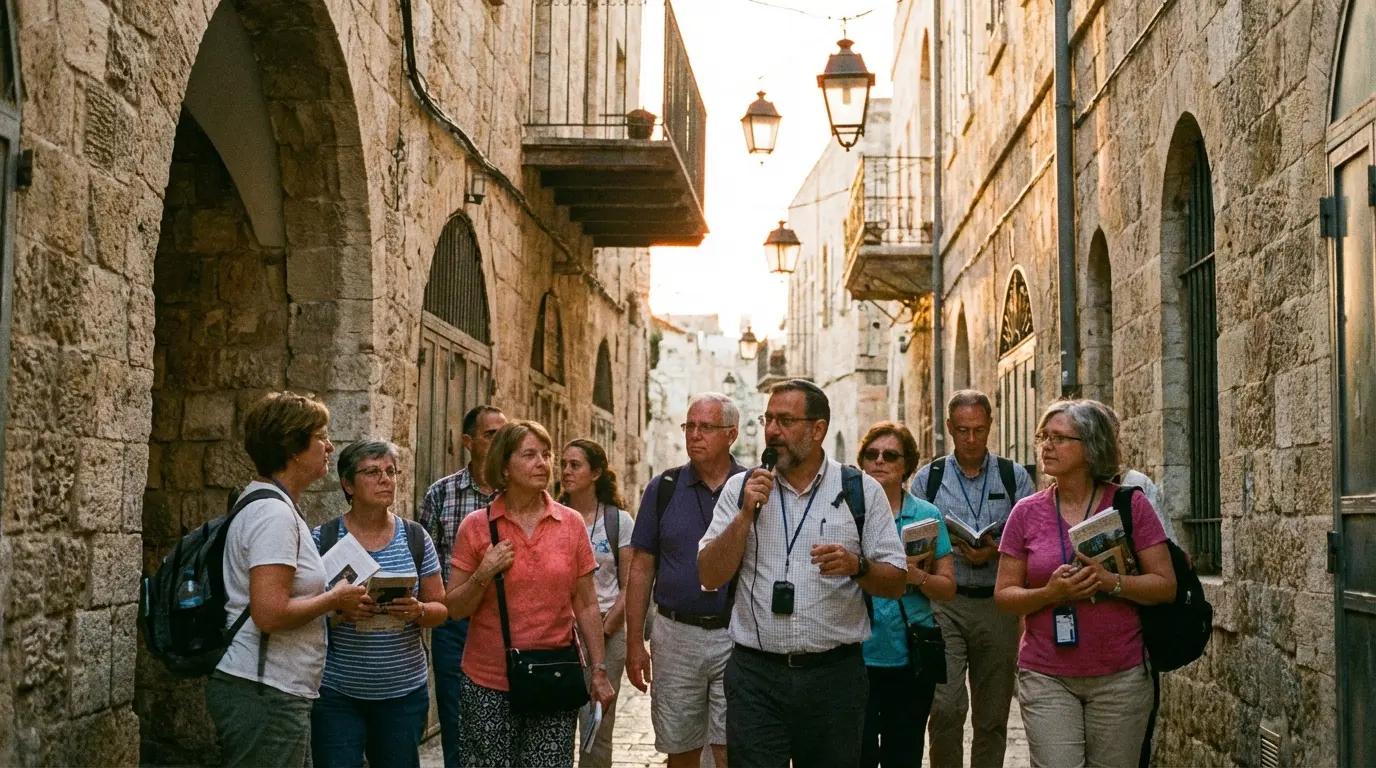
You’ve probably thought about leading your congregation to Israel for years. Maybe you’ve been once yourself. You know what it does to people, the way it rewrites the map they carry in their head, the way scripture becomes three-dimensional, the way your congregation walks off the plane at Ben Gurion already changed before they’ve seen a single thing.
And yet you haven’t done it yet. Maybe it feels too complicated to organize. Maybe you’re not sure how much it costs, or who handles what, or how you’d frame it to your community. Maybe you’ve been waiting for the right moment.
This guide is for you. It covers everything you actually need to know before you start planning, the practical pieces, the financial structure, the timing, and what to say to your congregation when you’re ready to announce it. If you lead a synagogue or a church, if you’ve been carrying this idea for one year or ten, this is where to start.
Why Community Leaders Choose to Organize Group Travel (And Why It’s Worth It)
Leading a group to Israel is one of the most significant things a spiritual leader can do for their community. That sounds like an overstatement. It isn’t.
Here’s what actually happens: people who’ve attended your services for twenty years, people who know your sermons by heart, people who sit in the same pew every week, they experience something in Israel that they couldn’t experience anywhere else. They see the places they’ve been reading about and praying about and singing about their whole lives. And they experience it together, with their community, under your leadership. That shared experience changes the fabric of a congregation in ways that last.
Rabbis often tell me that members who went on a heritage journey together form a different kind of bond afterward. Pastors say the same thing. There’s a shorthand that develops between people who stood at the same place and felt the same thing at the same moment. That’s hard to manufacture in a sanctuary. It happens naturally on the road.
And honestly, it changes you too. Leading a group through sacred sites you care about deeply, watching your community encounter places you love, that’s not a burden. It’s a privilege.
The Leader Travels Free: Here’s How It Works
Let’s be direct about this, because it matters and there’s no reason to bury it.
When your group has 15 or more participants, the group leader, the rabbi, pastor, or minister organizing the journey, travels at no cost. Flights, accommodations, meals, site entrances, guides: included. This is standard in group heritage travel, and Heritage Tours honors it fully.
This matters for a few reasons. First, practically: organizing a group trip is real work. You’re the one fielding questions at 10pm, you’re the one following up with members who haven’t paid their deposit, you’re the one thinking about the spiritual arc of the journey while everyone else just gets to show up. The complimentary travel is recognition of that work.
Second, it means you can honestly tell your congregation that this is something you’re doing for them, not a personal trip you’re tagging them onto. The trip is designed around your community’s needs. You are there as their leader, not as a co-traveler.
If you want to bring a spouse or partner, there are options for that as well. Ask Dina when you speak.
What Heritage Tours Handles (So You Don’t Have To)
The piece that stops most spiritual leaders from organizing group travel is the logistical complexity. Coordinating fifteen or thirty or forty people across an international trip feels like a second job. It doesn’t have to be.
Logistics
Heritage Tours coordinates flights, ground transportation, hotel accommodations, and hotel pickup and dropoff. Daily breakfast and dinner are included. Entrance fees to all sites on the itinerary are covered. Emergency support is available throughout the journey.
What this means practically: you are not managing a spreadsheet of thirty different flight times. You are not negotiating hotel rates. You are not figuring out which bus goes where and when. All of that is handled.
Local Experts
The quality of a heritage journey depends almost entirely on the quality of the guides. A guide who recites historical facts at sacred sites is not the same as a guide who helps your congregation actually inhabit those places, who understands that your group came to feel something, not just to learn something.
Heritage Tours works with local expert guides who know Israel’s history, its spiritual traditions, and its complexity. For Jewish heritage groups, guides who can speak fluently about rabbinic tradition, about Kabbalah, about the history of Jewish communities in the land. For Christian pilgrimage groups, guides who understand the theological significance of sites and can hold space for reflection and prayer alongside the history.
Custom Itineraries
There is no single right itinerary for a congregation. A group from a Reform synagogue interested in Jewish history and culture has different priorities than a group from an Orthodox community focused on sacred sites and halacha. A Baptist congregation on a New Testament pilgrimage has different needs than a Catholic group following the Via Dolorosa.
Your itinerary is built around your community. Dina works with you directly to understand what matters most to your group, what you want them to carry home, and how to structure the journey to make that happen.
Planning Timeline: When to Start, What to Book
The single most common mistake group leaders make is starting too late. Here is an honest timeline.
12 months out: This is the ideal starting point for most group departures. Twelve months gives you time to announce the trip, collect deposits, finalize the roster, and let Heritage Tours build the itinerary without rushing.
6-9 months out: Possible, but tight. Some flight and hotel availability will already be limited. You’ll feel the pressure in the last few months of planning.
Passover and Easter: Book 12 to 18 months ahead. These are the highest-demand windows in Israel for faith-based travel. If you want to be in Jerusalem for Passover seder or walking the Via Dolorosa on Good Friday, you need to begin planning well over a year in advance. No exceptions.
Summer (July-August): Israel is very hot and very crowded. Not impossible, but not ideal. If summer is your only option, plan accordingly, lighter clothing, earlier mornings, more shade.
Practical early steps:
- Set your travel dates before you announce anything (you can’t build momentum without a date)
- Open a group registration list so interested members can signal intent
- Require a deposit to confirm, soft commitments don’t turn into bookings
- Communicate regularly between announcement and departure; silence creates dropout
What to Tell Your Congregation
How you frame this trip to your community matters. Here is the framing that tends to work.
This is not a vacation. It’s a pilgrimage, a journey with purpose. The purpose is to experience our sacred sites, our roots, our traditions, in the place where they began. You will come back changed. I know because I’ve seen it happen.
Be honest about the cost. Group pricing makes these journeys more accessible than individual travel, but Israel is not cheap and you shouldn’t pretend otherwise. What you’re offering your congregation is not a discount trip, it’s access to something that money alone can’t buy: a shared experience in the land of our heritage, led by their spiritual leader, with people they know and trust.
Address the question of safety directly, because someone will ask. Israel receives millions of visitors every year. Heritage journeys are carefully planned with experienced local partners. Your group will be in good hands. But also: yes, this is a complex region with a complex reality, and you’re not promising your congregation a politically simple experience. You’re promising them a meaningful one.
Make it easy to say yes. A clear cost, clear dates, a clear process for registering. The harder you make it to sign up, the smaller your group will be.
For Pastors: Building a Meaningful Christian Pilgrimage
A Christian pilgrimage to Israel is not a history trip. It is walking the actual ground where the events of the New Testament occurred. That distinction matters, and good planning honors it. If you’re a pastor weighing the idea, our guide to church group trips to Israel walks through the specifics.
The Sea of Galilee circuit, Capernaum, the Mount of Beatitudes, the site of the feeding of the 5,000, Tabgha, gives a congregation an embodied sense of the Galilee ministry that no amount of reading can replicate. Standing on the shore of the Kinneret in the early morning, before the tour buses arrive, with your congregation around you, reading from Luke or Matthew, this is the thing people describe thirty years later.
Jerusalem’s Old City holds the Via Dolorosa, the Church of the Holy Sepulchre, the Garden of Gethsemane, the Mount of Olives. Each of these deserves time. Gethsemane in particular, the ancient olive trees in the garden, some of them possibly old enough to have been there in the first century, tends to stop people in their tracks in a way they don’t anticipate.
Bethlehem, technically in the Palestinian Authority, is accessible and worth including. The Church of the Nativity, the oldest continuously operating Christian church in the world, sits over the traditional site of the birth of Jesus. Your congregation will have complicated feelings about the political context. Hold space for that. It doesn’t diminish the sacred weight of the place.
Many pastors also find value in including Jewish heritage sites, Yad Vashem especially, as part of a Christian pilgrimage. Understanding the Jewish roots of the faith, and the history of the Jewish people in the land, deepens the Christian experience of Israel rather than diluting it.
For Rabbis: Leading a Jewish Heritage Journey
For a rabbi leading a congregation to Israel, the question is rarely which sites to include, Jerusalem, the Galilee, Yad Vashem, Safed, but how to lead the experience.
Your role on this journey is different from your role in the sanctuary. You’re not delivering a sermon. You’re walking with your congregation through places that have shaped everything you believe and practice, and you’re helping them feel what that means in their own lives. Some of the most powerful moments I’ve witnessed on heritage journeys are when a rabbi stops the group in the middle of the Old City, or at the Kotel, or in the Tzfat synagogue where the Ari prayed, and simply says: here we are. After everything, here we are.
A few things that tend to matter for Jewish heritage groups:
Shabbat. If the timing allows, spending Shabbat in Jerusalem is transformative. Walking to the Kotel Friday evening with your congregation, the city taking on its different atmosphere as the week ends, plan for this if you can.
Yad Vashem. Give it a full day. Brief your group before they arrive. Decide in advance whether you want to lead a brief service or moment of collective memory there, because the impulse will arise and it’s better to have thought about it.
Safed. Many rabbis underestimate how much Tzfat affects their congregation. Budget at least a full day, and consider arriving in the late afternoon to walk the old city as the light changes.
The complexity of Hebron. Your congregation will have questions about Hebron that you may or may not want to engage. Have a sense of how you want to hold that conversation before you arrive.
The scouting trip. Many rabbis visit Israel privately first, sometimes years before organizing a congregational journey, to know the land in their own way before they bring others. If you haven’t been recently, consider it. Heritage Tours supports scouting trips for spiritual leaders. Come alone, walk the sites, talk to Dina. Then bring your congregation.
FAQ from Group Leaders
How big does my group need to be to get good pricing? Group pricing starts at 10 participants. The complimentary leader spot activates at 15. Most congregational groups fall between 15 and 35 people, which is also the range where the group feels cohesive rather than unwieldy.
What if some of my members can’t afford the full cost? This comes up often, and there are a few approaches. Some congregations run internal scholarship funds. Some build a fundraising period into their planning timeline. Some leaders talk to their board about partial subsidies for members who couldn’t otherwise participate. It’s worth having this conversation early rather than discovering at registration that some of your most committed members can’t come.
Do I need to handle the money, or does Heritage Tours? Heritage Tours handles the financial processing with participants directly. You are not the bank. Your role is to lead, not to manage payments.
Can I customize the trip after we’ve booked? Yes, within reason. Itinerary adjustments are possible, especially with lead time. If a member of your group has a specific request, a family connection to a particular city, a site that’s personally significant, we do our best to accommodate it.
What if someone in my group has to cancel? There are standard cancellation terms that cover this. Trip insurance is strongly recommended and something we’ll walk you through when you book.
Is it safe? Millions of people visit Israel every year, including hundreds of faith-based groups. We monitor the situation on the ground continuously and have local partners who are on the same page. The honest answer is: yes, it’s safe for the vast majority of travelers, the vast majority of the time. We won’t promise you what no one can promise. But we’ll do everything in our power to keep your group safe and supported throughout.
Can I do a shorter trip, say, one week? A week is possible but genuinely rushed for a congregational heritage journey. You’ll see the major sites but you won’t breathe. Ten to fourteen days is the range where something meaningful happens. If one week is the only option, we’ll make it count, but I’ll always tell you honestly what you’re trading off.
For more on what Heritage Tours offers in Israel, visit our Israel destination page. If you’re ready to map out the details, the complete guide for group leaders covers the full planning process step by step.
Thinking about bringing your congregation to Israel? Dina Aharon was born in Ein Karem, Jerusalem. She’s been leading heritage journeys here for over 20 years. Reach out, she’ll personally help you plan the trip.