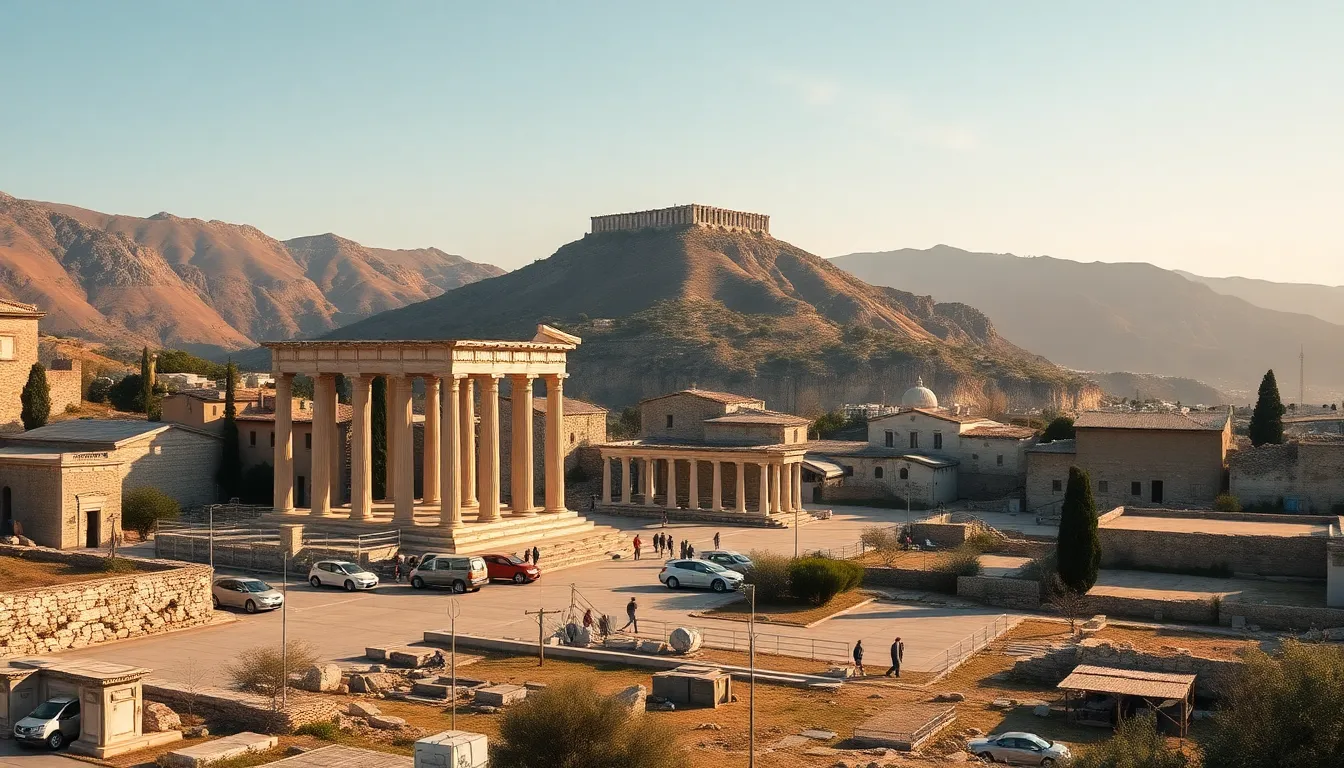
The first time a group really felt it was in Corinth. We were sitting near the bema, the stone platform where Paul was brought before Gallio, and one of the pastors traveling with me opened his Bible and read the verse from Acts 18 that names that exact proconsul. He looked up, looked at the platform, and said, “It’s right there.” That is the thing about Greece in the New Testament. It is not a backdrop. It is a list of addresses, and most of them are still standing.
People sometimes assume the New Testament is mostly a story of Galilee and Jerusalem. A surprising amount of it happens on Greek soil. Three of Paul’s missionary stops, the cities behind several of his letters, and the island where John received the Revelation all sit inside the borders of modern Greece. For a heritage group, that means you can take the text and turn it into an itinerary, almost line by line.
Let me map it out for you the way I would on the ground, city by city, with the scripture attached to each place.
Why Greece Holds So Much of the New Testament
When you ask where the gospel first crossed into Europe, the answer is Greece. Paul’s vision at Troas, the man of Macedonia saying “come over and help us,” sent him across the Aegean, and everything after that is written into Greek geography. Acts 16 through 18 reads almost like a travel log.
Then there are the letters. First and Second Thessalonians, both Corinthian letters, and Philippians are addressed to churches Paul planted in Greek cities. When you stand in those cities and read those letters, the local detail in the text suddenly makes sense. And at the far edge of the New Testament, the Book of Revelation opens on Patmos, a Greek island in the Dodecanese.
So Greece is not a side trip for a Christian heritage group. It is a place where the text and the map line up better than almost anywhere else. Our guide to the spiritual sites of Greece lays out the wider picture, and this article zooms in on the specific New Testament references.
Neapolis and Philippi: The Gospel Enters Europe
The journey begins at the port. Neapolis, the modern city of Kavala, is where Paul first set foot on European ground after crossing from Troas (Acts 16:11). From there he walked inland to Philippi.
Philippi is the headline. This is the first place in Europe where the gospel was preached and the first European church planted. The ruins are extensive: the forum, the basilicas, and the traditional site of the prison where Paul and Silas sang at midnight before the earthquake (Acts 16:25). Just outside the city runs the river where Lydia, a seller of purple, became the first recorded European convert (Acts 16:14). Many groups hold a short service or a baptism renewal at the riverside baptistery there. I have watched people go quiet at that spot more times than I can count.
Philippi also gives you the letter. Paul’s epistle to the Philippians, with its call to “rejoice in the Lord always,” was written to this community. Reading it here, in the place it was sent, changes the way it sounds.
Thessaloniki and Berea: Two Letters and a Lesson
Heading west along the old Via Egnatia, you reach Thessaloniki. Paul preached in the synagogue here for three Sabbaths (Acts 17:2), and the visit ended in an uproar that pushed him on to Berea. Two of his letters, First and Second Thessalonians, are addressed to this community. Thessaloniki is a large, living city, not an archaeological park, so the New Testament layer sits underneath a modern metropolis. That layering is part of what makes it powerful.
Then comes Berea, the modern town of Veria, which rushed itineraries skip and shouldn’t. The Bereans “received the word with all readiness of mind, and searched the scriptures daily” (Acts 17:11). There is a monument here, the Bema of the Apostle Paul, with mosaics depicting his ministry. For any group that values honest study, Berea is meaningful ground, and I usually pause here longer than the schedule suggests.
Athens: Paul on the Areopagus
Athens is where the New Testament meets classical philosophy head on. Standing on the Areopagus, Mars Hill, in the shadow of the Acropolis, Paul addressed the philosophers and pointed them from their altar “to an unknown god” toward the God who made the world (Acts 17:22 through 31).
For your group, Athens is a study in contrasts. The Parthenon and the ancient agora are extraordinary on their own terms, and they frame the encounter exactly. Your people stand where Paul stood, surrounded by the temples he saw, and they understand in their bodies what he was up against and what he was offering.
A practical word for leaders: the rock of the Areopagus is smooth and slippery. For older travelers, take it slow and use the stairs. The view, and the moment, are worth the care.
Corinth and Cenchreae: Where Paul Settled and Wrote
Corinth is the longest stop in Paul’s Greek journey. He stayed eighteen months (Acts 18:11), worked as a tentmaker, and planted a church that would receive two of his most demanding letters.
The site rewards a careful visit. You can see the bema, the public platform where Paul stood before the proconsul Gallio (Acts 18:12), a detail that lets historians date the New Testament timeline. You can see the temple of Apollo, the agora, and the Acrocorinth towering above. When you read First Corinthians here, with its worries about a divided, distracted, cosmopolitan church, the letter makes complete sense, because you are standing in exactly that kind of city.
Nearby is Cenchreae, Corinth’s eastern port, where Paul had his hair cut off because of a vow (Acts 18:18) and the home of Phoebe, the deacon Paul commends in Romans 16:1. The harbor ruins are modest, but the connection to a named woman of the early church gives groups something concrete to hold.
Patmos: The Revelation
The last piece of the New Testament map in Greece sits offshore. John was “on the island that is called Patmos, for the word of God and for the testimony of Jesus” (Revelation 1:9), and there he received the visions that became the final book of the Bible.
The Cave of the Apocalypse, where tradition says John heard the voice “as of a trumpet,” is now a small chapel built into the rock. Above it stands the Monastery of Saint John the Theologian, a UNESCO World Heritage site. Patmos is a ferry ride and an extra day or two, so it usually becomes an extension rather than part of the core route. For groups studying Revelation, though, it is the one place that anchors the whole book.
How to Turn the New Testament Map Into an Itinerary
Here is the shape I recommend for a group that wants to cover the New Testament sites in sequence:
- Days 1 to 2: Arrive in Thessaloniki and visit the city’s sites. Use the north as your base.
- Day 3: Kavala (Neapolis) and Philippi, with the riverside service at Lydia’s baptism site.
- Day 4: Berea, then begin the drive south.
- Days 5 to 6: Athens, the Areopagus, the Acropolis, and the agora.
- Days 7 to 8: Corinth and Cenchreae, with time to read the Corinthian letters on site.
- Days 9 to 10 (optional): Ferry to Patmos for groups studying Revelation.
Eight days covers the mainland route comfortably. Add the Patmos extension if Revelation matters to your study. One detail worth folding into your planning early: with Heritage Tours, the group leader travels free when you bring fifteen or more participants. For a pastor building a congregation trip, that changes the math.
FAQ: Greece in the New Testament
Which New Testament books mention Greece?
Acts (chapters 16 through 18) narrates Paul’s travels through Philippi, Thessaloniki, Berea, Athens, and Corinth. The letters of Philippians, First and Second Thessalonians, and First and Second Corinthians are all addressed to churches in Greek cities. Romans 16 names Phoebe of Cenchreae. And Revelation opens on the Greek island of Patmos. Greece runs through a large stretch of the New Testament.
Can you actually visit the places named in the New Testament in Greece?
Yes, and that is what makes Greece so rewarding for a heritage group. Philippi, ancient Corinth, the Areopagus in Athens, and the Patmos cave are all excavated, marked, and open to visitors. The cities Paul preached in are still here, many along a route you can travel in the order Acts describes.
What is the best order to visit the New Testament sites in Greece?
Travel north to south, the way Paul’s journey unfolds in Acts. Begin at Philippi and Thessaloniki in the north, move through Berea, then head south to Athens and finish at Corinth. Following the biblical sequence makes the whole trip cohere for your group.
Is Patmos worth adding for a Revelation study?
For a group focused on the Book of Revelation, yes. The Cave of the Apocalypse and the Monastery of Saint John the Theologian are the only sites that physically anchor the book. It requires a ferry and an extra day or two, so we usually build it in as an extension to the mainland route.
How long do you need to cover the New Testament sites in Greece?
Eight days covers the mainland route at a comfortable pace. Add two days for a Patmos extension. Rushing this itinerary is the most common mistake I see, and it costs your group the quiet moments at places like the river outside Philippi.
If you are starting to picture this journey for your congregation, I would be glad to help you build it. The text gives you the route, the sites are real, and the story tells itself once your people are standing in it. You can see how we structure these trips on our Greece heritage page or learn how the group experience works on our group heritage tours page.
Contact us whenever you are ready to start planning.