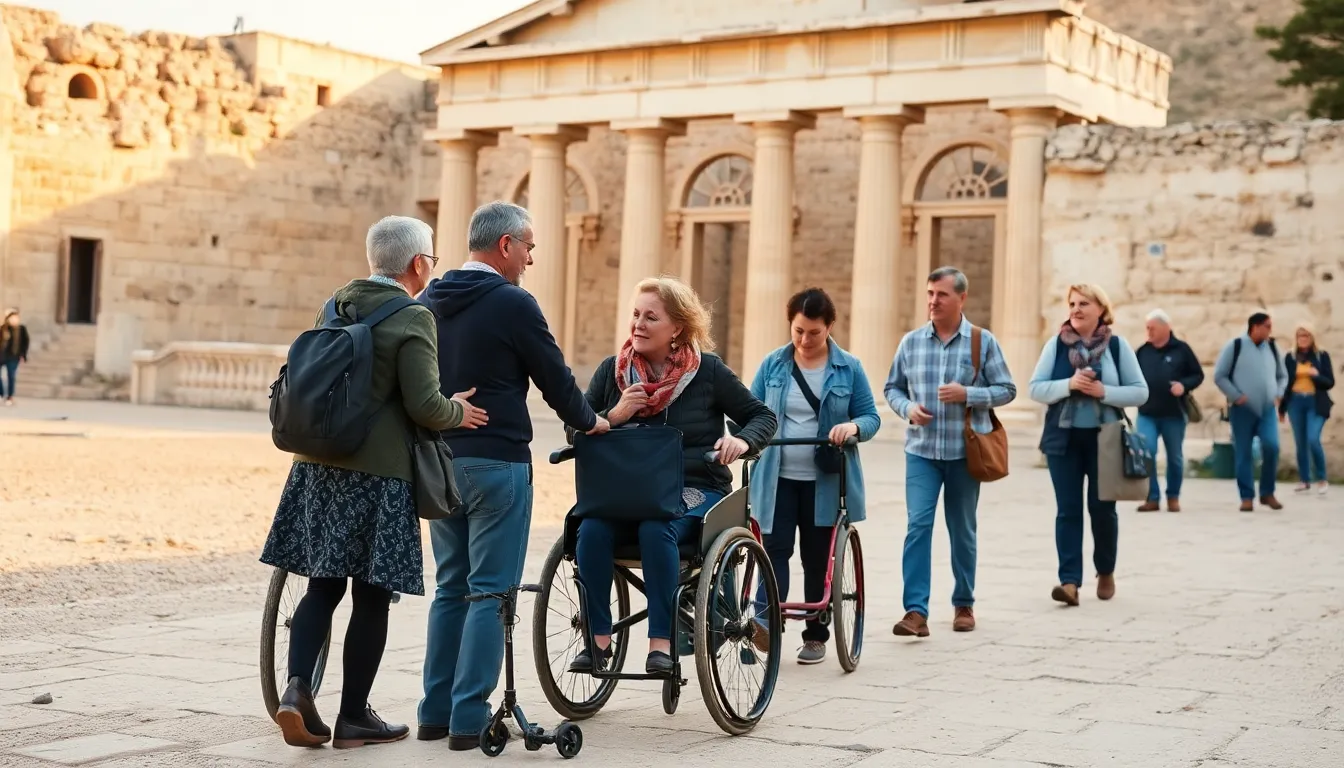
I will start with the thing other tour companies will not tell you: Greece is not an easy country for limited walkers. The ancient sites are uneven, the cobblestones are merciless, and a lot of the most famous places were built on hills for defense. I have led groups where someone in a wheelchair was effectively stranded at the bottom of a site while everyone else went up, and it is a terrible feeling for everyone involved. So I do not pretend. What I do instead is build itineraries that are honest about access, that choose sites a mobility-limited group can genuinely experience, and that never leave anyone watching from the parking lot.
This itinerary is for groups with members who use wheelchairs or walkers, who tire easily, who cannot manage long climbs or rough ground. That includes a lot of congregations, frankly, especially those traveling with older members. The goal is a real heritage trip, full of meaning, where the access has been thought through in advance so that the meaningful moments belong to everyone. Where a site genuinely cannot be made accessible, I say so plainly and we plan around it.
Here is a mobility-conscious route through Greece.
Days 1 and 2: Athens, With the Access Built In
Athens is the right place to start, and it has more accessibility than its reputation suggests, if you know where to look. The big one is the Acropolis, and here is the honest picture: there is a wheelchair lift on the north slope that carries visitors up to the top, and a paved path across the summit. It is not perfect, it can be out of service, and the top is still uneven in places, but it means a wheelchair user can reach the Parthenon. Most groups never know the lift exists. We book and confirm it in advance.
For members who would rather not attempt the Acropolis at all, the new Acropolis Museum is fully accessible, with ramps, lifts, and level floors, and it gives a richer understanding of the site than the climb does. The ancient agora below has some accessible paths, though the ground is mixed. We spend day two moving at a pace that suits the slowest walker, with rest stops and shade planned into the schedule rather than improvised.
The principle for Athens, and the whole trip, is that we plan the access before we arrive, not on the spot.
Day 3: Corinth, One of the Kinder Sites
Ancient Corinth is one of the more accessible major heritage sites in Greece, and it is rich in meaning, which is why I build the trip around sites like it. The terrain is relatively flat and open, much of it manageable for walkers and, with care, for wheelchairs. This is where Paul lived for eighteen months and worked as a tentmaker, and the bema, the platform where he stood trial before Gallio, is reachable.
Because Corinth does not demand a climb, the whole group experiences it together, and that togetherness is the point. I would rather give a mobility-limited group a full, shared encounter with Corinth than a half-encounter with a site half of them cannot reach.
The Corinth Canal stop on the way back is fully accessible, viewed from the bridge, and gives everyone a shared moment that costs no one any effort.
Day 4: A Rest Day, Planned Not Improvised
For a mobility-conscious group, a true rest day is not optional, it is structural. I put one early, on day four, before the longer travel north. This is a slow morning, free time at an accessible hotel, perhaps a flat seaside promenade or an accessible coastal drive. The point is to bank energy. Groups with limited walkers who push through without rest days fall apart by the end of the trip, and the last sites, often the most meaningful, get lost.
Days 5 and 6: Thessaloniki, a Modern, Walkable City
Thessaloniki is one of the best heritage cities in Greece for a mobility-limited group, precisely because it is a modern working city rather than an archaeological hill. There are paved waterfront promenades, accessible cafes, benches, and a flat city center. Paul preached here and wrote two letters to this community, and the great early churches, the Rotunda and Hagios Demetrios, are at street level and largely accessible, unlike the hilltop ruins elsewhere.
The Rotunda, one of the oldest Christian buildings in the world, can be entered on the level. Hagios Demetrios is reachable. This is where a mobility-limited group gets to stand inside genuinely ancient sacred space without a fight. Thessaloniki also holds one of the great Jewish heritage stories in Europe, once called the Jerusalem of the Balkans, and the Jewish Museum is accessible. You can read more about the city in our 10-day heritage itinerary for Greece.
Two nights in one accessible hotel matters enormously here. One unpacking, one familiar room, no daily luggage transfers.
Day 7: Philippi and Lydia’s River, the Moment for Everyone
Philippi is the site I work hardest to include, because it is the emotional heart of a Greek heritage trip and it can be made to work for a limited-mobility group. The archaeological site itself is uneven, and I am honest with groups about which parts a wheelchair can reach. But the baptistery by the river, where tradition says Lydia was baptized, is a gentle, low-lying spot, and with planning the whole group can gather there.
This is where many groups hold a short service or a baptism renewal, and for a mobility-limited group, reaching this riverside together is often the most powerful moment of the trip. No one watches from the bus. Everyone is at the water. That is the standard I hold every accessible itinerary to.
Days 8 and 9: An Accessible Close
The end of the trip should be gentle. I close an accessible itinerary with sites and experiences that ask little and give much. Depending on the group, this is the accessible Acropolis Museum if we saved it, a flat coastal day, or unhurried free time and a farewell dinner at a step-free restaurant. We end on rest and on shared meals, not on a final exhausting push.
Sites I am honest about: Meteora, the cliff-top monasteries, and Mystras are largely inaccessible to wheelchairs and very hard for limited walkers, built on rock and reached by long stairways. I do not put a mobility-limited group through the disappointment of arriving somewhere they cannot enter. If a group is set on Meteora, we discuss honestly what is and is not possible before it goes on the plan.
How We Build Access Around Your Group
Every group’s needs are different. A group with one wheelchair user and several slow walkers plans differently from a group where most members are fully mobile and a few tire easily. We confirm accessible transport with lifts or ramps, accessible hotels with roll-in rooms where needed, and we scout the specific access at each site rather than trusting a website. Where a famous site genuinely cannot be reached, we are honest in advance and we find the meaning elsewhere.
One thing worth knowing as you plan: with Heritage Tours, the group leader travels free when you bring fifteen or more participants.
FAQ: Planning an Accessible Greece Heritage Trip
Is the Acropolis wheelchair accessible?
Partly. There is a wheelchair lift on the north slope that carries visitors to the summit, and a paved path across the top, though the surface is still uneven in places and the lift is occasionally out of service. We book and confirm it in advance. For members who prefer not to attempt it, the new Acropolis Museum is fully accessible and deeply rewarding.
Which Greek heritage sites are easiest for limited walkers?
Ancient Corinth is relatively flat and open. Thessaloniki is a modern, walkable city with street-level churches like the Rotunda and Hagios Demetrios. The Corinth Canal viewpoint and the Acropolis Museum are fully accessible. Lydia’s baptism river at Philippi can be reached with planning. We build the route around sites like these.
Which sites should a mobility-limited group skip?
Meteora and Mystras are the hardest, both built on rock and reached by long stairways, largely inaccessible to wheelchairs and very difficult for limited walkers. We are honest about this in advance rather than driving a group to a site they cannot enter, and we find equivalent meaning at accessible places.
Can you arrange accessible transport and hotels?
Yes. We arrange coaches with lifts or ramps, accessible hotels with roll-in rooms where needed, and we plan rest days and shade stops into the schedule. We scout the real access at each site rather than relying on what a website claims. The planning happens before the trip, not on the day.
Will members with limited mobility be left out of the meaningful moments?
No, and that is the whole standard of this itinerary. We choose sites and plan access specifically so the group experiences the meaningful moments together, especially the riverside at Philippi. Where a site cannot be fully reached, we plan around it so no one is watching from the parking lot.
If your congregation includes members who use wheelchairs or walkers, or who simply cannot manage the climbs, I would love to help you build a trip where the meaning belongs to everyone. Honest planning is the whole difference. See our Greece heritage page or learn how the group experience works on our group heritage tours page.
Contact us whenever you are ready to start planning.