Why England Is a Pilgrimage Destination, Not Just a Tourist One
England does not announce itself as a pilgrimage destination. It does not carry the immediate associations of Israel or Rome. But the story of Christian faith in the British Isles was built here, in cathedrals and on islands and along roads that pilgrims still walk today. And for Jewish faith travelers, England holds a heritage of witness that demands attention.
Canterbury has received pilgrims for over 800 years. Lindisfarne was the launching point for Christianity in northern Britain. Westminster Abbey has held daily worship for a millennium. These are not historical relics. They are living places of faith. When you bring a group here, you are not visiting a museum. You are joining something that is still underway.
For the pastor considering where to take a congregation next, England deserves serious thought. The spiritual sites here shaped an entire tradition of Christianity, and they are accessible, open, and welcoming to groups that come with genuine purpose.
Canterbury Cathedral: The Becket Shrine and the Pilgrimage Road
In 1170, four knights entered Canterbury Cathedral and murdered Archbishop Thomas Becket. The king, Henry II, had spoken in frustration about his troublesome priest, and the knights took those words as a command. Becket died on the floor of his own cathedral.
Within three years, Becket was declared a saint. Canterbury became the most important pilgrimage destination in England, and it has remained so for more than eight centuries. Chaucer wrote his Canterbury Tales about the pilgrims who walked this road. People still walk it today.
The spot where Becket fell is marked inside the cathedral. Standing there with your group, in the place where a man died for refusing to bend his faith to political convenience, is one of the most powerful moments available in English heritage travel. This is not an abstract story. The place is the story.
Canterbury is an active cathedral with daily services. Group visits require advance booking, and Heritage Tours coordinates schedules that allow your group meaningful time in the nave and at the Becket shrine without competing with general tourist traffic. For timing considerations, see our seasonal guide.
Westminster Abbey: Faith, Monarchy, and 1,000 Years of History
Westminster Abbey is many things at once. It is the coronation church of English monarchs, the burial place of kings and poets and scientists, a center of national ceremony, and, before all of that, a place of daily worship that has continued without interruption for a thousand years.
For a Christian heritage group, the weight of Westminster is in its layers. You walk past the tomb of Edward the Confessor, who founded the abbey. You stand where every English monarch since 1066 has been crowned. You pass the Poets’ Corner and the graves of Handel and Newton. And through it all, the community of monks and later clergy has maintained the rhythm of prayer.
A group visit to Westminster is not a walk-through. It is an experience that requires time and guidance. Heritage Tours arranges group access that includes time in spaces that general visitors pass quickly. The Chapter House, the medieval Cloisters, the College Garden. These quieter areas give a group the space to absorb what Westminster represents.
For a Jewish heritage group visiting Westminster as part of a broader England itinerary, the abbey provides essential context about the institution that governed the country through the expulsion and return of the Jewish community.
York Minster: The Largest Medieval Cathedral in Northern Europe
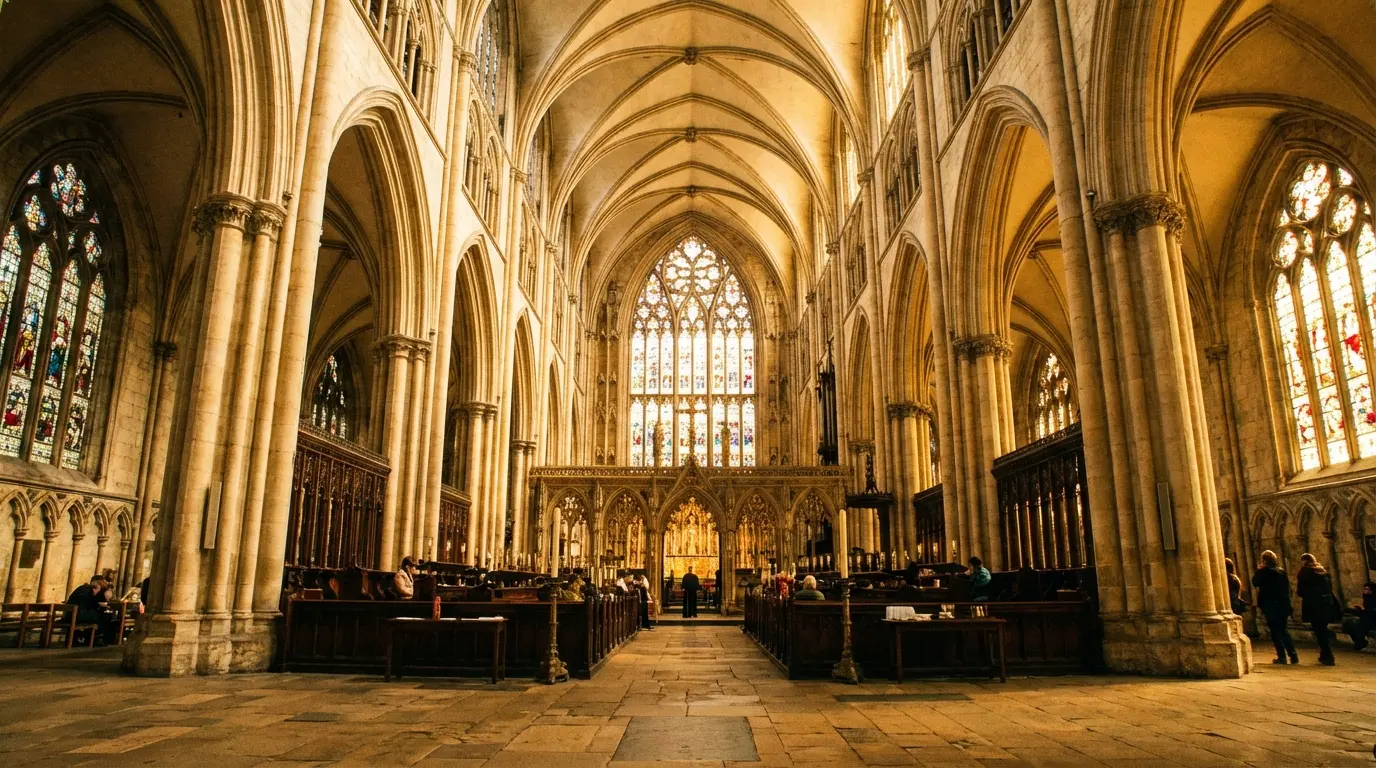
York Minster is not just large. It is overwhelming. The Great East Window, the largest expanse of medieval stained glass in the world, tells the story of the Bible from Genesis to Revelation in a single wall of light. The nave holds a silence that seems impossible for a space this size.
For a group leader, York Minster works on multiple levels. The architecture tells the story of medieval Christianity’s ambition and devotion. The stained glass windows are a visual theology, teaching the faith through color and light at a time when most people could not read. The Undercroft, beneath the Minster, reveals Roman and Viking foundations, placing the cathedral in the much longer story of York’s continuous habitation.
York Minster holds regular services, and Heritage Tours can arrange group visits that align with the cathedral’s schedule. The Minster is also within walking distance of Clifford’s Tower, which means that a day in York moves between the grandeur of Christian devotion and the weight of Jewish suffering. That juxtaposition is not comfortable, but it is honest, and it is one of the reasons York is essential on any heritage itinerary. See our full itinerary for how the York days are structured.
Lindisfarne (Holy Island): Where Christianity Came to Northern Britain
Lindisfarne is different from every other site on this list. It is not grand. It is not famous in the way Canterbury is famous. It is a small, wind-swept island off the Northumberland coast, accessible only by a tidal causeway that vanishes under the North Sea twice a day.
In the 7th century, the monk Aidan came from Iona to Lindisfarne and established a monastery. From this island, Christianity spread into northern England. The Lindisfarne Gospels, created here around the year 700, are among the most important illuminated manuscripts in Western civilization. The ruins of the medieval priory still stand on the island.
Getting to Lindisfarne requires planning. The causeway is passable only at low tide, and the crossing times change daily. Heritage Tours builds the visit around the tide schedule. There is no alternative.
What your group will find on the island is silence, simplicity, and the knowledge that faith took root here in a place that the world has mostly passed by. For a Christian pilgrimage group, Lindisfarne is one of the most sacred sites in Britain. For anyone willing to make the crossing, it is unforgettable.
Glastonbury: Layers of Faith, Legend, and History
Glastonbury is the most complicated site on this list, and it deserves honesty.
The Christian heritage is real and ancient. The ruins of Glastonbury Abbey are beautiful and moving. Tradition holds that Joseph of Arimathea brought Christianity to Britain here, and that the abbey was one of the earliest churches in the country. The Lady Chapel, even in ruins, still carries a sense of devotion.
But Glastonbury today is also a center of New Age spirituality. The Tor, the hill that rises above the town, attracts visitors with very different intentions than a Christian heritage group. The town’s shops and culture reflect this mix. A pastor bringing a congregation here should know what to expect.
This does not mean Glastonbury should be avoided. The abbey itself is a place of genuine spiritual weight. The legend of Joseph of Arimathea, whether historical or not, has sustained faith for centuries. But the leader who visits with open eyes, and who prepares their group for the broader culture of the town, will have a better experience than one who is surprised.
For Jewish Faith Travelers: Bevis Marks, York, and the Heritage of Witness
England’s Jewish spiritual sites carry a different weight. They are not places of pilgrimage in the traditional sense. They are places of witness, of memory, of a community that was present, then absent, then present again.
Bevis Marks Synagogue in London, in continuous use since 1701, is the anchor. Standing in a space where Jews have worshipped for over 300 years, unchanged since its construction, is itself a spiritual act. It is evidence that continuity survived.
Clifford’s Tower in York is the opposite. It is a place of destruction and mourning, where approximately 150 Jews died in 1190. Visiting it is an act of remembrance, not celebration. For a Jewish group, standing at Clifford’s Tower is a sacred obligation.
The medieval Jewish sites in Lincoln and the Hebrew manuscripts in Oxford’s Bodleian Library complete the picture: evidence of what Jewish communities built, what they lost, and what endured. For the full Jewish heritage story, see our dedicated guide.
FAQ: Planning a Faith Travel Itinerary in England
Is Canterbury Cathedral still an active pilgrimage site? Yes. Canterbury has been an active pilgrimage destination continuously since the 12th century. The cathedral holds daily services, and organized pilgrimage walks along the historic route are available. Heritage Tours arranges group visits that connect with the cathedral’s pilgrimage programming when timing allows.
Can a group attend a service at Westminster Abbey? Yes. Westminster Abbey holds daily services that are open to all. Attending a service is free and does not require the general admission ticket. Heritage Tours can schedule group visits that include attending Evensong or a morning service, which many groups find more meaningful than a standard daytime visit.
What is the story of Lindisfarne and why does it matter for Christian heritage travel? Lindisfarne is where Christianity established itself in northern Britain. The monk Aidan founded a monastery here in 635 AD, and the island became a center of learning and mission. The Lindisfarne Gospels were created here. The island’s isolation, its tidal access, and the continuity of its spiritual significance make it one of the most important Christian heritage sites in Britain.
Is Glastonbury appropriate for a Christian heritage group? Glastonbury Abbey has genuine Christian heritage and is appropriate for a heritage group. The town of Glastonbury has a broader spiritual culture that includes New Age elements. A prepared group leader will know what to expect and can guide the visit around the abbey and its Christian significance. Heritage Tours advises leaders on how to approach the visit.
Are there Jewish spiritual sites in England worth including in a faith itinerary? Absolutely. Bevis Marks Synagogue in London (in continuous use since 1701), Clifford’s Tower in York (site of the 1190 massacre), and the medieval Jewish sites in Lincoln are all significant. For a mixed-faith group, including these sites alongside Christian heritage sites creates a richer and more honest experience of England’s spiritual landscape.
If you are considering England for a faith heritage trip with your congregation, we would welcome the conversation. Learn more about Heritage Tours’ England programs.