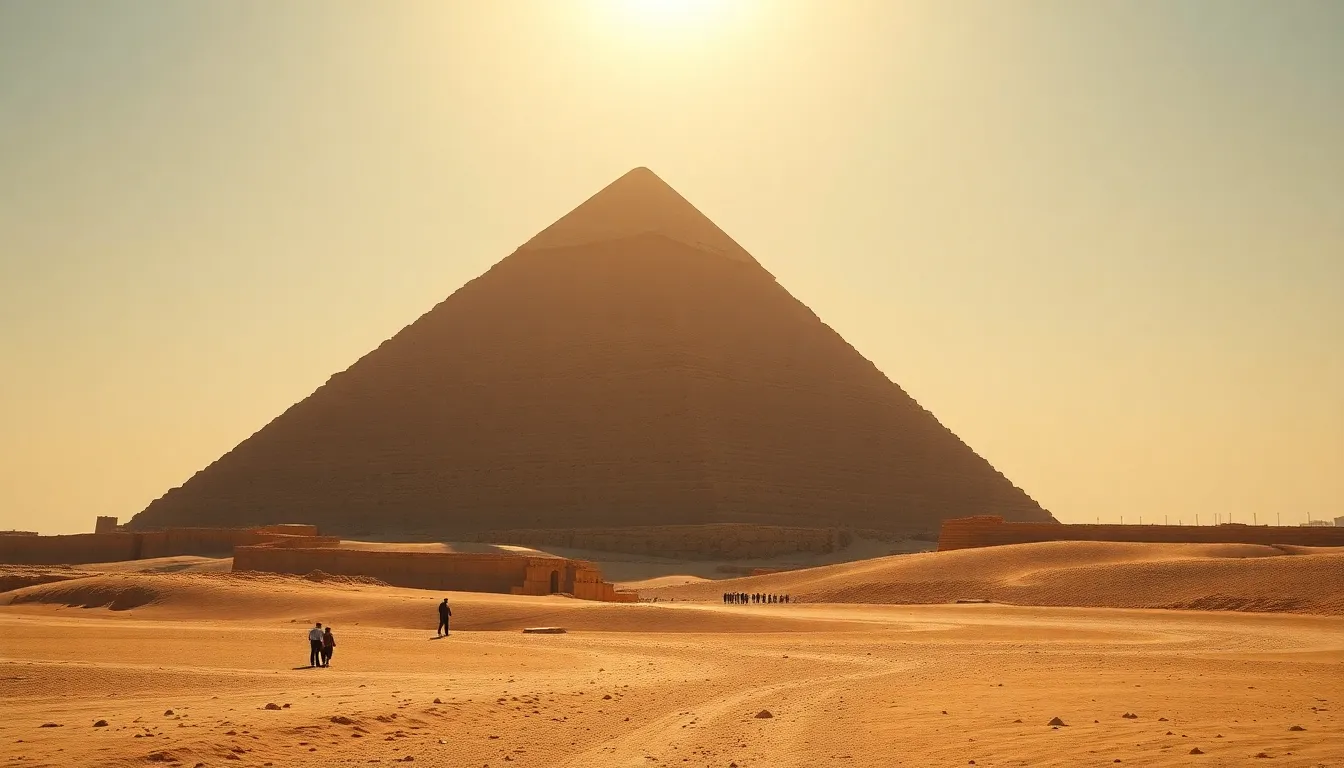
Most groups want to go straight to Giza. I understand the pull. The Great Pyramid is the Great Pyramid. But when I have a congregation with me for more than a day or two around Cairo, I take them first to Saqqara, to the Step Pyramid of Djoser. And I tell them the same thing every time: you are about to stand in front of the oldest large stone building on earth. Everything else you will see in Egypt, including the pyramids at Giza, begins here.
There is a particular quiet that settles over a group when that sinks in. We are so used to thinking of the pyramids as the beginning of human achievement that it surprises people to learn the pyramids themselves had a beginning, a first one, a moment when someone looked at a flat tomb and decided to build toward the sky. That moment is the Step Pyramid. For a faith group tracing the deep history of the world the Bible grew out of, Saqqara is where Egypt’s story of monument and eternity opens.
What the Step Pyramid Is
The Step Pyramid was built around 2670 BCE for the pharaoh Djoser of the Third Dynasty, during the period archaeologists call the Old Kingdom. It stands at Saqqara, the sprawling necropolis that served the ancient capital of Memphis, about an hour south of central Cairo. The pyramid rises in six great tiers to a height of around 60 meters, and at the time it was built it was the tallest structure humans had ever made.
What makes it the dawn of monumental Egypt is not just its age. It is the leap of imagination it represents. Before Djoser, Egyptian kings were buried in mastabas, low flat-roofed tombs of mud brick. The architect Imhotep took that idea and did something nobody had done before: he stacked mastabas of stone one on top of another, each smaller than the one below, building a staircase to the heavens. He worked not in mud brick but in cut stone, on a scale never before attempted. The Step Pyramid is the first monumental stone structure in human history. Everything in the history of architecture that involves large dressed stone descends, in a sense, from this.
Imhotep, the First Named Architect
I always make sure groups hear about Imhotep, because he is one of the most remarkable figures in human history and few visitors know his name. Imhotep was Djoser’s chief minister and the architect of the Step Pyramid. He is the first architect in history whose name we know. He was also revered as a physician, a sage, and a writer.
In the centuries after his death, Imhotep was so esteemed that he was elevated to the status of a god, one of very few non-royal Egyptians ever deified. To stand at his great work and know his name, more than 4,500 years later, is to feel the long reach of human memory. There is something fitting about that for people of faith, who carry their own ancient names forward across millennia.
Why Saqqara Matters for a Faith Heritage Group
The deep value of the Step Pyramid for a faith group is perspective, the kind that reframes the whole biblical timeline.
When a congregation comes to Egypt for the Exodus, they are thinking of a period around the 13th century BCE, the era of Ramesses and the great temples of Luxor. The Step Pyramid was already more than a thousand years old by then. Think about that. When Moses, in the tradition, confronted Pharaoh, the Step Pyramid was as ancient to that Egypt as the fall of Rome is to us. Egypt was an old, old civilization with a deep memory of its own greatness long before Israel’s story in Egypt began.
That perspective changes how a group reads the biblical narrative. The Egypt that Joseph rose to govern, the Egypt that enslaved and then released the Israelites, was not a young or primitive power. It was the most enduring civilization the world had yet seen, with monuments already ancient and a confidence built on millennia. The Bible’s claim that the God of a small, enslaved people humbled that empire becomes far more striking when you have felt, at Saqqara, just how immense and self-assured that empire was.
Saqqara also sits beside Memphis, the ancient capital where, in the biblical tradition, the events of Joseph’s rise and the Exodus court drama largely played out. Memphis itself is mostly gone, but its great necropolis at Saqqara remains, and standing here you are at the doorstep of the city where so much of the Genesis and Exodus narrative is set.
What You Actually See at Saqqara
Saqqara is more than the one pyramid, and a good visit takes in the whole site.
The Step Pyramid stands within a vast walled funerary complex, much of which has been restored. You enter through a reconstructed colonnade of tall stone columns, an architectural first in itself, into a great open court in front of the pyramid. The scale and the antiquity together do the work. People fall silent.
Around the main pyramid, Saqqara holds an extraordinary range of tombs. The mastaba tombs of nobles and officials contain some of the finest and best-preserved carved and painted reliefs in all of Egypt, scenes of daily life, farming, fishing, feasting, that bring the ancient world vividly close. Several of these tombs can be entered. There are also later pyramids at Saqqara, including ones containing the Pyramid Texts, the oldest religious writings in the world.
In recent years, Saqqara has been one of the most active archaeological sites in Egypt, with major new discoveries of sealed tombs, coffins, and artifacts. I love bringing groups to a place where the story is still being uncovered, where what they see this year might be more than what visitors saw a few years ago.
How Groups Visit the Step Pyramid
Saqqara sits about 30 kilometers south of Cairo and is usually combined with nearby Memphis and Dahshur, where the Red Pyramid and the Bent Pyramid stand. Together these make a full and rewarding day that I often place before the Giza visit, precisely so the group experiences the development of the pyramid in the order it actually happened: the Step Pyramid first, the experiments at Dahshur next, and the perfected Great Pyramid at Giza last. Walking that progression in sequence turns a series of monuments into a story.
Plan for around two hours at Saqqara itself, more if the group wants to enter several tombs and the pyramid’s interior, when it is open. The site is open desert, with walking on sand and uneven ground and very little shade.
Practical Access Notes
- Combine it well. Saqqara, Memphis, and Dahshur form a natural day trip from Cairo. A knowledgeable operator paces it so the group is not exhausted.
- Terrain is desert. Sand, uneven stone, and steps into tombs. Manageable for a mixed-age group at a measured pace, but good shoes are essential.
- Tomb interiors can be low, narrow, and warm. Lovely for those who go in, easy to skip for those who would rather not.
- Sun protection is non-negotiable. The site is exposed. Hats, water, and an earlier start make the visit far more comfortable.
- Photography rules vary by area and change periodically, so a guide who knows the current rules saves trouble.
For how Saqqara fits within a full Cairo and Memphis program, our Egypt heritage travel guide lays out the regions together.
Pairing Saqqara with the Wider Itinerary
The Step Pyramid pairs most naturally with Giza and the Egyptian Museum to tell the complete pyramid-age story, and with Memphis for the biblical capital connection. Many groups also use the Cairo days to reach the early Christian and Jewish heritage of Old Cairo. For congregations who want to go past the famous monuments, I weave in some of the hidden heritage sites in Egypt that most tours miss entirely.
And because Saqqara is open desert with real sun exposure, the season shapes the day a great deal. Our guide to the best time to visit Egypt for a heritage journey lays out the calendar with a faith focus.
FAQ: The Step Pyramid of Djoser
What is the Step Pyramid of Djoser?
The Step Pyramid is the oldest large stone building in the world, built around 2670 BCE for the pharaoh Djoser at Saqqara, south of Cairo. It rises in six tiers and was designed by the architect Imhotep. It marks the birth of monumental stone architecture and the beginning of the pyramid age that led to the Great Pyramid at Giza.
How old is the Step Pyramid compared to the Exodus?
The Step Pyramid was already more than a thousand years old by the time of the events traditionally associated with the Exodus, around the 13th century BCE. For a faith group, this drives home that the Egypt of the biblical story was an ancient, deeply established civilization, with monuments already old when Moses, in the tradition, stood before Pharaoh.
Who built the Step Pyramid?
It was built for Djoser by his architect Imhotep, the first architect in history whose name is known. Imhotep was also revered as a physician and sage, and was later deified, one of very few non-royal Egyptians ever raised to the status of a god.
Where is the Step Pyramid located, and how do groups visit?
The Step Pyramid is at Saqqara, the great necropolis of ancient Memphis, about 30 kilometers south of Cairo. Heritage groups usually visit it as part of a day trip combining Saqqara, Memphis, and the pyramids at Dahshur, often placing it before Giza so the development of the pyramid is experienced in historical order.
Is Saqqara worth visiting if we are already seeing Giza?
Yes. Saqqara shows the very beginning of the pyramid story, while Giza shows its peak. Visiting both, in order, turns a set of monuments into a clear historical progression. Saqqara is also less crowded than Giza, holds beautifully preserved tomb reliefs, and sits beside Memphis, the ancient capital tied to the Joseph and Exodus narratives.
Saqqara is where I like an Egypt heritage journey to truly begin, because it sets the scale for everything that follows. Standing before the oldest pyramid on earth, a congregation grasps just how ancient and immense the world of the biblical story was. If you are planning your community’s journey, this is a stop I will always make room for. Group leaders travel free with fifteen or more participants, and we handle every logistical detail.
Contact us when you are ready to begin. I would be glad to help you build it.