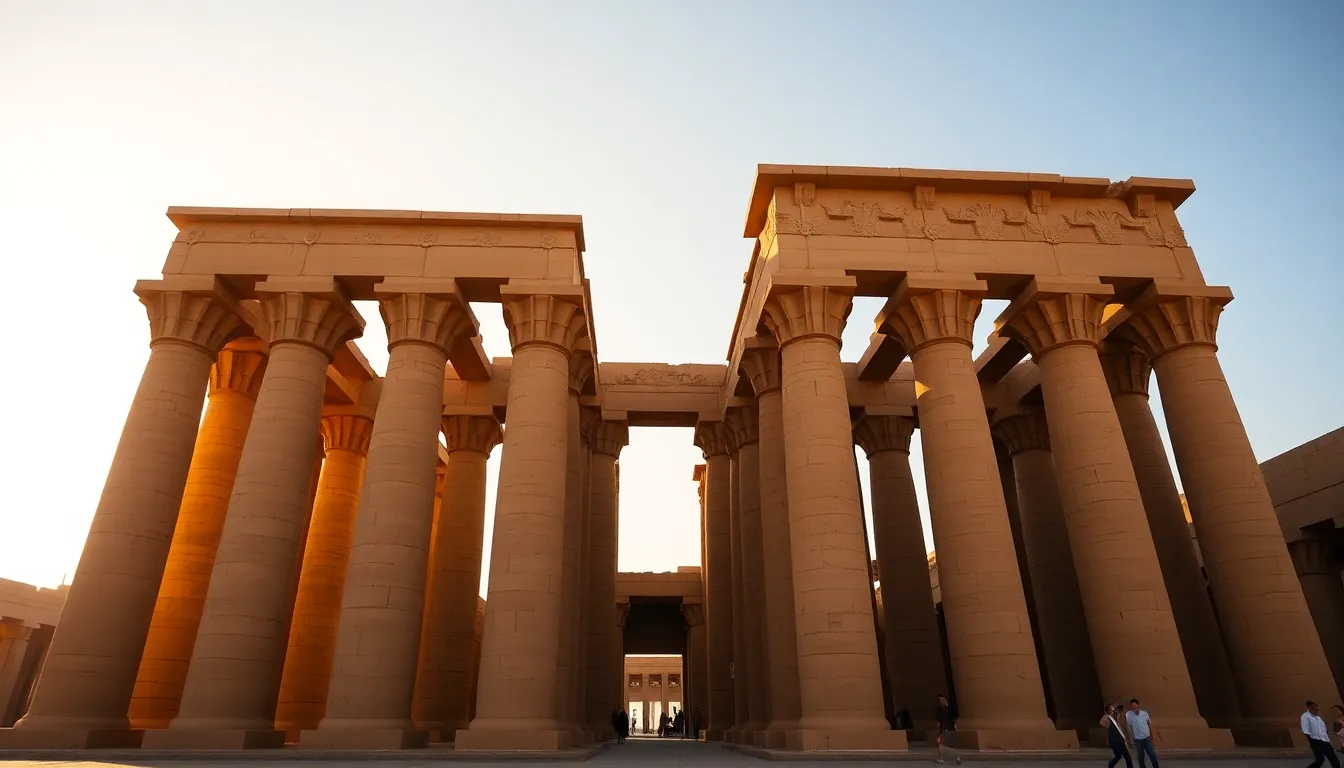
The first time I walked a group into the Great Hypostyle Hall at Karnak, a retired pastor in the front of the line stopped, looked up, and didn’t say anything for almost a full minute. When he finally spoke, all he said was, “I didn’t know stone could do this.” That is the reaction Karnak earns. It is not a building you tour. It is a place that puts you in your size.
I have brought faith groups to Karnak for years, and I want to tell you why it belongs on a heritage itinerary, not just a tourist one. Because the standard tour walks you through the columns, reads off some dates, and moves you to the bus. For a congregation tracing the world the biblical story unfolded in, Karnak is something more. This is the great temple of Thebes, the religious center of the Egypt that Israel knew, the place whose priesthood and power form the backdrop against which the Exodus story makes sense.
What Karnak Actually Is
People say “Karnak Temple” as if it were one building. It is not. Karnak is a vast complex of temples, chapels, pylons, obelisks, and sacred precincts that grew over roughly two thousand years. Pharaoh after pharaoh added to it, each one wanting to leave his mark on the home of Amun-Ra, the king of the Egyptian gods. The result is the largest religious building complex ever constructed in the ancient world. The main precinct alone, the Precinct of Amun-Ra, could hold several large cathedrals inside its walls.
To understand Karnak is to understand how central religion was to Egyptian power. The pharaoh was not just a king. He was the link between the gods and the people, and Karnak was where that link was maintained. The priesthood of Amun at Thebes became so wealthy and so powerful that, at certain points in Egyptian history, the high priest rivaled the pharaoh himself. When you stand in the complex and grasp its scale, you are seeing the physical expression of a religious system that dominated a civilization for two millennia.
The Great Hypostyle Hall
If Karnak has a heart, this is it. The Great Hypostyle Hall covers an area of about 5,000 square meters and contains 134 massive columns arranged in 16 rows. The twelve central columns stand around 21 meters tall, roughly the height of a six-story building, and their tops are wide enough that scholars have estimated dozens of people could stand on a single capital.
The hall was built primarily under Seti I and his son Ramesses II in the 13th century BCE. That detail matters for a faith group, and I will come back to it. Every surface of every column is carved, and originally all of it was painted in bright color. A few protected areas still hold their pigment. When I point those out, groups understand for the first time that this gray-brown forest of stone was once a riot of red, blue, gold, and green.
Why Karnak Matters for a Faith Heritage Group
Here is where I slow a group down, because the connection is real and it is worth sitting with.
The Bible names a pharaoh called Shishak. In 1 Kings 14 and 2 Chronicles 12, Shishak invades Judah in the fifth year of King Rehoboam, Solomon’s son, and carries off the treasures of the Temple in Jerusalem and the royal palace. This is one of the earliest points where the biblical narrative and Egyptian records touch the same event.
On the exterior wall of Karnak, near the Bubastite Portal, there is a relief commissioned by the pharaoh Sheshonq I, whom most scholars identify with the biblical Shishak. The relief shows the king smiting his enemies and lists the towns of his military campaign in the land of Canaan. Scholars still debate the details of the list and how exactly it lines up with the biblical account. But the basic fact stands: here, carved into stone at Karnak, is an Egyptian pharaoh’s own record of a campaign into the land of the Bible, in the era of the divided kingdom of Israel and Judah.
I have stood at that wall with groups and watched it land. The Bible is not describing a vague, mythical Egypt. It is describing this Egypt, the one with this temple, this priesthood, these kings who carved their victories into walls that still stand. Karnak is the Egypt of the biblical world made visible.
And then there is Ramesses II, the builder of the Hypostyle Hall, the pharaoh most often associated with the Exodus tradition. Whatever position your group holds on the dating of the Exodus, standing in a hall built by the pharaoh many connect to Moses is a powerful thing. You are inside the architecture of the very power that the Exodus story confronts.
How Groups Actually Visit Karnak
Let me be practical, because the difference between a good Karnak visit and a forgettable one is mostly logistics.
Karnak sits on the east bank of the Nile in Luxor, about 2.5 kilometers north of Luxor Temple, to which it was once connected by a long avenue of sphinxes. Most heritage itineraries that include the Nile Valley will base a group in Luxor for two or three nights, and Karnak is the centerpiece of the east bank day.
The single most important decision is timing. Karnak gets crowded and hot. I bring groups at opening, right when the gates open in the morning, before the large bus tours arrive and before the sun turns the open courts into an oven. An early entry means you can stand in the Hypostyle Hall with space around you and actually hear your guide instead of three other guides at once. For a faith group, that quiet is not a luxury. It is the difference between sightseeing and encounter.
Plan for roughly two to three hours at Karnak to do it properly. That allows time for the main precinct, the Hypostyle Hall, the sacred lake, the standing obelisk of Hatshepsut, and the walk out to the Shishak relief, which most general tours skip entirely. A guide who knows to take you there, and who can explain the biblical connection, is the whole point.
Practical Access Notes
A few things worth knowing before you go:
- Tickets are bought at the main entrance, and a knowledgeable operator handles this for the group so no one stands in line.
- Terrain is uneven in places, with some steps and a lot of open walking on stone. For a mixed-age congregation, this is manageable but not effortless. Good shoes and a slower pace matter.
- Shade is limited. Hats, water, and sun protection are not optional, especially outside the cooler months.
- The Sound and Light show runs in the evening. It is a separate experience and a matter of taste. Some groups love it for the atmosphere; others prefer to keep their Karnak memory to the daytime visit. I help groups decide based on their pace.
For the broader picture of how Karnak fits with the other east bank sites, our Egypt heritage travel guide lays out the Nile Valley together.
Pairing Karnak with the Wider Itinerary
Karnak rarely stands alone. The natural pairing is Luxor Temple, a short distance south, which makes a beautiful late-afternoon or evening visit when it is lit and cooler. Across the river on the west bank lie the Valley of the Kings and the mortuary temples, including the temple of Hatshepsut, whose obelisk you will have already seen standing at Karnak. Together these form the ancient city of Thebes, the religious capital that shaped so much of the world the Hebrew prophets spoke into.
For groups that want to go deeper than the famous monuments, I often weave in some of the hidden heritage sites in Egypt that most tours never touch. And the question of when to come matters enormously at a place like Karnak, where heat shapes the whole day. Our guide to the best time to visit Egypt for a heritage journey walks through the seasons with a faith calendar laid on top.
FAQ: Karnak Temple for Heritage Travelers
What is the biblical connection to Karnak Temple?
The clearest connection is the relief of Pharaoh Sheshonq I, identified by most scholars with the biblical Shishak, who invaded Judah in the time of King Rehoboam (1 Kings 14, 2 Chronicles 12). His campaign into Canaan is recorded on an exterior wall of Karnak near the Bubastite Portal. Karnak’s Great Hypostyle Hall was also built largely under Ramesses II, the pharaoh most often associated with the Exodus tradition, which gives the site deep resonance for faith groups.
How much time do you need to visit Karnak?
Plan for two to three hours to see Karnak properly, including the Great Hypostyle Hall, the sacred lake, the obelisks, and the Shishak relief that most general tours skip. Rushing it in under an hour, which many bus tours do, means missing what makes the site meaningful for a heritage group.
When is the best time of day to visit Karnak?
Early morning, right at opening. The complex gets crowded and very hot as the day goes on, and the open stone courts hold the heat. An early entry means cooler temperatures, fewer crowds, and the quiet that lets a faith group actually reflect rather than just file through.
Where is Karnak Temple located?
Karnak is on the east bank of the Nile in Luxor, in Upper Egypt, about 2.5 kilometers north of Luxor Temple. Most heritage itineraries base groups in Luxor for two or three nights, with Karnak as the centerpiece of the east bank day and the Valley of the Kings across the river on the west bank.
Is Karnak suitable for older travelers?
Yes, with awareness. The terrain is uneven with some steps and a lot of open walking on stone, and shade is limited. For a mixed-age congregation it is manageable at a measured pace with good shoes, hats, and water. We structure the visit so no one feels rushed and everyone can take the time they need.
Karnak is one of those places where the world of the Bible stops being an idea and becomes stone you can put your hand on. If you are thinking about bringing your congregation to Egypt, this is a site I will always build the Luxor days around. Group leaders travel free with fifteen or more participants, and we handle every logistical detail so your focus stays on your people.
Contact us when you are ready to start the conversation. I would be glad to help you build the journey.