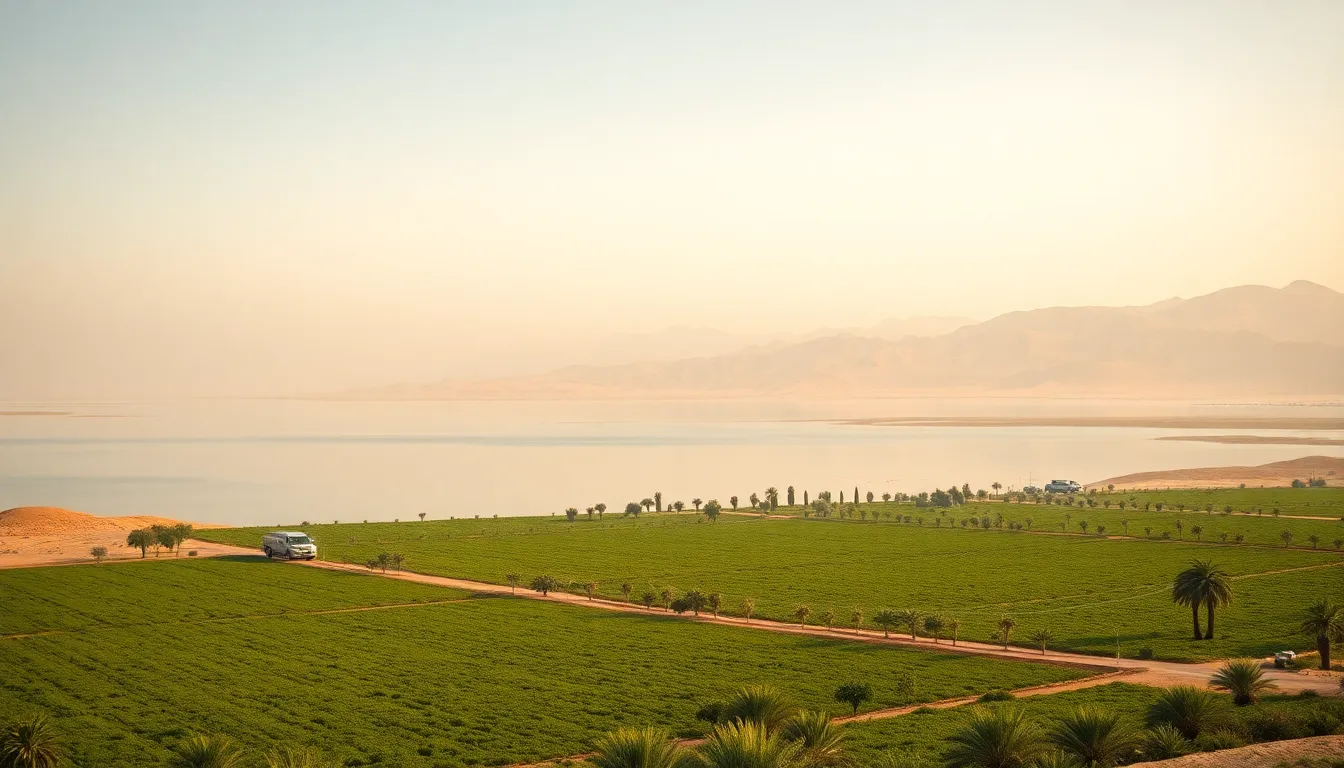
Most of the groups I have led to Egypt never hear the word Faiyum until I bring it up. It is not on the standard tourist circuit, and that is precisely why I love taking heritage groups there. The Faiyum is a great green depression in the desert southwest of Cairo, fed by a branch of the Nile, and it holds layers of history that speak directly to a faith traveler: the desert fathers who invented Christian monasticism, monasteries still praying after sixteen centuries, and a landscape that local tradition has long tied to the story of Joseph. It is quiet, it is rooted, and it gives a group something the famous sites cannot. Let me show you why I include it.
A Different Kind of Heritage Ground
The Faiyum sits about a hundred kilometers southwest of Cairo, an easy day trip or a worthwhile overnight. Unlike the Nile Valley proper, it is not a thin strip of green along a river. It is a broad basin, watered by the Bahr Yusuf canal and centered on Lake Qarun, one of Egypt’s oldest lakes. The land is fertile, the pace is slow, and the modern tour buses mostly pass it by.
For a heritage group, that very obscurity is part of the gift. The Faiyum lets you step out of the crowds at Giza and the museums of Cairo and stand in a landscape where the early Christian centuries are still tangibly present, where monks still live the life the desert fathers began, and where the deep agricultural history of Egypt, the history the Joseph narrative is set inside, is right under your feet.
The Bahr Yusuf: Joseph’s Canal
The canal that brings Nile water into the Faiyum has been called Bahr Yusuf, the Waterway of Joseph, for centuries. The name reflects a long-standing local tradition that connects the engineering of the Faiyum’s water system to the biblical Joseph, the Hebrew who rose to govern Egypt and managed its grain through seven years of famine.
I am careful with my groups here. The historical and archaeological record does not let us prove that the biblical Joseph dug this specific canal, and the waterway’s documented history is long and complex. What I tell groups is the honest and still powerful truth: the name itself is a witness. For generation after generation, the people of this land have looked at the system that turns desert into farmland and attached the name of Joseph to it. The Joseph story is fundamentally a story about Egyptian agriculture, grain storage, and surviving famine. Standing in the Faiyum, looking at canals and granary country, you are standing inside the world that story takes place in. That is the kind of resonance I want a heritage group to feel.
The Cradle of Christian Monasticism
If the Faiyum’s connection to Joseph is a matter of tradition and resonance, its connection to early Christianity is a matter of documented history. The deserts around the Faiyum and the wider region of Middle Egypt are where Christian monasticism was born. This is one of the most important and least understood facts in Christian heritage, and I make sure every Christian group I bring here grasps it.
The Desert Fathers and Where the Whole Tradition Began
In the third and fourth centuries, men and women withdrew into the Egyptian desert to pray, to fast, and to seek God in solitude and community. Saint Anthony the Great, often called the father of monasticism, went into the desert east of the Nile. Saint Pachomius, in the region of Upper Egypt, organized the first communal monasteries with a written rule. From these Egyptian beginnings, the entire monastic tradition of the Christian world spread outward.
This is the part that stops Christian groups in their tracks. When you visit a monastery in Italy, in Ireland, in the hills of California, you are visiting a tradition that was invented here, in the Egyptian desert. The Faiyum and its surrounding deserts are not a footnote to that story. They are its homeland. I have watched pastors stand at the edge of this desert and understand, for the first time, where a thousand years of their own church’s spiritual practice actually came from.
The Monasteries of the Faiyum
The Faiyum region holds ancient Coptic monasteries that have been continuously inhabited for many centuries. The Monastery of the Archangel Gabriel, known as Deir al-Malak, sits on the desert ridge with sweeping views over the basin. The Monastery of Saint Samuel the Confessor, deeper in the desert south of the Faiyum, is one of the most atmospheric living monasteries in Egypt, still home to a community of monks living a rhythm of prayer largely unchanged for sixteen hundred years.
Visiting a living monastery is different from visiting a ruin. There are monks here. There is liturgy. There is the smell of incense and the sound of chanting in Coptic, a language descended from the speech of the ancient Egyptians. When a Christian group sits in one of these churches, they are not looking at history behind glass. They are sitting inside a living continuation of the earliest centuries of their faith. I prepare groups before these visits so they understand the etiquette, the significance, and the depth of what they are entering.
The Ancient and Greco-Roman Layers
The Faiyum’s heritage runs deeper still, into the ancient Egyptian and Greco-Roman past, and these layers matter for a group trying to understand the full sweep of the land.
Karanis and the Faiyum Portraits
The Faiyum was a thriving region in the Greco-Roman period, after Alexander’s conquest brought Greek settlers into Egypt. The ruined town of Karanis preserves the remains of houses, granaries, and temples from that era. It was here and in nearby sites that archaeologists found the famous Faiyum mummy portraits, strikingly lifelike painted faces of ordinary people, attached to their mummies. These portraits show us the actual faces of the people who lived in Egypt in the early Christian centuries, the world into which Coptic Christianity was born.
For a heritage group, these faces are quietly moving. They are not kings or gods. They are merchants, mothers, and craftsmen of the very period when the New Testament church was spreading through Egypt. Looking into those painted eyes collapses the distance between the present and the first Christian centuries in a way that statues of pharaohs never quite do.
A Landscape of Deep Time
The far reaches of the Faiyum hold even older wonders. Wadi al-Hitan, the Valley of the Whales, is a desert landscape filled with the fossilized skeletons of ancient whales, a reminder that this desert was once an ocean floor. It is a striking thing to stand in, and for groups inclined to reflect on the deep age of creation, it adds a contemplative dimension to the journey. I leave the theology of it to each group’s own leaders, but the landscape itself invites wonder.
How the Faiyum Fits a Heritage Itinerary
The Faiyum is close enough to Cairo to work as a day trip and rich enough to justify an overnight. Here is how I use it.
For most groups, I build the Faiyum in as a contrast and a depth stop. After the intensity of Cairo, the Giza pyramids, the Egyptian Museum, the Coptic and Jewish heritage of Old Cairo, the Faiyum offers a quieter, more reflective day. It pairs naturally with the Coptic heritage thread that runs through any good Egypt faith itinerary, deepening the monastic story that begins in Old Cairo’s ancient churches. Our Egypt heritage travel guide lays out how these threads connect across the whole country.
For groups with a strong Christian or monastic focus, I sometimes build a longer Faiyum and desert monasteries segment, connecting it to the broader story of the desert fathers. And for groups tracing the Joseph and patriarchal narrative specifically, the Faiyum’s agricultural landscape and its Joseph’s Canal tradition make a meaningful addition.
Practical Notes for a Group Visit
The Faiyum is rural and uncrowded, which is wonderful, but it means planning matters. Let me answer the common questions.
How do we get there and how long does it take? The Faiyum is about a two-hour drive from central Cairo. As a day trip it makes a full and satisfying day. With an overnight, you can reach the more remote monasteries and the desert sites without rushing. Our team handles all transport so the group moves together.
Is it physically demanding? Mostly no. Monastery visits and Lake Qarun are gentle. The more remote desert sites, such as Wadi al-Hitan, involve some walking on uneven ground, which we plan around the group’s mobility.
What about visiting the monasteries respectfully? Living monasteries have customs around dress and conduct, and we brief every group in advance. The monks are welcoming to respectful visitors, and a well-prepared group has a richer and more genuine encounter.
Does the group leader travel free? With 15 or more participants, yes. The group leader’s trip is fully covered, which makes adding a Faiyum segment to your itinerary straightforward for your congregation.
FAQ: The Faiyum Heritage Region
What is the Faiyum and why does it matter for faith travelers?
The Faiyum is a large fertile oasis southwest of Cairo, fed by a Nile branch called Bahr Yusuf, the Waterway of Joseph. It matters to faith travelers on two levels. Its water system carries a centuries-old traditional connection to the biblical Joseph and Egypt’s agricultural history, and the deserts around it are the documented birthplace of Christian monasticism, with living Coptic monasteries that have prayed continuously for over sixteen hundred years.
Is the Bahr Yusuf really Joseph’s canal?
The canal has been called Bahr Yusuf, the Waterway of Joseph, for centuries, reflecting a long-standing local tradition tying it to the biblical Joseph who managed Egypt’s grain through famine. The historical record does not let us prove the biblical Joseph engineered this exact waterway, and its documented history is complex. The lasting value for a heritage group is the resonance: the Joseph story is about Egyptian agriculture and grain storage, and the Faiyum is exactly that kind of landscape.
Why is the Faiyum important in Christian history?
The deserts of the Faiyum and the wider region of Middle Egypt are the cradle of Christian monasticism. In the third and fourth centuries, the desert fathers withdrew here to pray in solitude and community, and from these Egyptian beginnings the entire monastic tradition spread across the Christian world. Living Coptic monasteries in the region still continue that tradition today, making the Faiyum a homeland of Christian spiritual practice.
Can you visit the Faiyum on a day trip from Cairo?
Yes. The Faiyum is about a two-hour drive from central Cairo and makes a full, satisfying day trip, especially as a quieter, more reflective contrast to the intensity of Cairo’s major sites. Groups wanting to reach the more remote desert monasteries or sites like Wadi al-Hitan benefit from an overnight, which allows the visit to unfold without rushing.
Is the Faiyum suitable for a faith group itinerary?
Very much so. The Faiyum adds depth to the Coptic and monastic thread of an Egypt heritage journey and offers a reflective change of pace after Cairo. It works as a day trip or a longer segment depending on your group’s focus, whether that is monasticism, the Joseph narrative, or simply a quieter encounter with Egypt’s living Christian heritage. We tailor the visit to your group’s interests and pace.
The Faiyum is the part of Egypt that most groups never see and the part that many remember most. It is where the noise drops away and the deep layers of the land come forward. You can see how it fits a full journey on our Egypt heritage destination page, or look at how we build group heritage tours.
When you are ready to talk about adding the Faiyum to your congregation’s itinerary, reach out. I would be glad to help you bring your people somewhere quieter, older, and deeper than the guidebooks go.