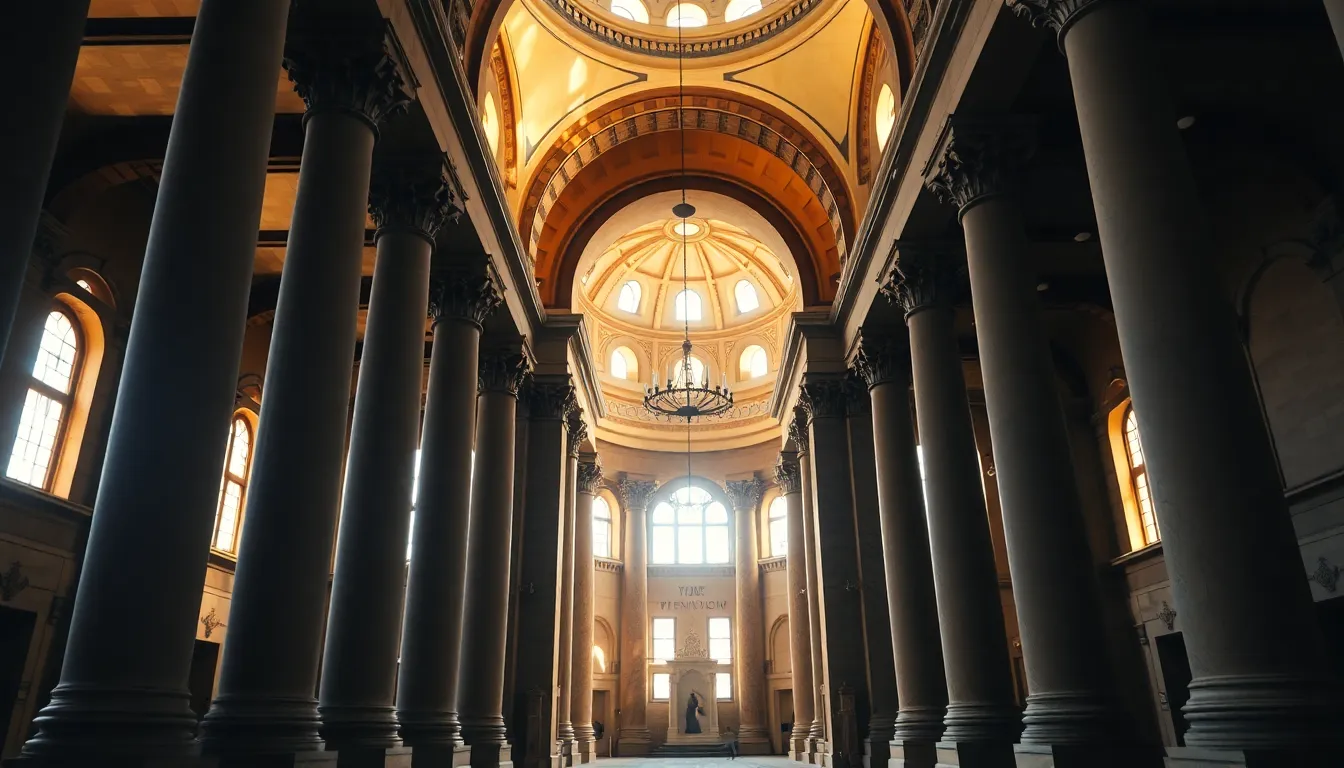
The thing that gets people about Eliyahu Hanavi is the size. You walk in expecting a synagogue and you find yourself standing in something closer to a cathedral, a vast hall of marble columns and high arches built to hold a community of thousands. And then the silence settles on you, because the hall is nearly empty, and you understand all at once that it was built for a congregation that no longer exists. I have watched that realization move across people’s faces many times. It is one of the most powerful moments in all of Jewish Egypt.
I have brought groups to Alexandria for more than twenty years, and Eliyahu Hanavi is always the center of that visit. This guide is for rabbis, educators, and Jewish heritage travelers who want to understand this remarkable synagogue, the community that built it, and what it means to stand inside it now that the community is gone.
A Synagogue Built for a Great Community
The Eliyahu Hanavi Synagogue, named for the prophet Elijah, stands on Nebi Daniel Street in the heart of downtown Alexandria. The present building was constructed in the mid-nineteenth century, around 1850, on the site of an earlier synagogue that tradition traces back to the fourteenth century, destroyed during the Napoleonic campaign. So the site itself has held Jewish prayer for many centuries, even though the structure you see is the nineteenth-century one.
And what a structure it is. The hall stretches long and high, lined with rows of tall marble columns, lit by chandeliers, with seating that once held a congregation in the thousands. The bimah, the ark, the women’s gallery above: everything is built on a generous scale, because the community that built it was large, confident, and prosperous. This was not a small congregation’s modest shul. It was the great synagogue of one of the most important Jewish communities in the Mediterranean world.
Recently Restored
For decades the building suffered from neglect and the slow decay that comes when a community is no longer there to sustain it. Then, in a project completed in 2020, the Egyptian government carried out a major restoration of Eliyahu Hanavi, stabilizing the structure, repairing the roof and the interior, and returning the hall to something close to its full grandeur. The restoration was a significant gesture, and it means that groups visiting today see the synagogue in genuinely good condition, which was not always the case in earlier years. Walking into a fully restored Eliyahu Hanavi is a very different experience than walking into a crumbling one, and I am grateful that current groups get to see it as it was meant to look.
The Rise of Jewish Alexandria
To understand the synagogue, you have to understand the community that filled it, and that story runs deep.
Alexandria had one of the oldest and most significant Jewish communities anywhere. From the city’s founding by Alexander in 331 BCE, Jews settled there in large numbers, and by the first century the Jewish population of Alexandria was enormous, a substantial fraction of the whole city. This was the Alexandria of Philo the philosopher and of the Septuagint, the Greek translation of the Hebrew Bible. We tell that ancient story in full in our guide to Jewish Alexandria, and it is worth reading, because the modern community that built Eliyahu Hanavi stood at the end of a line that stretched back more than two thousand years.
The community that constructed the present synagogue in the nineteenth century was the modern flowering of that ancient root. Alexandria in the late nineteenth and early twentieth centuries was a booming Mediterranean port, cosmopolitan and multilingual, and its Jewish community was at the center of the city’s commercial and cultural life. Jews from across the Mediterranean and the Levant settled there. They spoke French and Italian and Arabic and Ladino. They built businesses, theaters, schools, and great synagogues. Eliyahu Hanavi was their crown.
The Fall
And then, within a single lifetime, it was over.
At the start of the twentieth century, Alexandria’s Jewish community numbered in the tens of thousands. After the establishment of Israel in 1948 and the Suez Crisis of 1956, the pressure on Egypt’s Jews mounted quickly. Property was seized, businesses nationalized, families pushed toward emigration. The great community of Alexandria scattered to Israel, to France, to Italy, to the Americas. By the time of the 1967 war, almost nothing of it remained. Today the Jewish community of Alexandria has effectively vanished, and Eliyahu Hanavi stands as the last great monument to what was.
Standing in the Emptiness
This is where the size of the building becomes almost unbearable, and I mean that as the truest thing I can say about visiting. A synagogue built for thousands, beautifully restored, immaculately kept, and silent. The chandeliers are lit and there is no one to light them for. The women’s gallery looks down on empty rows.
I do not try to soften this for groups, because the honesty is the point. We stand in the hall and I let the silence do its work, and then we mark it. Many groups recite psalms together, or a memorial prayer, or simply stand and remember the community that built this place and prayed here for generations. To say Shema in that vast empty hall is to fill it, for a moment, with the sound it was built for. Groups carry that moment home with them. It is one of the things they talk about long after the trip ends.
Visiting Eliyahu Hanavi Today
The synagogue is open to visitors, and since the 2020 restoration it has become a more accessible and welcoming stop than it was in the difficult years before. As with all Jewish sites in Egypt, group visits and any kind of service or ceremony require advance coordination with the authorities who maintain the building, and security arrangements are part of the picture in Alexandria. This is firmly within the range of what heritage groups do regularly, with the right preparation.
Heritage Tours handles every piece of this: contact with the custodial authorities, the coordination and security arrangements that an Alexandria synagogue visit involves, the timing, and a guide who can tell the full story from Philo and the Septuagint through the rise and fall of the modern community. We pair the synagogue with the wider Jewish and ancient heritage of Alexandria so the visit lands as a complete story rather than a single stop.
To place this synagogue in the full arc of Jewish Egypt, read our main Jewish heritage guide to Egypt and the companion piece on Jewish Alexandria’s ancient heritage. You can also see how Alexandria fits into a full itinerary on our Egypt heritage destination page.
FAQ: The Eliyahu Hanavi Synagogue
How old is the Eliyahu Hanavi Synagogue?
The present building dates to around 1850, but it stands on a site that held an earlier synagogue traced by tradition to the fourteenth century, destroyed during the Napoleonic campaign in Egypt. So while the current structure is nineteenth-century, Jewish prayer on this site goes back many centuries. The synagogue is named for the prophet Elijah.
Was the synagogue restored?
Yes. The Egyptian government completed a major restoration of Eliyahu Hanavi in 2020, stabilizing the structure, repairing the roof and interior, and returning the great hall to close to its original grandeur. Groups visiting today see the synagogue in genuinely good condition, which was not the case during the decades of neglect before the restoration.
Why is the synagogue so large?
Because it was built for a great community. In the nineteenth and early twentieth centuries, Alexandria had a Jewish population in the tens of thousands, at the center of a booming, cosmopolitan Mediterranean port. The synagogue, with its rows of marble columns and seating for thousands, was the crown of that community. The scale feels striking today precisely because the community that filled it is gone.
What happened to the Jewish community of Alexandria?
After the establishment of Israel in 1948 and the Suez Crisis of 1956, mounting pressure on Egypt’s Jews, including property seizures and nationalization of businesses, drove the community to emigrate to Israel, France, Italy, and the Americas. By the late 1960s almost nothing remained. Today Alexandria’s Jewish community has effectively vanished, and Eliyahu Hanavi stands as its last great monument.
Can a heritage group visit and pray at Eliyahu Hanavi?
Yes, with advance coordination. The synagogue is open to visitors, and groups that wish to recite psalms or hold a brief memorial service can do so when arrangements are made ahead of time with the custodial authorities. Visits in Alexandria involve security coordination, which Heritage Tours arranges for every group along with timing and guidance.
If you are considering bringing your community to Alexandria, I would be glad to talk with you about what standing in that great hall can mean for a group. It is one of the most moving experiences in all of Jewish Egypt, and it deserves to be led with care. Reach out through our contact page whenever you are ready.