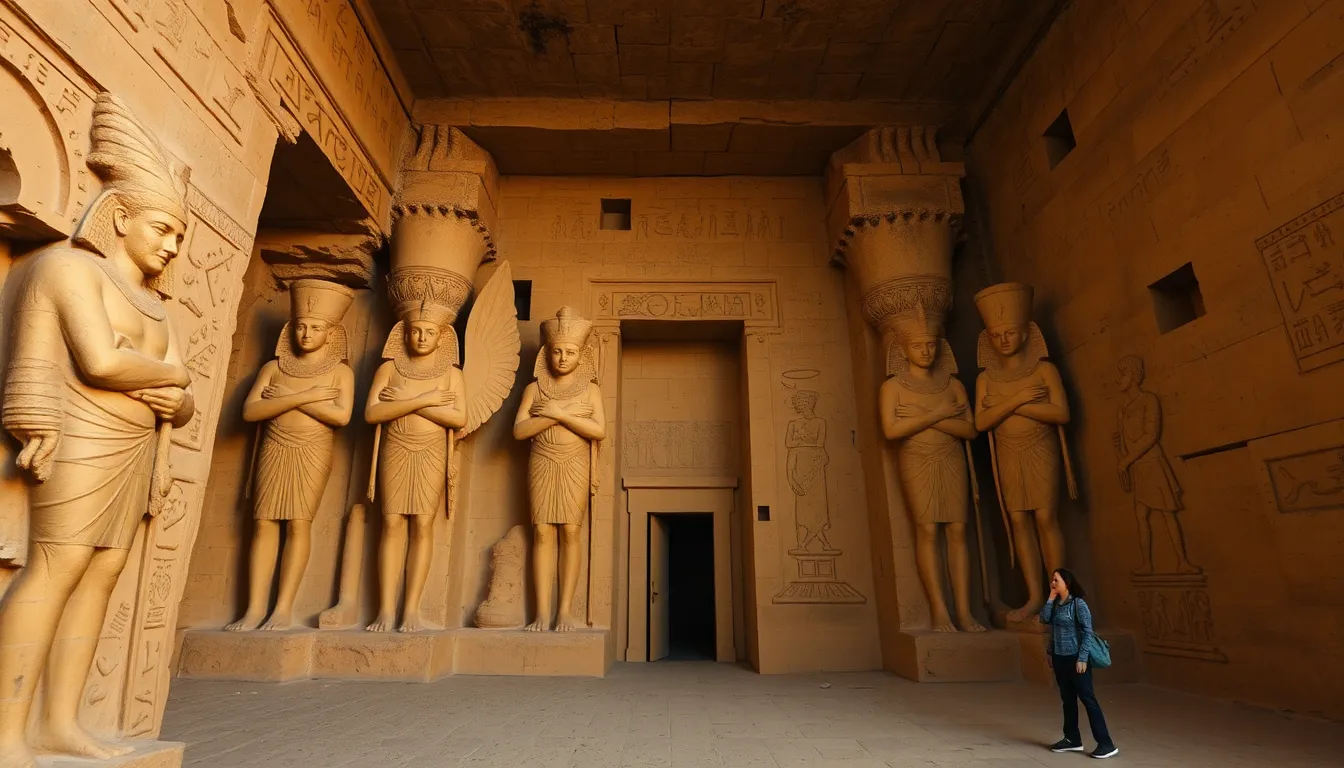
You descend into Kom el Shoqafa down a spiral staircase that wraps around an open shaft, the same shaft the ancient builders used to lower the bodies of the dead. The air cools as you go. The city noise of modern Alexandria fades above you, and you arrive, several stories underground, in a world where Egyptian gods stand carved in Roman dress and a Greek tomb wears the wings of Egyptian deities. I always pause a group at the bottom of those stairs, because the first thing I want them to feel is the strangeness of this place. Nothing else in Egypt is quite like it.
I bring faith groups to Alexandria when they want to understand the layered, cosmopolitan world the early church was born into, and the catacombs of Kom el Shoqafa are the single best place to feel it. This is a burial site where Egyptian, Greek, and Roman religion blend on the same walls. For a heritage group reading the New Testament, where Alexandria looms large, standing in this underground meeting of worlds is a quiet revelation.
What Kom el Shoqafa Is
Kom el Shoqafa, an Arabic name meaning “mound of shards,” is a large underground necropolis in Alexandria dating mostly to the 2nd century CE, the Roman period of Egypt. It was rediscovered in 1900, by tradition when a donkey fell through the ground into the buried complex. What was found is one of the most important burial sites in the Greco-Roman world, and one of the most unusual anywhere.
The catacombs descend on multiple levels, cut deep into the rock. They began, it seems, as a private family tomb and grew over time into a much larger communal burial complex, with hundreds of niches carved for the dead. There is a banqueting hall, the triclinium, where the living gathered to share memorial meals with their departed, reclining on stone couches as Romans did. And at the heart of it lies the principal tomb chamber, where the famous blending of cultures is carved into the stone.
A Tomb Where Three Religions Meet
This is what makes Kom el Shoqafa unforgettable, and what I make sure every group truly sees. In the central tomb, the imagery fuses three religious traditions on a single set of walls.
The Egyptian god Anubis, the jackal-headed guardian of the dead, is carved wearing Roman military armor. The bodies of figures are rendered in Egyptian style, stiff and frontal, while their faces and hair are Greco-Roman. The sacred Egyptian god Sobek appears alongside motifs straight out of classical mythology. Egyptian bearded serpents guard the entrance, wearing the double crown of Egypt, yet they hold a Greek symbol and a Roman one. It is not confusion. It is a deliberate, sophisticated blending, the work of a society in which Egyptian, Greek, and Roman religion lived side by side and intermarried in the imagination of the people who built it.
Scholars call this syncretism, the fusing of different religious systems into something new. Kom el Shoqafa is one of the clearest and richest examples of religious syncretism surviving anywhere in the ancient world.
Why Kom el Shoqafa Matters for a Faith Heritage Group
A group might ask why a pagan tomb belongs on a faith itinerary. The answer is Alexandria itself, and the world the early church grew up in.
Alexandria was one of the great cities of the ancient world, founded by Alexander the Great, home to the legendary Library, a center of learning, commerce, and faith where peoples and ideas from across the Mediterranean met. And it was profoundly important to both Jewish and Christian history.
Alexandria held one of the largest and most influential Jewish communities of the ancient world. It was here, in the 3rd and 2nd centuries BCE, that Jewish scholars translated the Hebrew Bible into Greek, producing the Septuagint, the version of the Scriptures quoted throughout the New Testament. The great Jewish philosopher Philo of Alexandria worked here, bridging Hebrew faith and Greek thought. When you walk Alexandria, you walk the city where the Scriptures first crossed into the Greek-speaking world.
Alexandria was just as central to early Christianity. By tradition, the church here was founded by Mark the Evangelist, and it became one of the most important centers of Christian thought in the world, producing towering early theologians. The Coptic Orthodox Church traces its roots to this city.
Here is why Kom el Shoqafa matters in that light. The syncretic, many-gods world carved into these walls is exactly the world that Alexandria’s Jews and Christians lived within and witnessed to. When the Septuagint proclaimed one God in Greek, it proclaimed it into this culture of blended deities. When the early Alexandrian church preached Christ, it preached into this exact spiritual marketplace. To stand in Kom el Shoqafa is to feel the religious environment that the people of the Bible navigated, argued with, and converted. The tomb shows you the world; the Scriptures show you the answer that emerged from it.
For a faith group, that contrast is powerful. You descend into a beautiful monument to many gods and many cultures fused together, and you understand, in your body, the courage of the communities that lived here and held to one God in the middle of it.
What You See at Kom el Shoqafa
The descent is part of the experience. You enter down the spiral staircase around the central shaft, passing the levels as you go. At the main level you reach the rotunda, the triclinium banqueting hall, and then the principal tomb with its carved syncretic figures. Lower levels, partly flooded in places, hold further burial niches.
Nearby, often visited in the same outing, is the Hall of Caracalla, a separate set of chambers connected to the complex. The whole site is dim, cool, and atmospheric, lit to show the carvings. It is a place that rewards a slow, attentive visit with a guide who can read the imagery, because much of the meaning is in details that are easy to walk past.
Plan for around an hour to an hour and a half underground. It is not a vast site like Karnak, but it is dense with meaning, and a good guide makes all the difference between seeing curious old carvings and understanding a whole vanished world.
How Groups Visit Kom el Shoqafa
Kom el Shoqafa sits in the heart of Alexandria, a city on the Mediterranean coast about three hours northwest of Cairo by road. Many heritage groups add Alexandria as a one or two-day extension to a Cairo-based program, and it is well worth it for groups interested in the early church and Jewish heritage.
The catacombs are almost always visited together with Alexandria’s other ancient sites, which lie close by: Pompey’s Pillar, the Roman amphitheater, and the modern Bibliotheca Alexandrina that honors the lost ancient Library. Together they make a rich Alexandria day rooted in the city’s layered faith history.
Practical Access Notes
- The descent is by stairs. A spiral staircase leads down several levels, and there are steps within the site. For travelers with mobility concerns this is the main consideration, and we flag it in advance so groups can plan.
- It is cooler underground, a welcome relief in warm months, but the air can feel close. Most travelers are very comfortable.
- Lower levels are sometimes wet or closed due to groundwater, so the exact extent open can vary.
- Photography rules change periodically and are sometimes restricted inside the tombs, so a guide who knows the current policy helps.
- Pair it with the Alexandria sites for a full day, and base in Alexandria or make it a long day trip from Cairo, which an operator can structure either way.
For how Alexandria fits a full faith itinerary, our Egypt heritage travel guide lays out the regions together.
Pairing Kom el Shoqafa with the Wider Journey
Alexandria and Kom el Shoqafa pair naturally with Cairo’s own early Christian and Jewish heritage, since the two cities together tell the story of the faith in Egypt across the centuries. Groups tracing the early church often combine an Alexandria extension with the Coptic and Jewish sites of Old Cairo. For congregations who want to go past the famous stops, I weave in some of the hidden heritage sites in Egypt, several of which, like the Cairo synagogues and the desert monasteries, deepen exactly this layered story of faith in Egypt.
And because an Alexandria extension takes planning around the rest of the itinerary and the season, our guide to the best time to visit Egypt for a heritage journey helps you frame the calendar.
FAQ: The Catacombs of Kom el Shoqafa
What are the catacombs of Kom el Shoqafa?
Kom el Shoqafa is a large underground necropolis in Alexandria, dating mostly to the 2nd century CE, the Roman period of Egypt. Cut deep into the rock on several levels, it is famous for tomb carvings that blend Egyptian, Greek, and Roman religious imagery on the same walls, making it one of the richest surviving examples of ancient religious syncretism.
Why is Kom el Shoqafa important for a faith group?
The site shows the blended, many-gods culture of ancient Alexandria, the very world in which the city’s large Jewish community produced the Septuagint, the Greek translation of the Hebrew Bible, and in which the early Christian church took root. Standing in the catacombs lets a heritage group feel the religious environment that the people of the Bible lived within and witnessed to.
What makes the carvings at Kom el Shoqafa unusual?
The carvings fuse three traditions. The Egyptian god Anubis appears in Roman military armor, figures have Egyptian-style bodies with Greco-Roman faces, and Egyptian serpents wear the crown of Egypt while holding Greek and Roman symbols. It is a deliberate, sophisticated blending of Egyptian, Greek, and Roman religion in a single tomb.
How do groups visit Kom el Shoqafa?
The catacombs are in central Alexandria, about three hours northwest of Cairo by road. Groups usually visit them as part of an Alexandria extension to a Cairo program, combined with nearby sites like Pompey’s Pillar, the Roman amphitheater, and the Bibliotheca Alexandrina. The visit takes roughly an hour to an hour and a half underground.
Is Kom el Shoqafa accessible for older travelers?
The main consideration is the descent: a spiral staircase leads down several levels, with steps inside the site. We flag this in advance so groups can plan. It is cooler underground, which is a relief in warm months, and most travelers are comfortable. Those who prefer not to manage the stairs can enjoy Alexandria’s above-ground sites instead.
Kom el Shoqafa is one of those places that quietly reframes how a group reads the New Testament. Descend into this underground meeting of three religions, and you understand the world Alexandria’s Jews and Christians spoke into with such conviction. If you are planning your congregation’s Egypt journey and want to reach the early church, an Alexandria extension is worth every hour. Group leaders travel free with fifteen or more participants, and we handle every detail.
Contact us when you are ready to begin. I would be glad to help.