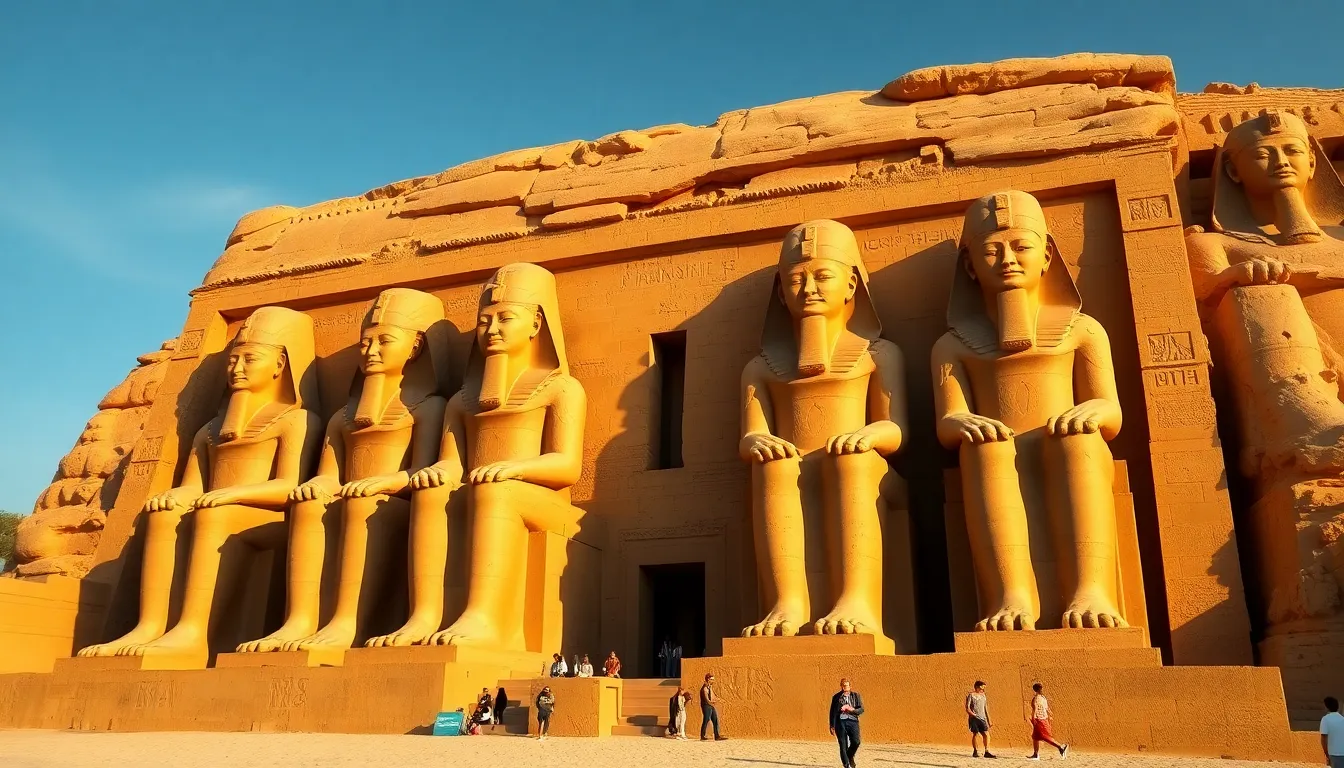
To reach Abu Simbel you get up in the dark. The convoy or the early flight from Aswan leaves before dawn, and there is always a little grumbling on the bus until the sun comes up over the desert. Then you arrive, walk around a rocky bluff, and four colossal figures of a single man, each more than 20 meters tall, are looking down at you from the face of a mountain. The grumbling stops. I have watched it happen dozens of times. People go quiet, then they reach for their cameras, then they put their cameras down and just look.
That single man is Ramesses II, and for a faith group there is no monument in Egypt that confronts the Exodus story more directly. This is the pharaoh many connect to Moses. These temples are his ultimate statement of his own power and divinity. To stand before them, as a person of faith reading the Exodus narrative, is to stand before the very pride that the story says God humbled. I will tell you how groups get here, what they see, and why it matters so much.
What Abu Simbel Is
Abu Simbel is a pair of massive rock-cut temples in the far south of Egypt, in ancient Nubia, near the modern border with Sudan. They were carved directly into a sandstone cliff in the 13th century BCE on the orders of Ramesses II, one of the longest-reigning and most powerful pharaohs in Egyptian history.
The Great Temple is fronted by four enormous seated statues of Ramesses himself, each over 20 meters high, flanking the entrance. Inside, the temple cuts deep into the mountain through a series of halls lined with more colossal statues and walls covered in reliefs celebrating the king’s military victories, especially the Battle of Kadesh, where Ramesses fought the Hittites. Everything about the Great Temple is designed to overwhelm, to communicate one message: this king is great beyond the measure of ordinary men.
Beside it stands the Small Temple, dedicated to the goddess Hathor and to Ramesses’s beloved queen, Nefertari. Its facade carries statues of the king and queen at equal height, an unusual honor for a queen, and it is one of the most graceful monuments in Egypt.
The Solar Alignment
There is one detail that astonishes every group. The Great Temple was engineered so that twice a year, the rising sun shines straight through the entrance, down the length of the temple, deep into the inner sanctuary, illuminating the seated statues of the gods and the deified Ramesses at the very back. The ancient builders aligned a mountain temple with the sun itself. That the precision of this alignment was largely preserved even after the temple was moved in modern times, which I will come to, makes it all the more remarkable.
Ramesses II and the Exodus Tradition
Here is where I slow a faith group right down, because this is the heart of why we come.
Ramesses II is the pharaoh most commonly identified, in popular tradition and in much scholarship, with the pharaoh of the Exodus, or at least the pharaoh of the oppression that precedes it. The biblical book of Exodus names one of the store cities the Israelites were forced to build as Raamses (Exodus 1:11), a name that points directly to this king. The era of Ramesses II, the 13th century BCE, is the period many associate with the events the Exodus describes.
I am always careful and honest with groups here. The dating of the Exodus is debated among scholars, and the Bible does not actually name the pharaoh of the Exodus. But the association with Ramesses is ancient and widespread, and the city name in Exodus genuinely connects to his reign. What is beyond dispute is this: Abu Simbel shows you, more vividly than any other site, exactly the kind of pharaoh the Exodus story confronts. A king who built temples to proclaim his own divinity. A king who placed statues of himself the size of cliffs. A king who, the inscriptions tell us, considered himself a god among men.
Read the opening chapters of Exodus standing in front of these statues and something shifts. The story claims that the God of an enslaved people brought low the proudest empire on earth and its god-king. At Giza or Luxor that claim is moving. At Abu Simbel, looking up at a man who carved his own face into a mountain so it would last forever, the claim becomes electric. This is the pride the story is talking about. This, in stone, is what the Exodus stands against.
For Christian and Jewish groups alike, that confrontation is unforgettable. The Exodus is not an abstract liberation. It is liberation from the rule of exactly this kind of power, and Abu Simbel lets your congregation see that power face to face.
The Rescue of Abu Simbel
The story of how these temples were saved is one I always tell, because it grips a group and it speaks to the work of preserving heritage.
When Egypt built the Aswan High Dam in the 1960s, the rising waters of the new Lake Nasser threatened to drown Abu Simbel completely. The temples had stood for over three thousand years, and they were about to disappear under the Nile forever. So the world acted. In one of the most ambitious heritage rescues ever attempted, an international team under UNESCO cut both temples out of the mountain, block by block, into more than a thousand massive pieces, some weighing 20 to 30 tons each.
They moved every piece to higher ground, about 65 meters up and 200 meters back, and reassembled the temples exactly as they had been, even rebuilding an artificial mountain behind them to recreate the cliff. The whole operation, completed in 1968, preserved the solar alignment almost perfectly. When you stand at Abu Simbel today, you are seeing the temples saved from the water by people who decided that this piece of human heritage was worth almost any effort to keep.
For people of faith, who carry an ancient memory forward across the centuries, that act of preservation resonates. We understand the impulse to refuse to let something sacred be lost.
How Groups Visit Abu Simbel
Abu Simbel takes commitment, and I tell groups that honestly. It sits about 280 kilometers south of Aswan, deep in the desert. There are two ways to reach it.
The first is by short flight from Aswan, an easy hop of under an hour, which lands you near the temples for a few hours before flying back. This is the gentlest option and the one I often recommend for mixed-age groups, because it removes the long road journey.
The second is by road, a desert drive of roughly three to four hours each way, traditionally departing very early in the morning. The early start is partly about heat and partly about arriving in the soft morning light, which is the most beautiful time to see the facade.
Either way, plan for around two hours at the temples themselves. That allows time for the Great Temple, the Small Temple of Nefertari, and the walk around the site, without rushing. Many groups combine Abu Simbel with their Aswan days, where the Temple of Philae also sits, making the far south a meaningful unit of the journey.
Practical Access Notes
- Choose your transport with care. For older travelers or those who tire on long drives, the flight from Aswan is worth the cost. We help each group weigh it.
- Start early either way. Heat in the far south is intense, and morning light on the facade is the best of the day.
- The site is exposed desert. Hats, water, and sun protection are essential. There is some walking on uneven ground and a few steps.
- Temple interiors are cut deep into rock, cooler and dim. Most travelers manage them comfortably.
- The twice-yearly solar alignment draws crowds on its dates. If those dates matter to your group, plan well ahead; if you want quiet, plan around them.
For how Abu Simbel and the southern Nile fit a full faith itinerary, our Egypt heritage travel guide lays out the regions together.
Pairing Abu Simbel with the Wider Journey
Abu Simbel pairs naturally with Aswan and the Temple of Philae, since both lie in the far south and both were saved by the same great UNESCO rescue from the rising Nile. Together they tell the story of Egypt’s southern frontier. Further north, the temples of Karnak and Luxor, also built in part by Ramesses II, complete the picture of this pharaoh’s reach across Egypt, so a group that sees Abu Simbel and then the Hypostyle Hall at Karnak grasps the full scale of his ambition.
For congregations who want to go beyond the headline monuments, I weave in some of the hidden heritage sites in Egypt that most tours never reach. And because the far south is genuinely hot, season matters: our guide to the best time to visit Egypt for a heritage journey walks through the calendar for faith groups.
FAQ: The Abu Simbel Temples
What is the connection between Abu Simbel and the Exodus?
Abu Simbel was built by Ramesses II, the pharaoh most often identified in tradition with the Exodus, or with the oppression that precedes it. The book of Exodus names a store city the Israelites built as Raamses (Exodus 1:11), pointing to his reign. The Bible does not name the Exodus pharaoh, and the dating is debated, but Abu Simbel vividly shows the kind of self-proclaimed god-king the Exodus story confronts.
Why was Abu Simbel moved?
The Aswan High Dam created Lake Nasser, whose rising water would have drowned the temples completely. In the 1960s, an international UNESCO-led effort cut both temples into more than a thousand massive blocks and reassembled them on higher ground 65 meters up, even rebuilding an artificial mountain behind them. The rescue, completed in 1968, preserved the famous solar alignment almost perfectly.
How do groups get to Abu Simbel?
Abu Simbel is about 280 kilometers south of Aswan. Groups reach it either by a short flight from Aswan, under an hour, which is the gentlest option, or by an early-morning desert drive of roughly three to four hours each way. Most heritage itineraries combine Abu Simbel with the Aswan leg of the journey.
What is the solar alignment at Abu Simbel?
The Great Temple was engineered so that twice a year the rising sun shines straight through the entrance and deep into the inner sanctuary, lighting the statues at the very back. The ancient builders aligned a mountain temple precisely with the sun, and the alignment was largely preserved even after the temple was relocated in the 20th century.
Is Abu Simbel worth the long journey for a faith group?
For groups focused on the Exodus, yes. No other site confronts the story so directly. Standing before four cliff-sized statues of the pharaoh many connect to Moses, a congregation sees in stone the very pride and power the Exodus narrative stands against. We help groups choose the transport, by flight or road, that fits their pace.
Abu Simbel is the place where the Exodus story stops being words on a page and becomes a face carved into a mountain, looking down at you. For a faith group, that confrontation is among the most powerful moments Egypt offers. If you are planning your congregation’s journey, this is a stop worth the early morning and the desert miles. Group leaders travel free with fifteen or more participants, and we handle every detail of getting you there.
Contact us when you are ready to begin. I would be glad to help.