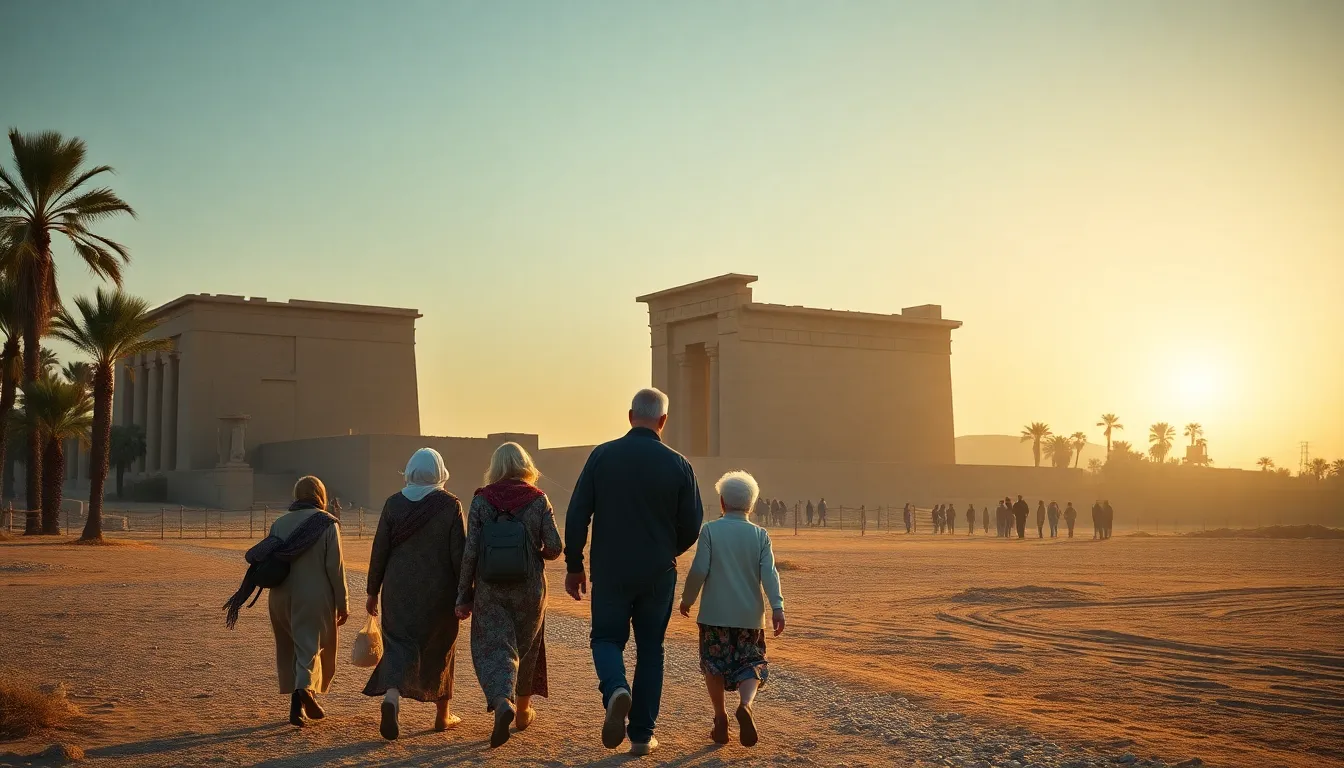
The most meaningful Egypt trips I have ever led were not the fittest groups or the most scholarly. They were the ones with three generations in them. A grandmother who had read the Haggadah for sixty years. Her son the cantor. And his eleven-year-old, who climbed into the Egyptian Museum bored and came out asking questions nobody could fully answer. When a whole family stands together in the land of Goshen, the story stops being something you teach the children and becomes something the family holds together.
But a multigenerational group needs a different kind of itinerary. You cannot run grandparents and middle schoolers on the same nine-hour days. You cannot assume everyone climbs. And you cannot let the youngest members drift while the adults have the deep moments. This itinerary is built for the mixed-age congregation: paced for the range of bodies in the group, designed so the children stay engaged, and structured so the reflection reaches everyone.
It is a gentler cousin of our 8-day heritage itinerary, redesigned around the real needs of a congregation that spans seventy years of age in one bus.
How I Build a Trip for Three Generations
Before the day-by-day, a few principles I hold to with mixed-age groups.
Shorter days, real rest. I cap active site time and build in genuine downtime, not “free time” that is really just a gap. Grandparents need to pace themselves, and children need to run.
Always an alternative. For every demanding element, there is a meaningful option for those who cannot or should not do it. Nobody sits in a hotel feeling left behind.
Give the kids a job. Children engage when they have a role. A question to answer at each site, a small journal, a thing to find. Bored kids are a planning failure, not a behavior problem.
One shared reflection a day. The whole group, every generation, gathers once a day for a single shared moment. That is where the trip lands as a family.
Day 1: Arrival in Cairo
Groups land at Cairo International, usually in the afternoon. No site on arrival day, and with a mixed-age group I mean that firmly. Everyone is tired, the youngest are overstimulated, and the oldest need to settle. Check in, eat together, rest early. Skip even the optional evening walk on this trip. The week is gentler than the standard itinerary, and it starts with real rest.
Recommended base: a comfortable hotel in or near Old Cairo with a pool, which matters more than you would think for the children’s energy, and central enough to keep transfers short for the older members.
Day 2: The Egyptian Museum, Half Day
We start at the Egyptian Museum on Tahrir Square, but with a multigenerational group I keep it to a focused half day. The full museum overwhelms children and exhausts grandparents. We go to a handful of rooms that matter, the New Kingdom rooms tied to the Exodus, the mummies, and a few showstoppers the kids will remember, like the treasures of Tutankhamun.
For the children, I assign a job: each finds one object and learns its story to share at dinner. It turns a museum from a march into a hunt.
The afternoon is rest at the hotel. Pool for the kids, quiet for the grandparents. This is not wasted time. It is what makes Day 3 possible for everyone.
Reflection moment. At dinner, the children share their museum objects. The whole group, every generation, hears the story through the eyes of the youngest.
Day 3: Coptic Cairo at a Walking Pace
Coptic Cairo is ideal for a mixed-age group because the most important sites sit within steps of each other, so nobody walks far. Ben Ezra Synagogue and the room of the Cairo Geniza. The Hanging Church, one of the oldest in Egypt. The crypt of Saints Sergius and Bacchus, tied to the Holy Family. Short distances, shade, places to sit.
For the children, this is where the trip gets personal. I tell them the Geniza story as a treasure: a hidden room, nearly a million documents, a thousand years of letters and lists and prayers. Kids understand a hidden room full of secrets. Then the adults can go deeper while the children are already engaged.
Reflection moment. Ask everyone, from the eleven-year-old to the grandmother: what would you put in a room to be found in a thousand years? The youngest answers are often the ones nobody forgets.
Day 4: The Land of Goshen, Gently
The Delta northeast of Cairo is the biblical land of Goshen, where the Israelites settled and labored. It is a calm day, flat green country, no climbing, no crowds. For a multigenerational group it is one of the easiest and most quietly powerful days. At the archaeological area near Tell el-Dab’a, we keep the walking light and the standing comfortable.
The Delta is where the family moment happens for many of my groups. There is no spectacle to compete with, just the land where the story says it all began. Grandparents who have carried this story their whole lives stand in it with their grandchildren. That is the whole point of bringing three generations.
Reflection moment. The grandparents speak. I ask the oldest members to tell the children, in their own words, why this story has mattered to them. The land does the rest.
Day 5: The Red Sea, a Travel Day Made Gentle
The drive from Cairo toward Suez takes about two hours. On a multigenerational trip I treat the travel day as part of the experience and keep it unhurried, with comfortable transport, stops, and snacks for the kids. We bring the group to the water and read the Song of the Sea from Exodus 15. For children, standing at the edge of the actual sea while the verse is read is the moment the story becomes real in a way no classroom ever made it.
This is a lighter day overall, ending with rest near the coast before the Sinai. The pacing is deliberate. The next two days ask more, and the group, all of it, needs to arrive ready.
Day 6: Saint Catherine’s and the Mountain, With Real Choices
This is the day that demands the most planning for a mixed-age group, and the day my “always an alternative” rule matters most.
The pre-dawn ascent of Mount Sinai is genuinely demanding. For the able and willing, including teenagers and fit grandparents, it is the high point of the trip, and I have brought people in their seventies to the summit. The Camel Path takes two to three hours in the cold, ending with the steep 750 Steps of Repentance.
For those who should not climb, there is no sitting it out alone. Saint Catherine’s Monastery, at the base of the mountain, is itself extraordinary: the burning-bush bramble in the courtyard, one of the world’s great icon collections, early biblical manuscripts, nearly 1,500 years of continuous monastic life. I build a meaningful morning at the monastery for the non-climbers, often with a guide, so that while one part of the group is on the summit, the other is having its own deep encounter at the base. Camel-assisted ascent is also available for part of the route, which brings the climb within reach of more members than you would expect.
Reflection moment. When the climbers come down, the whole group gathers at the burning bush and reads Exodus 3 together. The two halves of the group, summit and monastery, rejoin into one. Nobody was left behind.
Day 7: An Easy Day on the Sinai Coast
After Mount Sinai, every generation needs to exhale, and a mixed-age group needs it most. The drive to Nuweiba on the Gulf of Aqaba is short, and the day is deliberately easy: rest, the warm calm water, optional gentle snorkeling for the kids, conversation for the adults, an unhurried meal with the mountains behind you. This is the day grandparents and grandchildren end up sitting at the water together with nothing scheduled, which is often where the trip’s real bonding happens.
Day 8: Return to Cairo, Closing Circle, and Departure
Most groups fly home from Cairo, a return drive of four to five hours from the Sinai or a flight from Sharm el-Sheikh. I keep this last day light and end it with the closing circle that, for multigenerational groups especially, is the heart of the whole journey.
Gather all three generations. Read a passage about the journey from slavery to freedom, and let each person, from the youngest to the oldest, say one thing they are carrying home. Hearing an eleven-year-old and a grandmother answer the same question, in the same circle, after the same week, is the moment most family groups tell me they will never forget. Then flights depart from Cairo International.
Our Egypt destination page explains how we structure these journeys, our group heritage tours page covers the group leader experience, and the best time to visit Egypt guide is worth close reading for a mixed-age group, since cooler seasons make the Sinai climb far easier on every generation. Families wanting a shorter version often choose our 5-day Cairo and Sinai itinerary.
FAQ: Egypt Heritage Itinerary for Multigenerational Groups
Is Egypt a good heritage trip for families with children?
Yes, with the right pacing. Children engage deeply with Egypt when the days are not too long, when they have a role at each site, and when the story is told in a way that meets them. The Geniza as a hidden room of secrets, the Red Sea as the actual sea, the mountain as a real climb. We design mixed-age trips around keeping every generation present.
What if some members can’t climb Mount Sinai?
That is built into this itinerary. While the climbers ascend, non-climbers have a meaningful guided morning at Saint Catherine’s Monastery, with the burning bush, the icons, and the manuscripts. Camel-assisted ascent is also available for part of the route. Nobody sits alone in a hotel, and the whole group reunites at the burning bush.
How do you keep the pace manageable for grandparents and kids together?
Shorter active days, real rest built in, short walking distances at key sites like Coptic Cairo, comfortable transport on travel days, and a hotel with a pool. The week is gentler than our standard itinerary by design, so the oldest and youngest members can both thrive.
What ages does this itinerary suit?
It works well for groups spanning roughly age ten through eighties. Younger children can travel but need more flexibility, and we talk through that case by case. The sweet spot is a congregation with school-age kids, parents, and grandparents who want to experience the story as a family across generations.
How long should a multigenerational Egypt trip be?
Eight days, as laid out here, is a good balance: enough to reach the major heritage sites and Mount Sinai without exhausting the youngest or oldest members. Families wanting something shorter often choose the five-day Cairo and Sinai loop, which removes the longest travel days.
If you lead a congregation and you want to bring three generations through Egypt together, this is the journey I would build with you. Nothing makes a heritage trip land like a whole family standing in the story at once. Reach out when you’re ready, and let’s talk through how to make it work for every age in your group.