There is a version of this trip that finally makes the Exodus story feel whole. For years I led Egypt journeys that ended at Mount Sinai, and they were powerful, but they ended in the middle of the story. The Israelites did not stay at the mountain. They wandered. They crossed wildernesses. They came at last to the edge of the Promised Land, and Moses climbed Mount Nebo to see the land he would never enter.
Egypt and Jordan together complete that arc. You walk out of the land of slavery, you receive the commandments at the mountain, you cross the same wilderness the story crosses, and you stand where Moses stood looking across the Jordan. Add Petra, one of the wonders of the ancient world and a place woven through Nabatean and biblical history, and you have two weeks that move the way the narrative moves.
This is the combined journey I build for groups ready to give their community the full sweep. It extends our 8-day heritage itinerary eastward across the border, following the story rather than the map.
Days 1-2: Cairo, the Museum, and the Heritage Quarter
Groups arrive at Cairo International and settle on the first afternoon, with no site scheduled. Rest, a meal together, and an optional gentle walk near Khan el-Khalili.
The next day begins at the Egyptian Museum on Tahrir Square, in the New Kingdom rooms that scholars connect to the Exodus period. In the afternoon, Coptic Cairo: Ben Ezra Synagogue with the room where the Cairo Geniza was found, the Hanging Church, and the crypt traditionally tied to the Holy Family. Two stories, Jewish and Christian, in one quarter.
Reflection moment. In the museum garden, read the opening of Exodus. The land of slavery is where the two-week arc begins.
Day 3: The Land of Goshen
The Nile Delta northeast of Cairo is the biblical land of Goshen, where the Israelites settled and labored. At Tell el-Dab’a, Austrian archaeologists have uncovered evidence of a Semitic population in the eastern Delta during the relevant period. Archaeology is not literal proof of the text, and honest faith travel does not pretend it is, but it shows that the geography of the story is real. Standing in the flat green Delta, your group feels the ordinary human texture of the story before the journey out begins.
Reflection moment. Let your group say it plainly: this is where the labor happened. Here is where the story starts to move.
Day 4: To the Red Sea and Into the Sinai
The drive from Cairo toward Suez takes about two hours across desert the fleeing Israelites would have crossed. We bring the group to the water, read the Song of the Sea from Exodus 15, and let the place carry the words.
Then we cross into the Sinai, through the Suez Canal into granite mountains and ancient silence. The drive to the Saint Catherine’s area runs four to five hours through the interior, often with a pause at the oasis of Feiran, which some scholars identify with biblical Rephidim. Arrive at Saint Catherine’s for dinner, a briefing on the early ascent, and rest.
Day 5: Mount Sinai and Saint Catherine’s
The climb up Jebel Musa, the Mountain of Moses, begins around 2:00 or 3:00 a.m. to reach the summit by sunrise. The mountain rises to 2,285 meters (7,497 feet). The Camel Path takes two to three hours, ending with the steep 750 Steps of Repentance. It is demanding and the cold is real, and I have still watched people in their seventies reach the top and call it the most important morning of their lives.
Reflection moment. At the summit, Exodus 19:3, no commentary. Just the text, the place, and silence.
At the base, Saint Catherine’s Monastery has stood since the sixth century, with the burning-bush bramble in its courtyard, a remarkable icon collection, and early biblical manuscripts. The afternoon is for rest. In the story, the mountain is not the end. Tomorrow you begin the wandering.
Day 6: Across the Sinai to the Gulf of Aqaba and the Border
The drive north to Nuweiba on the Gulf of Aqaba takes about two hours along a coastline of granite mountains dropping into clear water. Some scholars locate the sea crossing here, so we take a quiet second moment at the water. Then we make the crossing into Jordan, by ferry across the Gulf of Aqaba to the Jordanian port city of Aqaba, or by the land border, depending on the group and the season. This is the literal hinge of the trip: you leave the Sinai wilderness and enter the land east of it, the way the story does.
Settle in Aqaba for the evening. The Red Sea here is calm and warm, and after the intensity of Sinai, the group needs an easy night.
Day 7: Wadi Rum and the Wilderness
Wadi Rum, an hour north of Aqaba, is the great desert wilderness of southern Jordan, vast red sandstone and open silence. For a faith group this is the landscape of the wandering, the kind of country the Israelites crossed for a generation. We take the group out among the rock formations, often with local Bedouin guides, and let the scale of the place do its work. This is not punishing emptiness. It is a wilderness with texture and beauty and a silence most group members have never encountered.
Reflection moment. In the open desert, talk about the forty years. The story is not only miracles. It is a long, ordinary, faithful walk through country exactly like this.
An evening in a desert camp under the stars is, for many groups, one of the unexpected high points of the whole two weeks.
Day 8: Petra, the Rose City
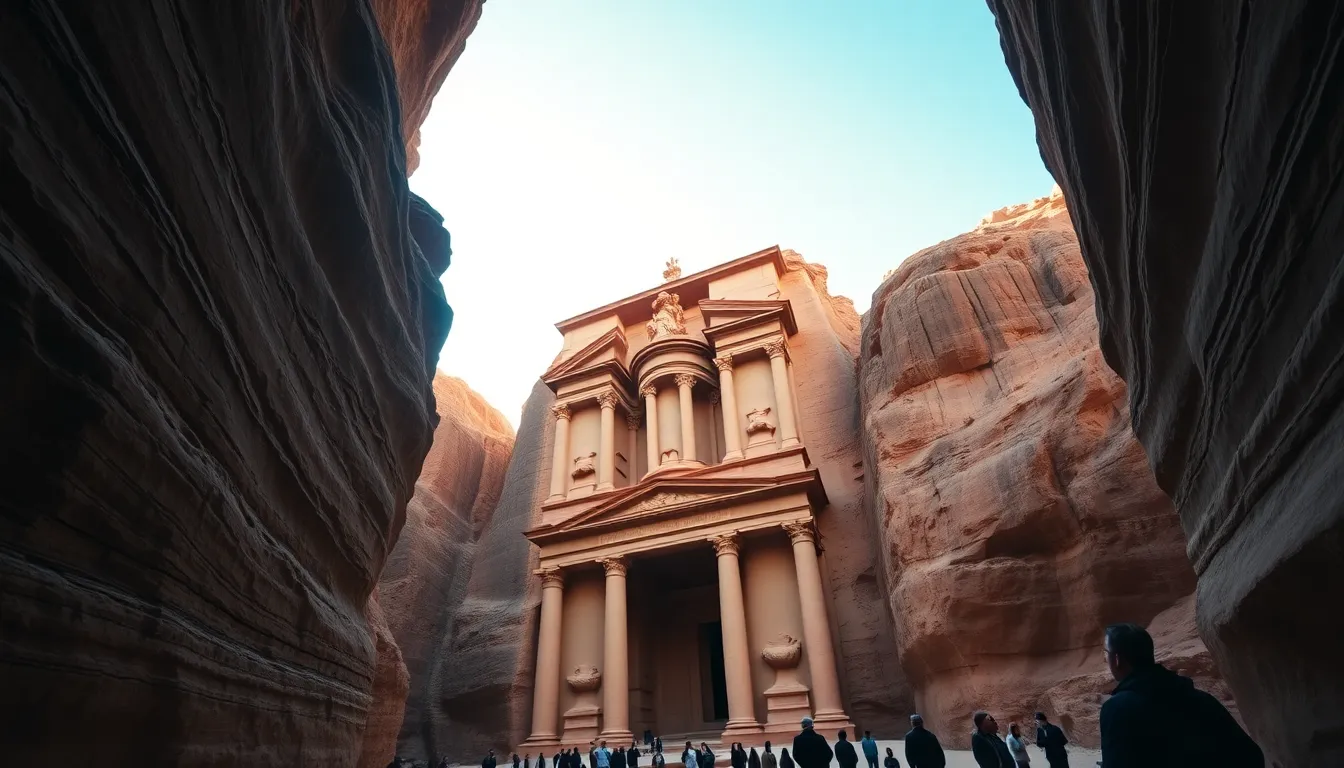
Petra deserves a full day, and I give it one. You enter through the Siq, a narrow canyon nearly a mile long, and emerge in front of the Treasury carved straight into the rose-colored cliff. Petra was the capital of the Nabateans, and the surrounding region is woven through biblical history. Tradition associates the nearby mountain of Jebel Haroun with the burial of Aaron, Moses’ brother, and you can see it from the high places of Petra.
A faith group can read Petra on two levels: as one of the genuine wonders of the ancient world, and as part of the biblical geography of Edom, through which the Israelites passed on their way north. Give the group time to walk, climb to the Monastery if they are able, and simply absorb the scale.
Reflection moment. From a high point in Petra, look toward Jebel Haroun and read the account of Aaron’s death in Numbers 20.
Day 9: The King’s Highway North
The drive north from Petra follows the ancient King’s Highway, the route named in the biblical text. We stop along the way at sites that mark the Israelites’ path through the lands east of the Jordan, the territories of Edom, Moab, and the kingdoms the story names. The landscape shifts from desert to highland, and the group watches the country change the way the narrative changes. We settle near Madaba for the evening.
Day 10: Madaba and Mount Nebo
Madaba holds the famous sixth-century mosaic map of the Holy Land on the floor of an ancient church, the oldest surviving map of the biblical world. For a faith group it is a quiet wonder: an ancient community’s own picture of the geography you have been walking.
Then Mount Nebo, the height from which Moses looked across the Jordan at the Promised Land he would never enter. On a clear day you can see the Jordan Valley, the Dead Sea, and the hills of the West Bank beyond. This is, for me, the emotional summit of the whole two weeks, more than Sinai even. You have walked the entire arc, from the land of slavery to this overlook, and now you stand exactly where the story’s leader stood at its end, seeing the promise without crossing into it.
Reflection moment. At Mount Nebo, read Deuteronomy 34:1-4. Let the group hold the ache and the hope of that ending together.
Day 11: The Jordan River and the Baptism Site
Down in the Jordan Valley, the baptism site of Bethany Beyond the Jordan marks where tradition places the baptism of Jesus and, for Christian groups, gives the journey a New Testament close. For mixed groups, the Jordan River itself is the boundary the whole Exodus story moves toward, the threshold of the Promised Land. We give the group time at the water, the third great water moment of the trip after the Red Sea and the Gulf of Aqaba.
Day 12: Amman, the Citadel, and Roman Jerash
A day in and around Amman gives the trip a fuller historical frame. The Amman Citadel layers Bronze Age, Roman, Byzantine, and Islamic remains on one hill. North of the city, Jerash is one of the best-preserved Roman provincial cities anywhere, a reminder of the empire that ruled this whole region in the New Testament period. It is a change of register after the intensity of the biblical sites, and groups appreciate the breadth.
Day 13: A Closing Day and Reflection
I keep the second-to-last day light, with a closing gathering at its center. After two weeks and three countries’ worth of landscape, the group needs time to name what happened. Read a passage that spans the whole arc, from Goshen to Nebo, and let each person say one thing they are carrying home. This circle is the single thing group leaders tell me they remember most. Not a site. The moment the group named the journey out loud.
Day 14: Departure
Most groups fly home from Amman’s Queen Alia International Airport, though some arrange an open-jaw routing, arriving in Cairo and departing from Amman, which suits this one-direction journey perfectly. We handle the routing so the logistics follow the story instead of fighting it.
Our Egypt destination page covers how we structure the Egypt half, our group heritage tours page explains the group leader experience across both countries, and the best time to visit Egypt guide helps with seasonal timing, which matters across two climates. Groups wanting the Egypt-only version often choose our 12-day complete itinerary instead.
FAQ: Egypt and Jordan Heritage Itinerary
Why combine Egypt and Jordan for a heritage trip?
Because together they complete the Exodus arc. Egypt ends the story at Mount Sinai, but the narrative continues through the wilderness wanderings to Mount Nebo, where Moses sees the Promised Land. Jordan holds Nebo, the wilderness of Wadi Rum, Petra and the land of Edom, and the Jordan River boundary. The two countries give your group the whole journey, beginning to end.
How do you cross from Egypt to Jordan?
Most commonly by ferry across the Gulf of Aqaba from Nuweiba in the Sinai to Aqaba in Jordan, or by the land border, depending on the group and the season. We coordinate the crossing, the permits, and the transfers so the move from one country to the other is smooth.
Is two weeks too long for this itinerary?
For the full Egypt and Jordan arc, two weeks is the right length, not too long. It covers the Exodus sites in Egypt, the wilderness and the biblical lands of Jordan, Petra, and Mount Nebo at a pace that allows reflection. Compressing it would force you to cut Wadi Rum, Petra, or the Nebo overlook, and each is essential to the arc.
Does this trip work for both Jewish and Christian groups?
Yes, and it is one of the most complete journeys for a mixed group. The Exodus narrative is central to both traditions, and Jordan adds the Jordan River baptism site for Christian members and the full wilderness-to-Nebo arc for everyone. We tailor the emphasis to your community.
Is Petra a biblical site or just a wonder of the ancient world?
Both. Petra was the Nabatean capital and is one of the genuine wonders of antiquity. It also sits in the biblical land of Edom, near Jebel Haroun, traditionally associated with the burial of Aaron, through which the Israelites passed on their way north. A faith group reads it on both levels.
If you lead a congregation ready for the full arc, from the land of slavery to the overlook of the Promised Land, this is the journey I would build with you. Reach out when you’re ready, and let’s talk through whether two weeks across Egypt and Jordan fit your community.