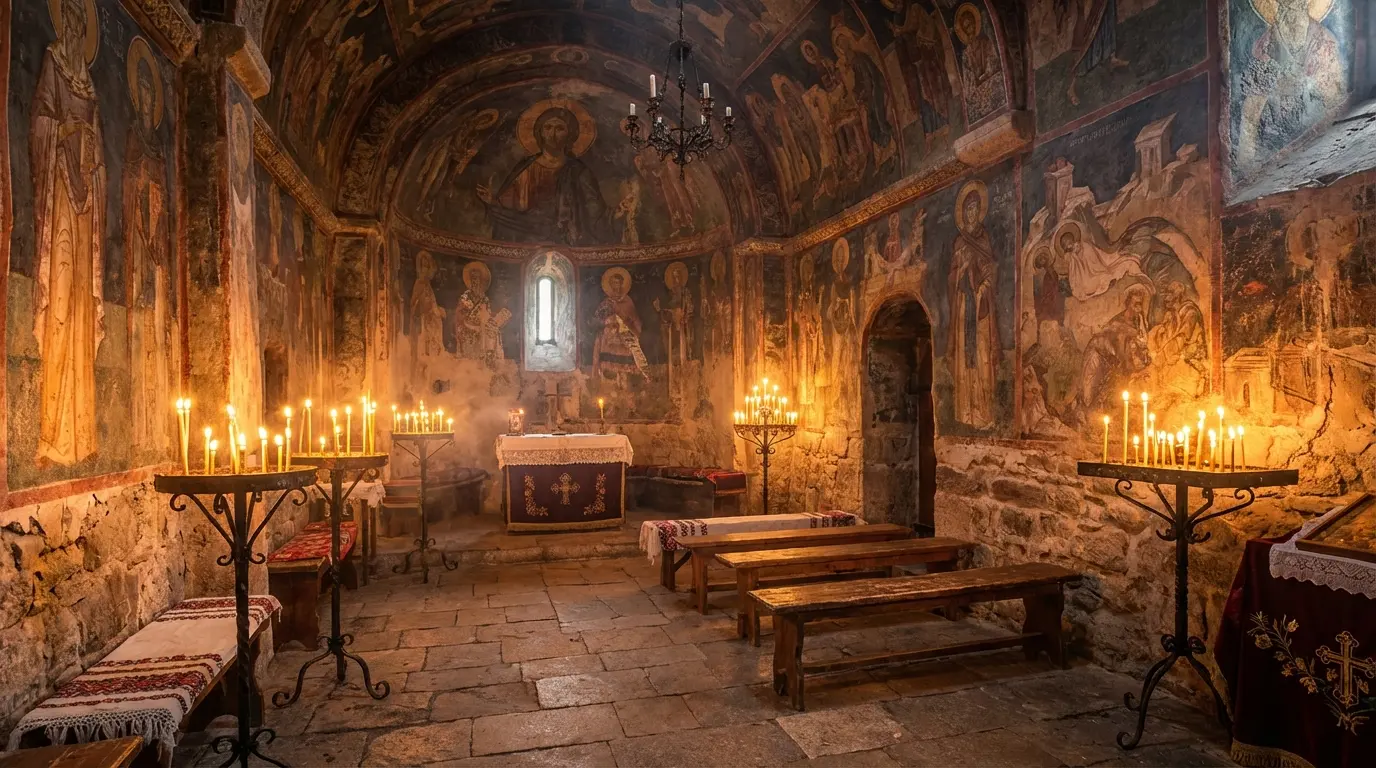
Sarajevo’s Bascarsija: Where Four Faiths Still Live Side by Side
There is a walk you can take in central Sarajevo that has no equivalent anywhere else in Europe.
Start at the Gazi Husrev-beg Mosque, built in 1531 during the Ottoman period. It is the largest historical mosque in Bosnia and still the center of Muslim worship in the city. Walk a few minutes south to the Old Orthodox Church, which dates to the 16th century and holds one of the most important collections of Orthodox icons in the region. Continue to the Sacred Heart Cathedral, a neo-Gothic Catholic church built in 1889 that remains the seat of the Archdiocese of Sarajevo. Then walk to the synagogue, where Sarajevo’s Jewish community has gathered for centuries.
All of these are active houses of worship. All of them sit within a ten-minute walk of each other. This is not a reconstruction, not a heritage park. This is a living neighborhood where four faith communities have worshipped in proximity for over 400 years.
For any faith group, walking this route is a lesson in what coexistence looks like in practice. Not in theory. Not in a textbook. In stone and mortar and daily prayer.
Dubrovnik’s Old Synagogue: Continuous Prayer Since 1352
The Dubrovnik Synagogue is small. It occupies the upper floor of a building on Zudioska Street, in the old Jewish quarter of the walled city. You could walk past it and not notice the entrance.
But this synagogue has held continuous Jewish worship since 1352. It is the second-oldest operating synagogue in Europe. Sephardic Jews who came to Dubrovnik after the Spanish expulsion of 1492 strengthened the community, and for centuries this was a center of Jewish spiritual life on the Adriatic.
The prayer space itself is modest and powerful. The Torah scrolls, the Aron Kodesh, the bimah, all carry the weight of nearly 700 years of use. This is not a monument. It is a place where Jews still pray.
For a rabbi bringing a group to Dubrovnik, arrange time here that goes beyond the standard guided tour. Sit in the synagogue. Let the space speak. If your visit coincides with Shabbat, the community can accommodate visiting groups for services with advance notice. This changes the visit from historical to spiritual.
Dubrovnik’s Cathedral and the Churches Inside the Walls
For Christian groups, Dubrovnik’s Old City holds a concentration of sacred spaces within a remarkably small area.
The Cathedral of the Assumption of the Virgin Mary was rebuilt after the devastating earthquake of 1667. Inside, it holds relics attributed to St. Blaise, the patron saint of Dubrovnik. The city’s relationship with St. Blaise goes back to the 10th century, and the annual Festival of St. Blaise (February 3) is a UNESCO-recognized cultural event.
The Franciscan Monastery, just inside the Pile Gate, houses one of the oldest continuously operating pharmacies in Europe, dating to 1317. The cloister is a place of genuine tranquility inside a city that can feel busy. The Dominican Monastery, at the eastern end of the Stradun, holds a collection of religious paintings and a peaceful cloister garden.
For a pastor leading a group, these three sites, the cathedral, the Franciscan monastery, and the Dominican monastery, can fill a morning of meaningful engagement with Christian heritage, all on foot, all within the city walls.
Kotor’s St. Tryphon Cathedral: Faith Built Into Rock
The Cathedral of St. Tryphon in Kotor was first built in the 9th century and rebuilt after an earthquake in the 12th century. It is one of the most significant Romanesque churches on the eastern Adriatic, and it has served as a place of Catholic worship for more than a thousand years.
Inside, the cathedral holds a treasury of sacred art, relics, and liturgical objects that have been maintained through centuries of shifting political and military control. Kotor passed from Byzantium to Venice to Austria to Yugoslavia, and through it all, this cathedral remained.
What strikes many visitors is the setting. The cathedral sits inside medieval walls, at the base of a mountain that rises sharply above the city. The fortifications climb the mountain behind it. The whole arrangement feels like a place where faith was not optional but necessary, a city built to protect the things it held sacred.
For a Christian heritage group, St. Tryphon deserves real time, not a quick photo. The treasury tour, the nave, and the history of this site repay attention.
Medjugorje: One of the World’s Major Catholic Pilgrimage Sites
In 1981, six young people in the small Herzegovinian town of Medjugorje reported seeing apparitions of the Virgin Mary. Since then, millions of Catholic pilgrims have traveled to Medjugorje, making it one of the most visited pilgrimage sites in the Catholic world.
The Vatican has not officially ruled on the authenticity of the apparitions. What is not in dispute is the experience of the pilgrims who come. For Catholic groups, Medjugorje is a place of deep prayer, reflection, and communal worship. The Church of St. James in the town center holds regular Masses in multiple languages. Apparition Hill (Podbrdo) and Cross Mountain (Krizevac) are the two main sites of devotion, each involving a climb that pilgrims make in prayer.
For a pastor bringing a congregation to Medjugorje, the experience is personal and communal at once. Being there with your own church community, praying together at a site that millions of believers have visited before you, carries a weight that is difficult to describe and that participants often say changed them.
Heritage Tours coordinates Medjugorje visits for Christian groups as part of the broader circuit, including local guides who understand the pilgrimage context and accommodation that reflects the nature of the visit.
For Both Communities: What This Region Teaches About Coexistence
The spiritual sites of this circuit are not just places to visit. They are evidence of something.
In Sarajevo, four faiths have worshipped within walking distance of each other for centuries. That coexistence was not always peaceful. It was disrupted by occupation, by war, by the kinds of violence that make coexistence seem naive. And yet the mosque, the synagogue, the Orthodox church, and the Catholic cathedral are all still there. All still active. All still holding services.
In Dubrovnik, a Jewish community maintained itself inside a Catholic city-state for 700 years. In Kotor, Catholic and Orthodox Christians shared a church. In Medjugorje, millions of pilgrims find something that sustains their faith.
For a group leader, whether you are a rabbi or a pastor, this circuit offers your community more than individual sites. It offers a conversation about what it means for different faiths to share a geography, and what it costs, and what it yields.
That conversation is part of the journey. And it is one of the reasons Heritage Tours believes this circuit matters.
If you are thinking about bringing your community to these sites, explore the Croatia, Montenegro & Bosnia destination or contact Heritage Tours to begin planning.
Frequently Asked Questions
What makes Medjugorje a major Catholic pilgrimage site? Since 1981, millions of Catholic pilgrims have visited Medjugorje following reports of apparitions of the Virgin Mary. The site includes Apparition Hill, Cross Mountain, and the Church of St. James. Regular Masses are held in multiple languages, and the experience of communal prayer at the site draws pilgrims from around the world.
Is the Dubrovnik synagogue open for prayer or only for tourism? The Dubrovnik Synagogue is an active house of worship, not just a museum. It has held Jewish services since 1352. Visiting groups can arrange to participate in Shabbat services with advance notice through the local Jewish community.
What is the spiritual significance of Sarajevo’s four-faith city center? Within a ten-minute walk in central Sarajevo, you can visit an active mosque, synagogue, Orthodox church, and Catholic cathedral. This concentration of living houses of worship from four different faith traditions, all in one neighborhood, is unique in Europe and reflects over 400 years of interfaith coexistence.
Can an interfaith group visit all of Sarajevo’s religious sites in one day? Yes. The major houses of worship in Sarajevo’s old city are all within walking distance of each other. A guided walking tour of the mosque, synagogue, Orthodox church, and Catholic cathedral can be completed in a morning, leaving the afternoon for the National Museum and the Sarajevo Haggadah.
What is St. Tryphon Cathedral in Kotor? The Cathedral of St. Tryphon is a Romanesque Catholic cathedral in Kotor, Montenegro, first built in the 9th century. It is one of the most important historic churches on the eastern Adriatic coast and holds a treasury of sacred art and relics maintained for over a thousand years. It remains an active place of worship.