Day 1: Arrive Dubrovnik, First Walk Inside the Old City Walls
You land in Dubrovnik, and depending on when you arrive, you take your first walk through the Pile Gate into the Old City. Do not try to see everything today. Just walk the Stradun, the limestone main street polished by centuries of footsteps. Let the scale of the walls register. Let the stone and the light and the Adriatic visible through the gaps in the ramparts settle into your group.
This evening, gather for dinner and set the context for the days ahead. If you are leading a Jewish heritage group, this is the time to tell the story of how Sephardic Jews came to this coast after 1492. If you are leading a Christian group, this is the time to introduce the city’s patron saint, St. Blaise, and the cathedral that holds his relics.
The trip begins here. Let the first evening be about orientation, not exhaustion.
Day 2: Dubrovnik, the Synagogue, the Cathedral, the Jewish Quarter
This is the day your group enters the heritage story of Dubrovnik.
The Dubrovnik Synagogue on Zudioska Street has been in continuous use since 1352. For a Jewish group, arrange a private visit with the local community. The interior holds Torah scrolls, ceremonial objects, and a prayer space that nearly 700 years of worship have made sacred. Take your time here. This is not a museum stop.
For Christian groups, the Cathedral of the Assumption holds relics attributed to St. Blaise. The Franciscan Monastery, home to one of the oldest pharmacies in Europe, and the Dominican Monastery are both within the Old City walls.
In the afternoon, walk the city walls themselves. The circuit is about two kilometers and takes roughly an hour and a half. The views of the Adriatic, the rooftops, and the harbor are extraordinary. For groups with older participants, note that the walk involves significant stairs and no shade in the afternoon.
Day 3: Coastal Route to Kotor, Medieval Montenegro
The drive from Dubrovnik south to Kotor follows the Adriatic coastline. It is one of the most beautiful drives in Europe, and your group should know that before they board the bus. The road hugs the water, passes through small Croatian and Montenegrin coastal towns, and crosses the border from Croatia into Montenegro.
The border crossing takes time. Heritage Tours manages the documentation and the timing, but tell your group to have passports accessible and to expect a brief stop.
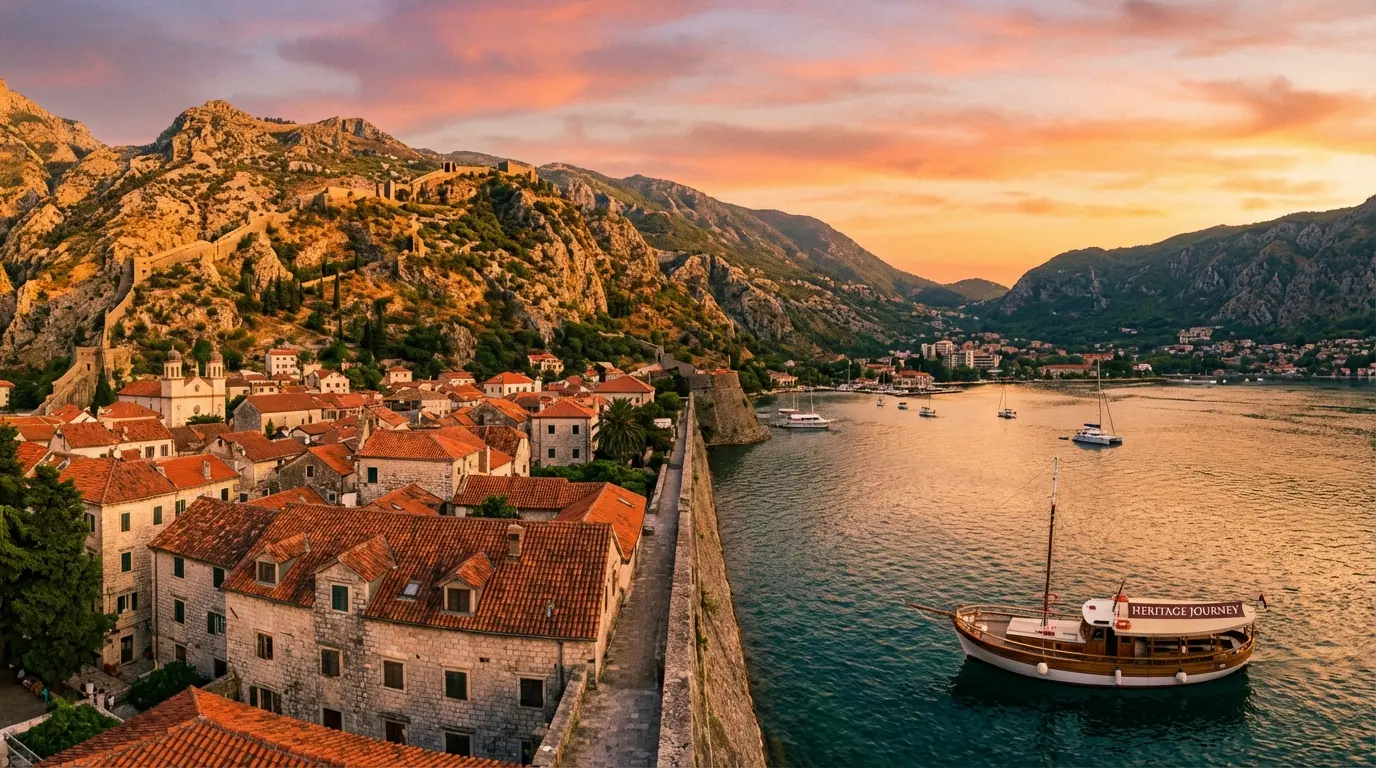
You arrive in Kotor by afternoon. The medieval walled city opens to you as you walk through the main gate. Check into your hotel, and spend the late afternoon simply being inside the walls. The narrow streets, the stone churches, and the mountain rising directly above the city are enough for one afternoon.
Day 4: Kotor, Fortress Walls and Old City Churches
Kotor deserves a full day, and too many itineraries deny it one.
The Cathedral of St. Tryphon, built in the 9th century, is one of the most important Romanesque churches on the Adriatic coast. The cathedral’s treasury holds sacred art, reliquaries, and textiles that have been maintained for more than a thousand years. For a Christian group, this is a place of genuine historical and spiritual weight.
The Church of St. Luke (1195) served both Catholic and Orthodox congregations, sometimes at the same time. It is a physical testament to the coexistence of Christian traditions in this city.
For those in your group who are able, the climb to the fortress above Kotor is demanding but rewarding. The fortifications climb 1,200 meters up the mountainside, and the views from the upper ramparts over the Bay of Kotor are among the most dramatic in the Mediterranean. Not everyone in a heritage group will make this climb, and that is fine. The churches and the Old City below offer more than enough for a full day.
Day 5: Drive to Sarajevo, Crossing Into Bosnia
The drive from Kotor to Sarajevo crosses some of the most dramatic mountain scenery in Europe. The road climbs from the Adriatic coast into the Dinaric Alps, through deep river gorges and green valleys. The landscape changes completely. The coast falls behind, and the mountains of Bosnia open ahead.
This is not a wasted travel day. The journey itself is part of the experience. Stop at Trebinje if time allows, a small Bosnian town with a beautiful old town and Orthodox monastery. Stop for lunch along the route and let the group absorb the transition from the coast to the interior.
You cross the border from Montenegro into Bosnia and Herzegovina. The currency changes to the Bosnian convertible mark. The road signs switch. The landscape becomes greener and more mountainous. By late afternoon, you arrive in Sarajevo.
The city in the valley below, with its minarets and church spires visible together, tells you immediately that you are in a different kind of place.
Day 6: Sarajevo, the Four-Faith City and the Haggadah
This is the day many of your group will remember longest.
Begin in the Bascarsija, Sarajevo’s Ottoman-era old town. Within a short walk, you pass the Gazi Husrev-beg Mosque (16th century), the Old Orthodox Church, the Sacred Heart Cathedral, and the synagogue. All of them active. All of them within minutes of each other. Walk this route with your group slowly and let the geography of coexistence speak for itself.
After the old city, go to the National Museum of Bosnia and Herzegovina. Inside, in a specially constructed room, sits the Sarajevo Haggadah. This manuscript was created in Barcelona around 1350. It survived the Spanish Inquisition. It crossed the Mediterranean. It was hidden from the Nazis by a Muslim scholar named Dervis Korkut. It was rescued from the museum vault during the shelling of Sarajevo in the 1990s. It has survived 670 years and it is here, in this room, in this city.
For a Jewish group, stand in front of that display case and give the story the time it deserves. For any heritage group, the Haggadah represents something universal about the persistence of sacred objects and the people who protect them.
Heritage Tours arranges this visit with advance notice to ensure proper time and access.
Day 7: Sarajevo, More Depth, the War Museum, the Old Synagogue
A second day in Sarajevo allows the depth that a single day cannot.
Visit the Sarajevo War Tunnel Museum, which tells the story of how the city survived the 1992 to 1995 siege. The tunnel, dug beneath the airport runway, was the city’s lifeline. For a first-time visitor, this museum provides essential context for understanding why Sarajevo looks and feels the way it does.
For Jewish groups, visit the Jewish Community Center and, if arranged, meet members of Sarajevo’s living Jewish community. Hear their story directly. The community is small but present, and their willingness to share their history with visiting groups is a gift.
Visit the Old Synagogue building and the Jewish cemetery, one of the oldest Sephardic cemeteries in Europe. Walk the Latin Bridge, where the assassination of Archduke Franz Ferdinand in 1914 triggered World War I. Sarajevo’s layered history does not fit neatly into a single narrative, and your second day here is where those layers become visible.
Day 8: Medjugorje, for Christian Groups Especially
Medjugorje lies about two hours southwest of Sarajevo, in the rocky hills of Herzegovina. Since 1981, it has been one of the most visited Catholic pilgrimage sites in the world.
For a Christian group, this is not a sightseeing stop. Arrive early, attend Mass if possible, and spend time at Apparition Hill and Cross Mountain. The experience of being at Medjugorje with your own congregation, led by your pastor, is something participants describe as one of the most meaningful spiritual experiences of their lives.
For Jewish or interfaith groups, Medjugorje can be replaced with a day trip to Mostar, home of the rebuilt Stari Most bridge and a heritage story of its own. The bridge, destroyed in 1993 and rebuilt in 2004, carries deep meaning about destruction and reconciliation.
Heritage Tours builds either option into the itinerary based on the group’s faith tradition and priorities.
Day 9: Return to Dubrovnik, Depart
The return drive to Dubrovnik follows the scenic route through Herzegovina and back to the coast. Depending on flight times, there may be time for a final walk through Dubrovnik’s Old City, a last visit to a site your group wants to revisit, or simply a quiet morning before departure.
This is also the day for your group leader to close the circle. What did we see? What will we carry home? What did this journey mean to us as a community? These conversations are part of the trip, and a good leader makes time for them.
How Heritage Tours Customizes This for Your Group
This nine-day framework is a starting point. Every group is different.
A rabbi’s group might spend an extra day in Sarajevo and skip Medjugorje. A pastor’s group might add a second day at Medjugorje and shorten Kotor. A family heritage group might add Split at the beginning to visit the Roman-era Jewish quarter. An interfaith group might visit every site on this list.
Heritage Tours builds the itinerary around your community’s needs and your tradition. Group leaders travel free with 15 or more participants. The border crossings, the transport, the hotel coordination across three countries, all of that is handled so you can focus on leading the experience.
If this itinerary speaks to what you are looking for, explore the Croatia, Montenegro & Bosnia destination or reach out to Heritage Tours. We will build it with you.
Frequently Asked Questions
How do you travel from Dubrovnik to Sarajevo by road? The most common route goes through Herzegovina, passing through Mostar. The drive is approximately four to five hours depending on the route and border crossing times. Heritage Tours coordinates the transport, including the border crossing between Croatia and Bosnia.
Is 9 days enough for a Croatia, Montenegro, and Bosnia heritage circuit? Yes, nine days provides a solid framework covering Dubrovnik, Kotor, Sarajevo, and either Medjugorje or Mostar. Groups wanting more depth in Sarajevo or wanting to add Split can extend to eleven days.
Can you visit Medjugorje and Sarajevo on the same trip? Absolutely. Medjugorje is about two hours from Sarajevo and fits naturally as a day trip or as a stop on the route between Sarajevo and the coast. Most Christian group itineraries include both.
How do you arrange a visit to the Sarajevo Haggadah? The Sarajevo Haggadah is displayed in the National Museum of Bosnia and Herzegovina. Group visits should be arranged in advance to ensure access and adequate time. Heritage Tours handles this coordination as part of the itinerary planning.
What is the driving time from Dubrovnik to Kotor? The drive is approximately one and a half to two hours, depending on traffic and the border crossing between Croatia and Montenegro. The coastal route is scenic and is itself part of the heritage experience.