What This Circuit Actually Feels Like on a First Visit
The Croatia, Montenegro, and Bosnia circuit surprises almost everyone the first time.
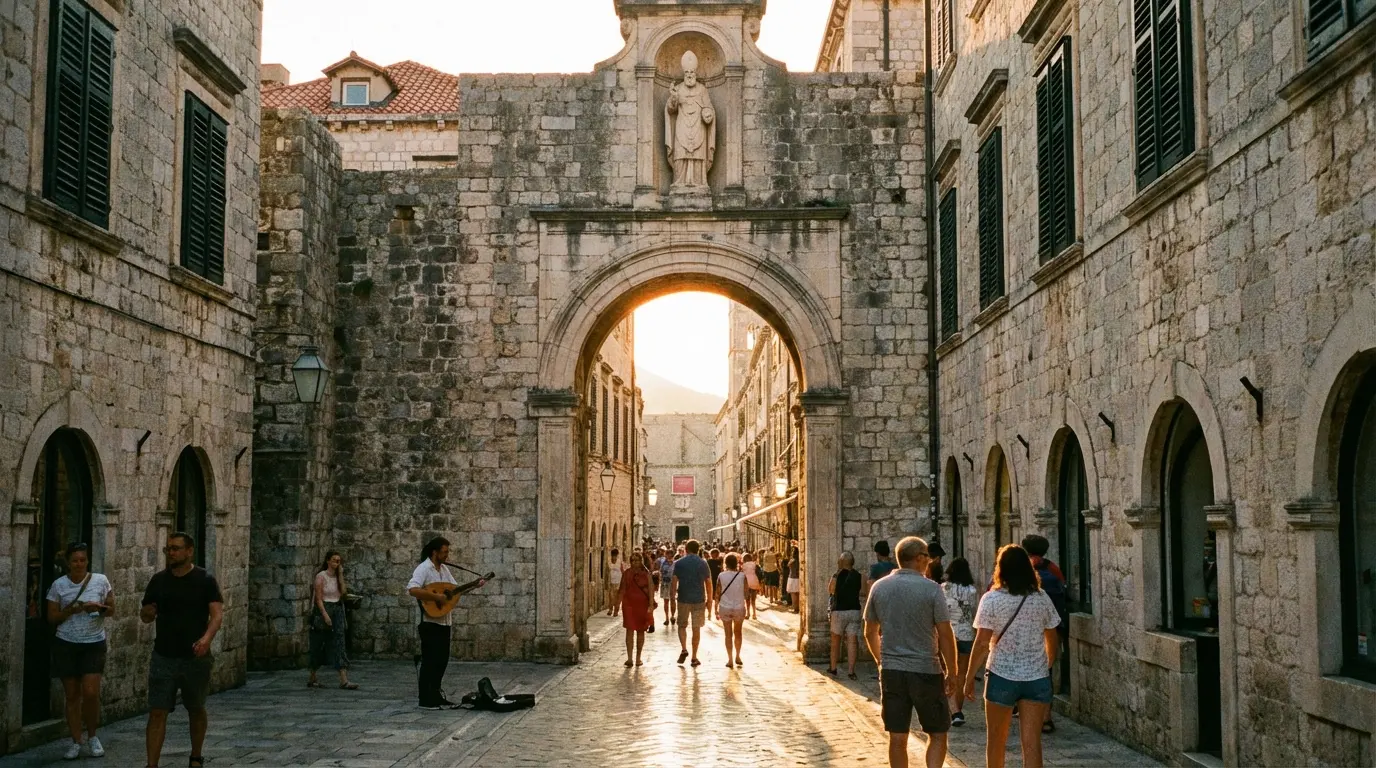
Dubrovnik is more beautiful than the photographs suggest. The stone, the light on the Adriatic, the scale of the medieval walls. You think you are prepared because you have seen pictures, and then you walk through the Pile Gate and realize the pictures did not capture it.
Sarajevo is more complex than most Western visitors expect. It is a city of great warmth, extraordinary food, and layered history. But it is also a city where the 1990s war is not distant memory. It is recent. Bullet holes are visible on some buildings. The Sarajevo Roses, shrapnel scars in the pavement filled with red resin, mark places where mortar shells killed civilians. The war ended in 1995. That is within living memory for every adult in the city.
The combination of beauty and gravity, of ancient heritage and recent suffering, is what makes this circuit different from other European heritage trips. It asks more of you as a traveler. And it gives more back.
The Three Experiences You Will Not Forget
Every group that travels this circuit comes home with certain memories that rise above the rest. After years of sending groups through this region, I can tell you what they are.
The first is standing inside the Dubrovnik Synagogue. Built in 1352, it is small and quiet and holds a weight that its size does not prepare you for. For Jewish groups, the realization that Jews have worshipped here for nearly 700 years changes the visit from tourism to something personal.
The second is the walk through Sarajevo’s old city, past the mosque, the synagogue, the Orthodox church, and the Catholic cathedral, all within minutes of each other, all still active. For any faith traveler, the physical reality of four faiths living side by side in one neighborhood is an education you cannot get from a book.
The third depends on your group. For Jewish groups, it is seeing the Sarajevo Haggadah, the 14th-century manuscript that survived the Inquisition, the Nazis, and the Bosnian War. For Christian groups, it is arriving at Medjugorje and praying together at one of the world’s great Catholic pilgrimage sites. Both experiences are unforgettable in their own way.
Practical Things to Know Before You Arrive
Currencies. Croatia uses the euro (it joined the eurozone in 2023). Montenegro also uses the euro, though it is not an EU member. Bosnia and Herzegovina uses the Bosnian convertible mark (BAM). Your group will need to handle at least two currencies on this trip. ATMs are available in all major cities, but Sarajevo has areas where cash is strongly preferred. Tell your group to withdraw convertible marks when they arrive in Bosnia.
Border crossings. This circuit crosses two international borders: Croatia to Montenegro, and Montenegro (or Croatia) to Bosnia. EU citizens and most Western passport holders do not need visas for any of these countries. But the border stops are real. They take time. Have passports accessible, and expect a brief wait.
Languages. Croatian, Montenegrin, and Bosnian are closely related languages. English is widely spoken in Dubrovnik and increasingly in Sarajevo. Kotor has good English coverage in the tourist areas. You will not have language problems at hotels, restaurants, or heritage sites.
Plugs and electricity. All three countries use European-style Type C and F plugs (two round pins) with 230V electricity. If your group is coming from North America, everyone needs an adapter.
Sarajevo: What First-Timers Need to Understand Before They Land
Sarajevo deserves special preparation, and a good group leader provides it.
The Bosnian War and the Siege of Sarajevo (1992 to 1995) are not ancient history. The city was under siege for 1,425 days, the longest siege of a capital city in modern warfare. Snipers targeted civilians. Mortar shells fell on markets and residential areas. Over 11,000 people were killed.
The physical evidence is still visible. Some buildings still carry bullet scars. The Sarajevo Roses mark places where shells killed people. The War Tunnel Museum tells the story of the tunnel that was the city’s only lifeline during the siege.
This is not something to shy away from with your group. It is something to prepare them for. Sarajevo’s people are warm, generous, and proud. They do not want pity. But they do want visitors to understand what their city went through and what it means that they rebuilt.
For a heritage group, this context deepens everything you experience in Sarajevo. The Haggadah’s survival story, the four-faith city center, the Jewish community that persisted through it all. These things mean more when you understand what this city has endured.
Brief your group before you arrive. Give them the context. Let them arrive ready to be present with what they see.
Common First-Timer Mistakes on the Adriatic Circuit
Underestimating the heat in Dubrovnik. The Old City is almost entirely stone, with limited shade. Summer temperatures regularly exceed 35 degrees Celsius. For a group of older adults, which is common in faith heritage travel, the heat is a real concern. Schedule heritage visits for the morning. Carry water. Rest in the afternoon.
Rushing through Kotor. Many itineraries treat Kotor as a transit stop between Dubrovnik and Sarajevo. This is a mistake. Kotor is a UNESCO World Heritage site with a 9th-century cathedral and medieval churches of genuine significance. Give it at least a half day.
Not preparing for Sarajevo emotionally. Arriving in Sarajevo without context is disorienting. The city is beautiful, but the war is present. Groups that arrive prepared have a richer experience. Groups that arrive uninformed sometimes feel overwhelmed.
Treating the border crossings as surprises. The borders between Croatia, Montenegro, and Bosnia are real international borders. They are not difficult to cross, but they take time and require documentation. Tell your group in advance.
Packing for one climate. Dubrovnik is Mediterranean and warm. Sarajevo sits in a mountain valley and can be significantly cooler, especially in spring and fall. Your group needs layers.
What to Tell Your Group Before They Land
If you are a group leader, here is what your participants need to hear before the trip.
Bring comfortable walking shoes with good grip. Dubrovnik’s Old City is stone streets and stairs. Kotor is cobblestone. Sarajevo’s old town is uneven pavement. This is not a trip for dress shoes.
Bring cash for Bosnia. Cards work in most hotels and restaurants, but the markets and smaller shops in Sarajevo’s Bascarsija operate on cash.
Expect to be moved. This is not a beach trip. This is a journey through places where faith communities have lived, suffered, protected each other, and persisted. Your group will come home with stories that matter.
And tell them to bring a sweater for Sarajevo, even in June.
If this is the first time you are considering this circuit for your community, explore the Croatia, Montenegro & Bosnia destination or contact Heritage Tours. We help first-time groups arrive ready.
Frequently Asked Questions
Is Croatia a good destination for a first heritage group trip? Yes. Croatia offers world-class heritage sites, excellent infrastructure, English-speaking guides, and the euro as currency. Combined with Montenegro and Bosnia, it forms a circuit that is well-suited to first-time heritage groups, particularly those interested in Jewish, Christian, or interfaith heritage.
What should first-time visitors know before visiting Sarajevo? Sarajevo is a warm, welcoming city with extraordinary heritage. First-time visitors should be prepared for the visible presence of the 1990s Bosnian War, including bullet-scarred buildings and the Sarajevo Roses (shrapnel marks in the pavement). This context is not meant to discourage visits but to help travelers arrive with appropriate awareness and respect.
Do you need a visa to travel from Croatia to Bosnia? Most EU citizens, US citizens, Canadian citizens, and other Western passport holders do not need a visa for Bosnia and Herzegovina for stays of up to 90 days. However, Bosnia is not an EU member state, so border controls are in place and passports are required.
What currencies are used in Croatia, Montenegro, and Bosnia? Croatia and Montenegro both use the euro. Bosnia and Herzegovina uses the Bosnian convertible mark (BAM). ATMs are available in major cities, but some areas of Sarajevo prefer cash transactions.
How physically demanding is Dubrovnik’s Old City for a heritage group? Dubrovnik’s Old City involves significant stone stairs, uneven surfaces, and limited shade. Summer temperatures can exceed 35 degrees Celsius. For groups with older participants, planning heritage visits for the morning and scheduling afternoon rest periods is important. The city walls walk is approximately two kilometers with considerable stair climbing.