The Sephardic Connection: How Spanish Jews Came to the Adriatic
In 1492, the same year Columbus sailed west, Spain expelled its entire Jewish population. Hundreds of thousands of Sephardic Jews scattered across the Mediterranean. Some went to the Ottoman Empire. Some went to North Africa. And some came to the Adriatic coast.
Dubrovnik, then an independent city-state known as Ragusa, became one of the key Sephardic settlements on the eastern Adriatic. The city was a trading power, and it understood that welcoming a community of educated, multilingual merchants was good for commerce. The Jewish quarter that developed inside Dubrovnik’s walls became a center of Sephardic life, learning, and worship.
This is where the story begins. But it does not end in Dubrovnik. The Sephardic trail continues east, over the mountains, into a city that would become home to one of the most important Jewish manuscripts in the world.
Dubrovnik’s Old Synagogue: In Continuous Use Since 1352
The Dubrovnik Synagogue on Zudioska Street is the second-oldest continuously operating synagogue in Europe. It was established in 1352, more than a century before the Spanish expulsion, though the community grew significantly after 1492 when Sephardic refugees arrived.
The synagogue is small. It sits on the upper floor of a building in the narrow Jewish quarter, and you could walk past the entrance without noticing it. But inside, the prayer space holds a weight that the modesty of its exterior does not prepare you for.
The bimah, the Aron Kodesh, the Torah scrolls, and the ceremonial objects displayed in the adjoining museum tell a story of a community that worshipped here for nearly 700 years. Through plagues, earthquakes, and wars, this synagogue remained. It remains still.
For a rabbi leading a group through Croatia, this is where to begin. Stand in this room and tell your community what it means that Jews have prayed here since the 14th century. The space itself will do most of the work.
Sarajevo’s Jewish Community: A Four-Faith City’s Jewish Heart
Sarajevo’s Jewish presence dates to the 16th century, when Sephardic Jews arrived in the Ottoman-governed city. They joined a city that already held Muslim, Catholic, and Orthodox communities. The Jews of Sarajevo were not merely tolerated. They were woven into the fabric of the city. They had their own quarter, their own institutions, their own synagogues.
At its peak before World War II, Sarajevo’s Jewish community numbered around 10,000. They spoke Ladino at home. They ran businesses in the Bascarsija market district. Their children went to Jewish schools. The community was vibrant, established, and deeply rooted.
What happened next is the story of the 20th century in miniature. And it is the story that gives this city its particular gravity for Jewish heritage travelers.
The Sarajevo Haggadah: A Manuscript That Survived Everything
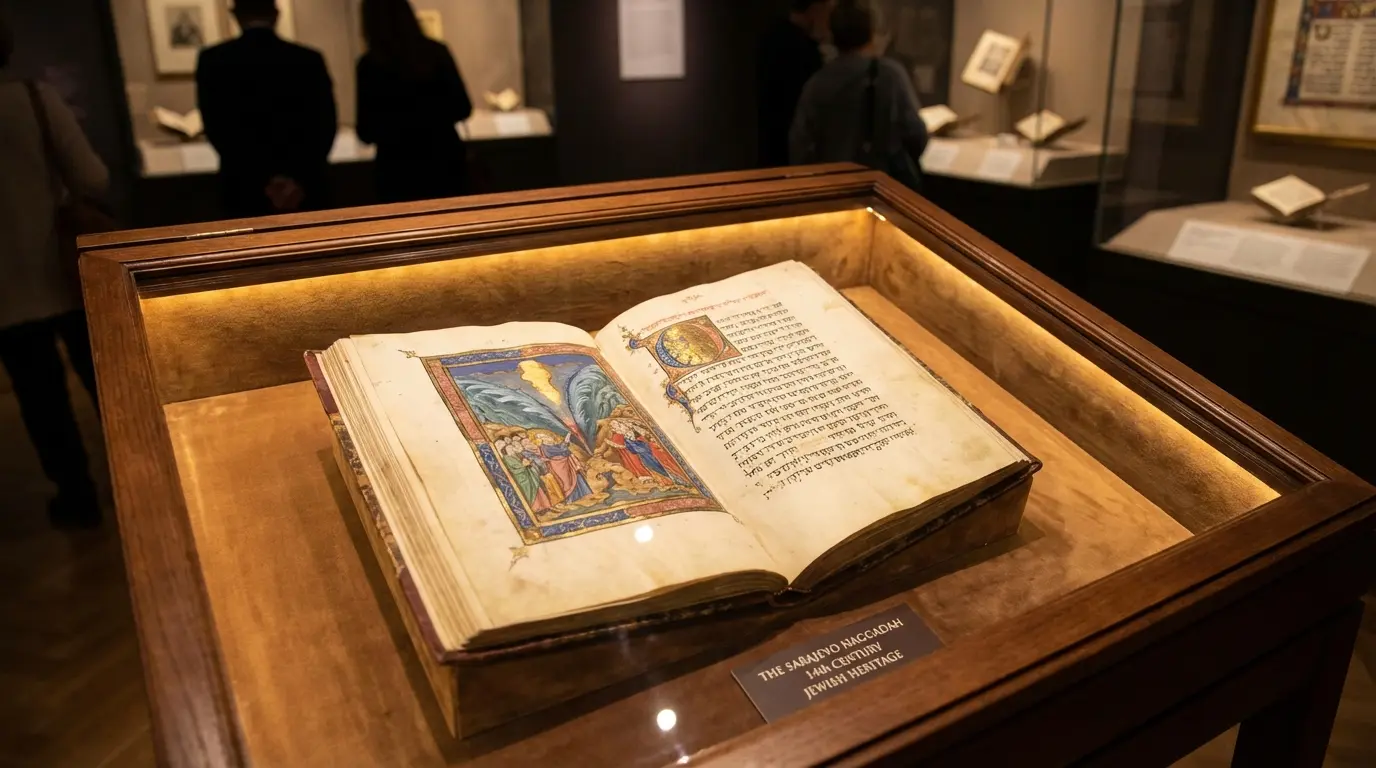
The Sarajevo Haggadah was created in Barcelona around 1350. It is an illuminated manuscript, decorated with painted miniatures depicting scenes from the Hebrew Bible. It is one of the oldest and most beautiful Haggadahs in existence. But what makes it singular is not its age or its artistry. It is the fact that it survived.
When Spain expelled its Jews in 1492, the Haggadah was carried across the Mediterranean by a Sephardic family. It passed through Italy and eventually arrived in Sarajevo, where it was sold to the National Museum in 1894.
During World War II, a Nazi general demanded that the Haggadah be handed over. The museum’s chief librarian, Dervis Korkut, a Muslim scholar, told the Germans the manuscript had already been taken. He had hidden it. Some accounts say he gave it to a Muslim cleric who concealed it in a mountain mosque. Others say he hid it in his own home. What is certain is that Dervis Korkut risked his life to protect a Jewish manuscript, and he succeeded.
The story did not end there. In 1992, when Sarajevo came under siege during the Bosnian War, the Haggadah was again in danger. Shells fell on the National Museum. Police officers broke into the museum vault during a lull in the bombardment and moved the manuscript to an underground bank vault, where it remained until the war ended.
The Haggadah is now displayed in a specially constructed room in the National Museum. It has survived the Spanish Inquisition, a world war, and a modern siege. It has been carried by Sephardic hands across six centuries and three continents. For a Jewish group standing in front of that display case, the experience is not like anything else in European heritage travel.
Heritage Tours arranges visits to the National Museum with advance notice, so that groups can see the Haggadah with proper time and context, not as a rushed museum stop.
How Sarajevo’s Jews Survived the Second World War
The story of the Haggadah’s rescue is part of a larger story that deserves to be told on its own terms.
When the Nazis and their Ustasa allies took control of Bosnia during World War II, Sarajevo’s Jewish community faced the full horror of the Holocaust. Thousands were deported and killed. The community of 10,000 was decimated.
But not all were lost. In Sarajevo and across Bosnia, Muslim families hid their Jewish neighbors. They shared their homes, their food, and their safety with people the occupying forces wanted dead. They did this knowing that discovery meant death for their own families as well.
Dervis Korkut, who saved the Haggadah, also hid a young Jewish woman named Mira Papo in his home. He and his wife Servet sheltered her until the danger passed. Korkut is recognized as Righteous Among the Nations by Yad Vashem, Israel’s official memorial to the victims of the Holocaust.
He was not alone. Many Bosnian Muslims are honored by Yad Vashem for the same reason. What happened in Sarajevo during the war was not the act of one brave individual. It was a pattern of interfaith solidarity under the most extreme circumstances imaginable.
For a Jewish heritage group, hearing this story in Sarajevo, in the city where it happened, is an experience that reshapes how you understand both the Holocaust and the possibility of human goodness across lines of faith.
What Jewish Groups Can Experience Today
Sarajevo’s Jewish community today numbers in the hundreds. It is small, but it is present, and it is proud. The Jewish Community Center in Sarajevo is active and welcoming to visiting groups. The community can arrange speakers, share their history, and open doors that a standard tour cannot.
In Dubrovnik, the synagogue is open for visits and services. The Jewish community maintains a small museum and can provide guided tours of the Jewish quarter for groups that arrange in advance.
Heritage Tours connects Jewish groups with both communities. Dina Aharon’s personal knowledge of Sephardic heritage and her relationships with Jewish community leaders in the region add a dimension to these visits that comes from decades of building trust.
A Jewish heritage trip through Croatia and Bosnia is not just about old buildings. It is about standing in the places where your people lived, worshipped, suffered, were saved, and persisted. The buildings are the setting. The story is the point.
If this is the kind of journey you are considering for your community, explore the Croatia, Montenegro & Bosnia destination or reach out to Heritage Tours directly. We would be honored to help you plan it.
Frequently Asked Questions
How old is the synagogue in Dubrovnik? The Dubrovnik Synagogue was established in 1352, making it the second-oldest continuously operating synagogue in Europe. It has been in use for nearly 700 years and still holds services today.
What is the Sarajevo Haggadah and why is it significant? The Sarajevo Haggadah is a 14th-century illuminated Jewish manuscript created in Barcelona around 1350. It is one of the oldest surviving Haggadahs in the world and is famous for surviving the Spanish Inquisition, being hidden from the Nazis during World War II by a Muslim librarian named Dervis Korkut, and being rescued again during the Bosnian War in the 1990s. It is displayed in the National Museum of Bosnia and Herzegovina in Sarajevo.
How did Sarajevo’s Jewish community survive the Nazi occupation? While thousands of Sarajevo’s Jews were killed during the Holocaust, many were saved by Muslim neighbors who hid them at great personal risk. Dervis Korkut, who saved the Haggadah, also sheltered a young Jewish woman named Mira Papo. Multiple Bosnian Muslims are recognized as Righteous Among the Nations by Yad Vashem for protecting their Jewish neighbors.
Can Jewish groups visit the Sarajevo Haggadah in person? Yes. The Sarajevo Haggadah is displayed in the National Museum of Bosnia and Herzegovina. Group visits can be arranged with advance notice. Heritage Tours coordinates these visits so that groups have adequate time and context for the experience.
Are there Sephardic Jewish communities still active in Croatia or Bosnia today? Yes, though they are small. Dubrovnik maintains an active synagogue with regular services and a small museum. Sarajevo has a Jewish community of several hundred members with an active community center that welcomes visiting groups. Both communities maintain their Sephardic heritage and history.