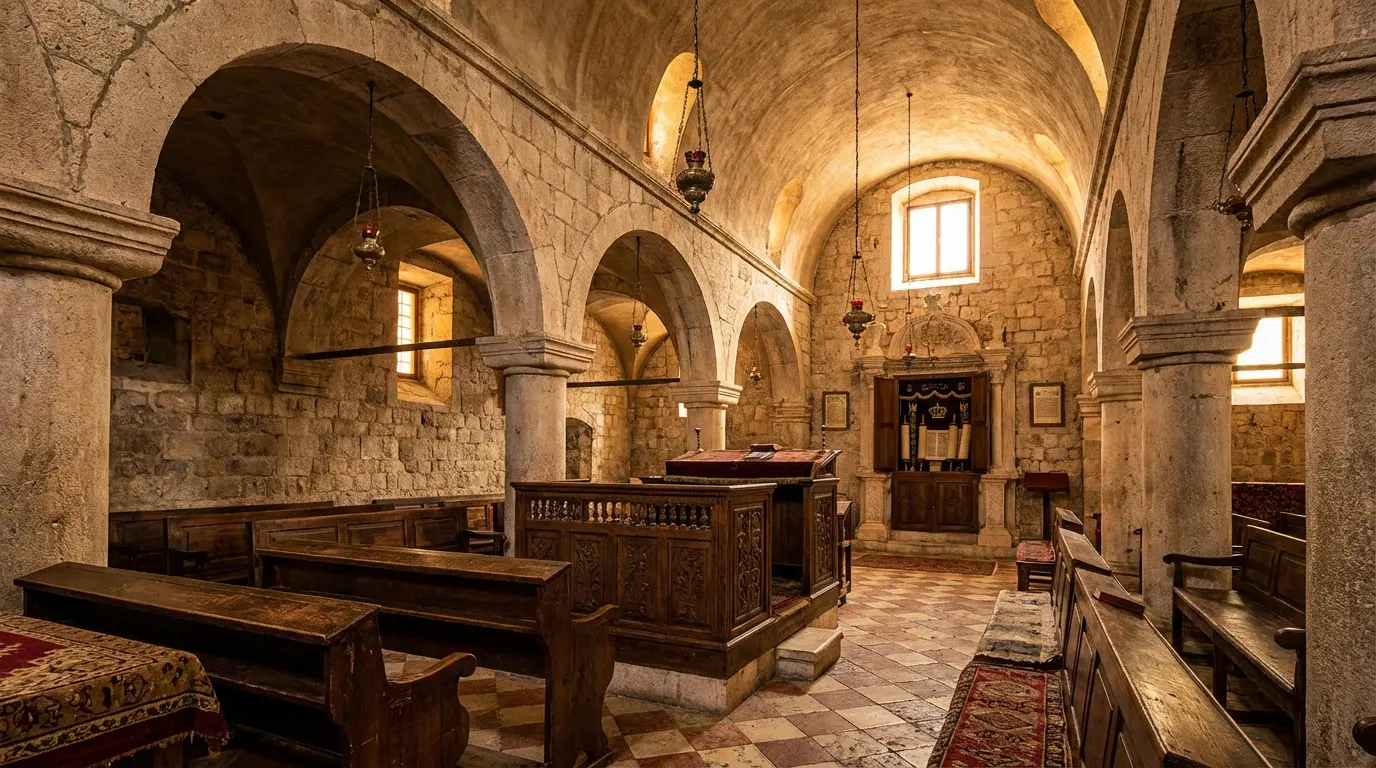
Split’s Jewish Quarter: Roman Walls, Medieval Community
Most heritage travelers fly into Split and head straight to Dubrovnik. That is understandable, but it means they miss one of the oldest Jewish stories in all of Europe.
Split’s Jewish community dates back to the Roman era. The ancient quarter, nestled inside the walls of Diocletian’s Palace, has held a Jewish presence for roughly 1,700 years. The community was small but continuous, surviving the centuries of shifting empires that ruled this coast. The synagogue on Zidovski Prolaz (Jewish Passage) sits in one of the narrowest streets in the old palace complex.
This is not a major tourist attraction. There are no crowds. There are no tour buses. For a heritage group willing to spend a morning in Split before heading south, it is a quiet encounter with Jewish roots that run deeper here than almost anywhere else on the continent.
Dubrovnik’s Old Synagogue Interior: What Most Tour Groups Never See
Dubrovnik’s synagogue appears in guidebooks, yes. But most tour groups see the exterior, learn the date (1352), and move on. What they miss is the interior, and the story it tells.
The synagogue’s upper floor holds a small but deeply moving collection of Torahs, textiles, and artifacts from the Sephardic community that built this place after fleeing Spain. The bimah, the Aron Kodesh, and the layout of the prayer space itself reflect centuries of continuous worship in a city that, while not always easy for Jews, never expelled them.
Visiting the interior requires advance coordination, particularly for groups. But for a Jewish heritage group, spending an hour inside this space, with a local guide who can speak to the community’s history, changes the visit from a sightseeing stop into something that matters.
Heritage Tours works with local Jewish community contacts in Dubrovnik to arrange these visits, including access beyond the standard tourist experience.
Sarajevo’s Old Synagogue and the Jewish Community That Survived the War
When people speak about Sarajevo’s Jewish heritage, they usually mean the Sarajevo Haggadah. And that manuscript deserves every word written about it. But there is another story in Sarajevo that is just as extraordinary, and it is almost entirely absent from English-language travel content.
During World War II, when the Nazis and their allies occupied Bosnia, Sarajevo’s Jewish community faced extermination. What happened next is one of the most powerful interfaith stories in modern Jewish history. Muslim families in Sarajevo hid their Jewish neighbors. They risked their own lives to protect people of a different faith, in a city where faith was and remains deeply personal.
The Old Synagogue building in Sarajevo still stands. The Jewish community, though small today, is still here. For a heritage group, hearing this story in the place where it happened, from people whose families lived it, is an experience that goes beyond what any guidebook can convey.
This is the kind of visit that Heritage Tours facilitates through its local relationships in Sarajevo, connecting groups with the living community, not just the historical sites.
Kotor’s Medieval Churches: Faith Carved Into Rock
Kotor gets attention for its bay, its fortified walls, and its dramatic mountain setting. All deserved. But inside those walls are medieval churches that most visitors walk past without entering.
The Church of St. Luke, built in 1195, served both Catholic and Orthodox congregations for centuries, sometimes simultaneously. The Church of Our Lady of Health, perched on the fortress walls above the city, requires a climb but rewards visitors with a space of genuine contemplation. And of course, the Cathedral of St. Tryphon, dating to the 9th century, holds a treasury of sacred art that has been maintained for over a thousand years.
For a Christian heritage group, Kotor’s churches are not footnotes. They are places where faith was practiced under siege, under empire, and under the weight of centuries. The walls that protected the city also protected these houses of worship.
Mostar: The Bridge That Divided and Reunited
The Stari Most, Mostar’s famous Old Bridge, is one of the most photographed structures in the Balkans. What many visitors do not know, or choose not to think about, is that the bridge was deliberately destroyed by shelling in November 1993, during the Bosnian War. It stood for 427 years before it fell.
The bridge was rebuilt and reopened in 2004. It is a UNESCO World Heritage site now. But in Mostar, the bridge means something specific. It connected the city’s Muslim east and Catholic west. Its destruction was not random. Its rebuilding was not casual.
For a heritage group, standing on the rebuilt Stari Most is a moment worth preparing for. The bridge is beautiful. It is also a statement about what a city chose to restore and what that choice says about the possibility of reconciliation.
Heritage groups visiting Mostar as part of the broader circuit can reach it as a day trip from Sarajevo or as a stop between Sarajevo and the coast.
How to Add These to a Group Itinerary
None of these sites require a separate trip. Split can be added as a half-day at the beginning or end of the circuit. The Dubrovnik synagogue interior visit requires advance booking but fits within a standard Dubrovnik itinerary. Sarajevo’s Old Synagogue and the community visit integrate naturally into a two-day Sarajevo stay. And Mostar works as a day trip or a half-day stop.
The circuit model that Heritage Tours uses for Croatia, Montenegro, and Bosnia is designed to accommodate these kinds of additions. The standard framework covers Dubrovnik, Kotor, and Sarajevo. Adding Split, the synagogue interior, or Mostar is a conversation about priorities, not a major restructuring.
If any of these places speak to what your community is looking for, explore the full Croatia, Montenegro & Bosnia destination or reach out to start planning.
Frequently Asked Questions
Is Split worth visiting on a Croatia heritage tour? Yes, particularly for Jewish heritage groups. Split’s Jewish community dates to the Roman era, making it one of the oldest continuous Jewish presences in Europe. A half-day visit can be added to the beginning or end of the standard Adriatic circuit without significantly extending the trip.
What is the oldest Jewish heritage site in Croatia? Split’s Jewish quarter inside Diocletian’s Palace has roots going back roughly 1,700 years to the Roman period. The Dubrovnik Synagogue, built in 1352, is the oldest continuously operating synagogue in Croatia and one of the oldest in Europe.
What happened to Sarajevo’s Jewish community during World War II? During the Nazi occupation of Bosnia, many of Sarajevo’s Jews were killed in the Holocaust. However, a significant number survived because Muslim neighbors hid them at great personal risk. This interfaith solidarity is one of the most powerful stories of the war period in the Balkans, and it is recognized by Yad Vashem.
Is Kotor worth visiting on a heritage circuit through Montenegro? Absolutely. Kotor is a UNESCO-listed medieval walled city with churches dating to the 9th century, including the Cathedral of St. Tryphon, one of the most important Romanesque Catholic churches on the Adriatic. It deserves at least a half day for any heritage group.
What is the Old Synagogue in Sarajevo? The Old Synagogue in Sarajevo is a historic synagogue building that has served the city’s Jewish community for centuries. While Sarajevo’s Jewish population is small today, the building still stands and the community remains active. It is distinct from the National Museum, where the Sarajevo Haggadah is displayed.