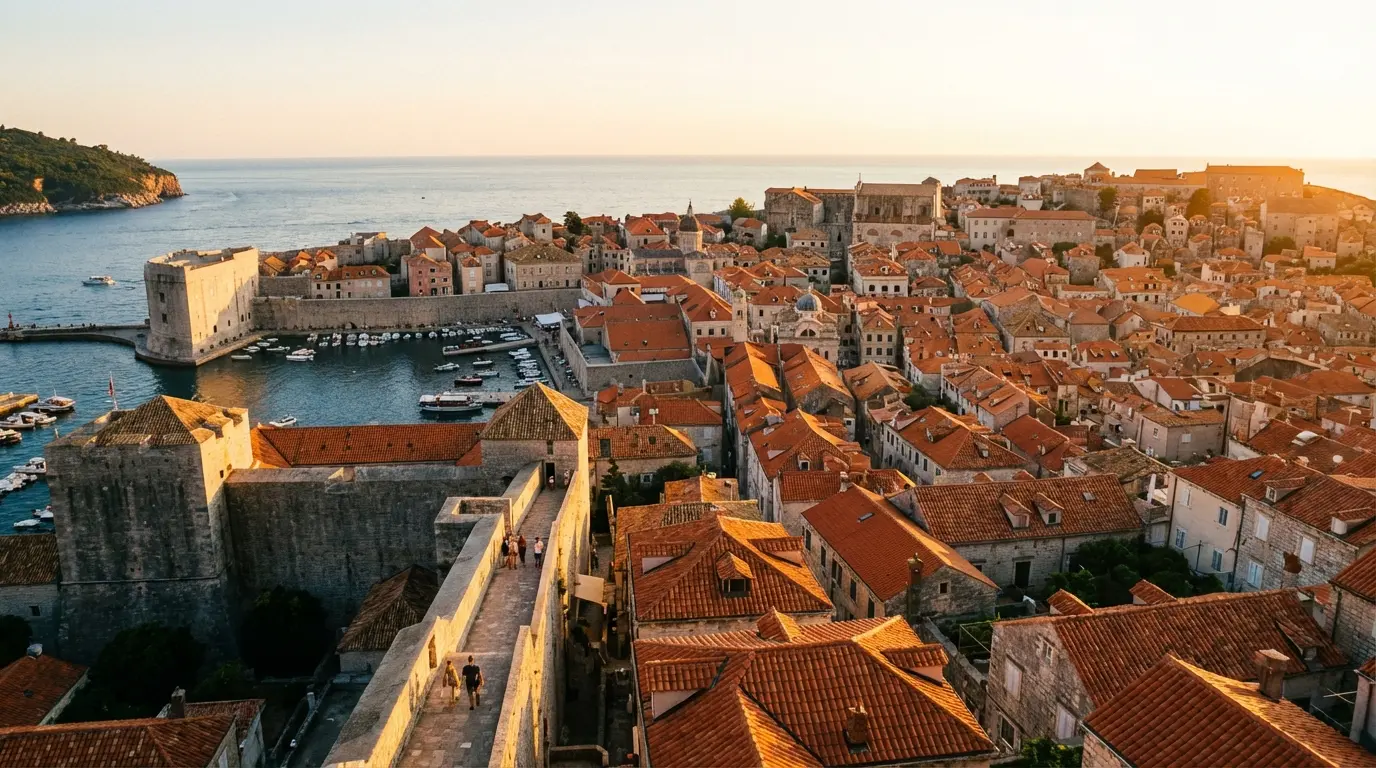
Why This Circuit? A Region Where Faiths Have Always Lived Together
Most people hear “Croatia” and think of coastline. They think of Dubrovnik’s stone walls lit gold at sunset, or the islands off the Dalmatian coast. And yes, those things are real and they are beautiful. But the heritage story of this region runs much deeper than scenery.
The stretch from Dubrovnik through coastal Montenegro and into the mountains of Bosnia is one of Europe’s most concentrated corridors of living faith. Jewish, Catholic, Orthodox Christian, and Muslim communities have shared this geography for centuries. Not always peacefully, not without suffering, but with a persistence that itself tells a story worth understanding.
For a group leader planning a heritage journey, this circuit offers something rare: a single trip that holds meaning for Jewish groups, Christian groups, and interfaith communities alike. That is not common in European travel, and it is not an accident. It comes from the particular history of this place.
Dubrovnik: Medieval Walls, an Ancient Synagogue, and Christian Heritage
Dubrovnik’s Old City is a UNESCO World Heritage site, and it earns that designation. The medieval walls are among the best preserved in Europe, and inside them sits a city that has been continuously inhabited since the 7th century.
For Jewish heritage travelers, the anchor is the Dubrovnik Synagogue. Built in 1352, it is one of the oldest continuously operating synagogues in Europe. The Sephardic Jewish community that established it came to Dubrovnik after the expulsion from Spain, and their presence here shaped the city’s trade, culture, and intellectual life for centuries. The synagogue still holds services. It is small, and it is extraordinary.
For Christian groups, Dubrovnik’s Cathedral of the Assumption holds relics attributed to St. Blaise, the city’s patron saint. The Franciscan Monastery, with its 14th-century pharmacy (one of the oldest in Europe), and the Dominican Monastery offer layers of Catholic heritage within walking distance.
What makes Dubrovnik special for heritage travel is that all of this exists within one walled city, on foot, in a single day.
Kotor and Montenegro: Fortified Faith on the Adriatic
The coastal drive from Dubrovnik south to Kotor, Montenegro, follows the Adriatic shoreline through one of the most dramatic landscapes in Europe. It also crosses an international border, which is worth knowing for group planning.
Kotor itself is a UNESCO-listed medieval walled city built into the base of a mountain at the edge of a deep bay. The fortifications climb 1,200 meters up the mountainside. Inside the walls, the Cathedral of St. Tryphon dates to the 9th century and is one of the most important Romanesque Catholic churches on the Adriatic coast. The cathedral houses a collection of sacred art and relics that has been maintained for over a thousand years.
Kotor deserves more than a photo stop. For a heritage group, a half day inside the walls, with time at the cathedral and the medieval churches tucked into the narrow streets, gives this city its proper weight.
Sarajevo: Europe’s City of Four Faiths
Sarajevo is the heart of this circuit. Within one square kilometer of the old city center, you can visit a 16th-century Ottoman mosque, a 19th-century Ashkenazi synagogue, an Orthodox cathedral, and a Catholic church. All of them are active houses of worship. All of them sit within a short walk of each other.
This is not a curated museum experience. This is how Sarajevo has been for centuries. The city’s Ottoman-era old town, the Bascarsija, was designed with this coexistence built into its streets. The Gazi Husrev-beg Mosque stands a few minutes’ walk from the Old Orthodox Church. The Sacred Heart Cathedral rises nearby. And the synagogue, though the Jewish community is now small, still stands as a witness to a presence that dates back to the 16th century.
For a heritage group, walking Sarajevo’s old city is an education in what interfaith coexistence actually looks like in brick and stone. It is not a theory. It is a neighborhood.
The Sarajevo Haggadah: The World’s Most Traveled Jewish Manuscript
Inside the National Museum of Bosnia and Herzegovina sits a manuscript that has survived more than almost any object in Jewish history. The Sarajevo Haggadah was created in Spain around 1350. It survived the Inquisition, crossed the Mediterranean with Sephardic refugees, and found its way to Sarajevo. During World War II, a Muslim museum director named Dervis Korkut hid it from the Nazis. During the Bosnian War of the 1990s, it was moved to a vault while the city was under siege.
It is still there. You can see it.
For Jewish groups especially, this manuscript carries a weight that is difficult to overstate. Its survival mirrors the survival of the communities that carried it. A visit to the National Museum to see the Haggadah is not a casual tourist stop. It is a pilgrimage of its own kind.
Medjugorje: One of the World’s Great Catholic Pilgrimage Sites
About two hours from Sarajevo, in the hills of Herzegovina, sits the small town of Medjugorje. Since 1981, it has been one of the most visited Catholic pilgrimage sites in the world, drawing millions of visitors who come to pray at the site where apparitions of the Virgin Mary were first reported.
For Christian groups, and particularly Catholic congregations, Medjugorje is a destination of deep spiritual meaning. The experience of being there with your community, led by your pastor or spiritual leader, is something many describe as transformative.
Medjugorje fits naturally into the Croatia-Montenegro-Bosnia circuit, typically as a day trip from Sarajevo or as a stop on the return route to Dubrovnik.
How to Structure This Circuit for a Group
The standard heritage circuit runs nine to eleven days and follows a geographic arc: Dubrovnik first (two to three days), then south along the coast to Kotor (one to two days), across the mountains to Sarajevo (two to three days), with Medjugorje either as a day trip or a stop on the way back to Dubrovnik.
A Jewish heritage group might spend more time in Dubrovnik and Sarajevo, building days around the synagogues and the Haggadah. A Christian group might prioritize Medjugorje and Kotor’s cathedral. Both groups benefit from the full circuit because the interfaith story of this region is part of what makes it meaningful.
Heritage Tours serves both Jewish and Christian groups on this circuit, with local operator relationships in Dubrovnik, Sarajevo, and Medjugorje. Group leaders travel free with 15 or more participants.
If you are considering this circuit for your community, we would welcome the chance to talk through what a trip could look like. Explore the Croatia, Montenegro & Bosnia destination to learn more, or reach out to start a conversation.
Frequently Asked Questions
What is the main Jewish heritage site in Dubrovnik? The Dubrovnik Synagogue, built in 1352, is one of the oldest continuously operating synagogues in Europe. It was established by Sephardic Jews who arrived after the expulsion from Spain and remains the centerpiece of Jewish heritage in the city. The synagogue also houses a small museum with historical artifacts from the community.
Why is Sarajevo significant for Jewish heritage travelers? Sarajevo is home to the Sarajevo Haggadah, a 14th-century illuminated manuscript that survived the Inquisition, the Nazis, and the Bosnian War. The city also has a centuries-old Jewish community, an active synagogue, and a history of interfaith coexistence that is unique in Europe. Jewish, Muslim, Catholic, and Orthodox communities have lived in Sarajevo’s city center for hundreds of years.
Is Medjugorje in Bosnia a major Christian pilgrimage site? Yes. Since 1981, Medjugorje has drawn millions of Catholic pilgrims from around the world. It is one of the most visited pilgrimage sites in the Catholic world today. The site is accessible as a day trip from Sarajevo or as a stop on the broader Croatia-Montenegro-Bosnia heritage circuit.
What is the Sarajevo Haggadah? The Sarajevo Haggadah is a 14th-century illuminated Jewish manuscript, originally created in Spain around 1350. It is one of the oldest surviving Haggadahs in the world and is famous for its extraordinary survival story, having been saved from destruction during the Spanish Inquisition, World War II, and the Bosnian War. It is currently housed in the National Museum of Bosnia and Herzegovina in Sarajevo.
How many days do you need for a Croatia, Montenegro, and Bosnia heritage circuit? Most heritage groups spend nine to eleven days on this circuit. This allows two to three days in Dubrovnik, one to two in Kotor, two to three in Sarajevo, and time for Medjugorje and travel between destinations. Shorter trips are possible but may require choosing between destinations rather than experiencing the full circuit.