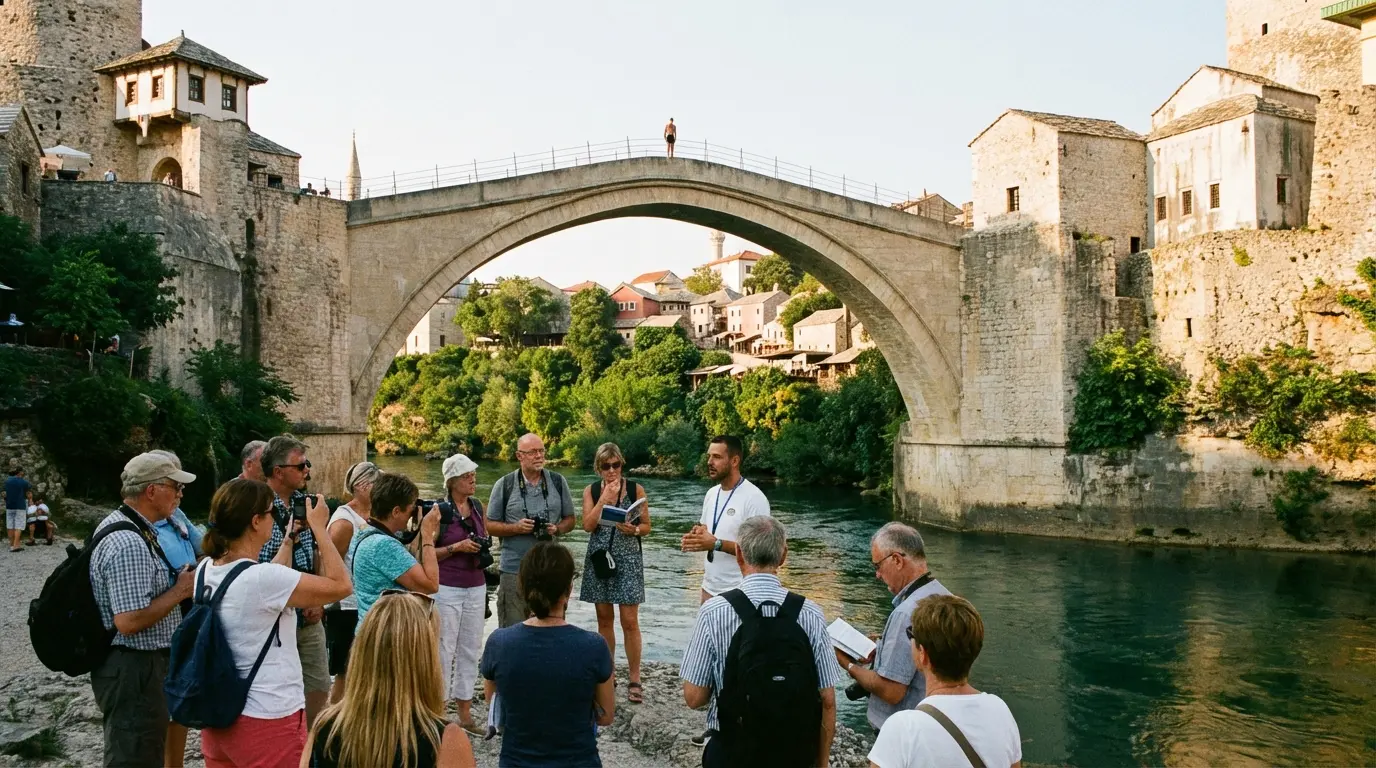
The Unique Appeal of This Circuit for Faith Groups
Few heritage circuits in Europe serve both Jewish and Christian communities as well as this one. That is not a marketing claim. It is geography and history.
Dubrovnik holds one of the oldest operating synagogues in Europe and a cathedral with relics of deep significance to Catholics. Sarajevo is a city where four faiths have coexisted for centuries, home to the Sarajevo Haggadah and an interfaith story that speaks to both Jewish and Christian groups. Medjugorje is one of the world’s most important Catholic pilgrimage sites. Kotor’s medieval cathedral has served Christian worship since the 9th century.
A rabbi and a pastor could plan two completely different group trips through the same region, each deeply meaningful, each rooted in their own tradition. Or an interfaith group could travel the circuit together and find something at every stop that speaks to the common ground between faiths.
That dual capacity is what makes this destination worth your serious consideration.
For Jewish Groups: What to Build an Itinerary Around
A rabbi planning a Jewish heritage group trip through this circuit has three anchors.
First, the Dubrovnik Synagogue. Built in 1352, it is one of the oldest continuously operating synagogues in Europe. The Sephardic community here dates to the Spanish expulsion, and the synagogue’s interior, its Torah scrolls, and its small museum tell a story that stretches back nearly 700 years. Arrange a private visit with the local community. Do not rush this.
Second, the Sarajevo Haggadah. This 14th-century illuminated manuscript survived the Spanish Inquisition, was hidden from the Nazis by a Muslim scholar, and was rescued again during the Bosnian War. It is in the National Museum of Bosnia and Herzegovina. A visit to see the Haggadah, with time to tell the story of how it got there, is the kind of experience your group will talk about for years.
Third, the living Jewish community of Sarajevo. The community is small but active, and they welcome visiting groups. Meeting them, hearing their story, and connecting with Jews who have maintained their presence in this four-faith city is something no amount of reading can replace.
For Christian Groups: Medjugorje, Kotor, and Dubrovnik’s Cathedral
A pastor planning a Christian heritage group trip has a different set of anchors, equally compelling.
Medjugorje, in the hills of Herzegovina, has drawn millions of Catholic pilgrims since 1981. For a Christian group, this is not a tourist stop. It is a pilgrimage. The experience of praying at the site with your congregation, led by your own spiritual leader, carries a weight that the location itself deepens.
Kotor’s Cathedral of St. Tryphon, dating to the 9th century, is one of the most significant Romanesque churches on the Adriatic. The cathedral’s sacred art collection has been maintained for more than a thousand years. Inside the medieval walls of Kotor, your group walks through a city where Christian worship has been continuous since the early Middle Ages.
Dubrovnik’s Cathedral of the Assumption, with its relics of St. Blaise, and the Franciscan and Dominican monasteries offer a day of immersion in Catholic heritage within the Old City walls.
Practical Logistics: Border Crossings, Coastal Ferries, and Group Transport
This circuit crosses three countries. That is part of what makes it interesting, and it is also what makes the logistics different from a single-destination trip.
The drive from Dubrovnik to Kotor crosses from Croatia into Montenegro. This is a land border crossing, and a group of 20 or more people in a coach bus needs to have documentation in order. EU citizens and most Western passport holders do not need visas for Montenegro, but the border stop takes time. Plan for it.
The route from Montenegro to Sarajevo crosses into Bosnia and Herzegovina. Again, a border crossing, and Bosnia is not an EU member state. Most Western visitors do not need visas, but the currency changes (Bosnia uses the convertible mark, not the euro or the Croatian kuna), and the infrastructure shifts as you move from the coast into the mountains.
For a group leader, these transitions are exactly the kind of thing that should not fall on your shoulders. Heritage Tours coordinates the transport, manages the border documentation, and handles the hotel-to-hotel transfers across all three countries. Your job is to lead the spiritual experience. The road between cities is ours.
Faith-Specific Considerations (Kosher, Halal, Mass Schedules, Shabbat)
For Jewish groups: kosher food in Dubrovnik and Sarajevo requires advance planning. Neither city has a large kosher restaurant infrastructure, but with preparation, Heritage Tours coordinates kosher catering and meal arrangements. Shabbat observance is possible in both cities, and the Dubrovnik Synagogue can be part of a Shabbat service for visiting groups.
For Christian groups: Mass schedules in Medjugorje are regular and well-organized, with services in multiple languages. Kotor’s cathedral and Dubrovnik’s churches hold regular services. Your group can attend worship at active churches throughout the circuit.
Halal food is widely available in Sarajevo and Bosnia, which is helpful for interfaith groups or groups with diverse dietary needs.
The Group Leader Free Policy and How It Works Here
Heritage Tours’ policy is straightforward: with 15 or more participants, the group leader travels free. On a multi-country circuit that includes hotels, transport, and guided access in three different countries, that represents meaningful savings.
For a pastor or rabbi organizing a heritage trip, this means the economics improve significantly once your group reaches that threshold. Your flight, accommodation, and ground transport are covered. You focus entirely on leading the spiritual and communal experience.
FAQ for Group Leaders
Is Medjugorje accessible as a day trip from Dubrovnik for a group? Medjugorje is roughly a two-and-a-half to three-hour drive from Dubrovnik. A day trip is possible but long. Most group itineraries position Medjugorje as a stop between Sarajevo and the coast, or as a dedicated overnight visit, to give the pilgrimage experience the time it deserves.
How do you cross the border from Croatia to Bosnia with a large group? Border crossings between Croatia, Montenegro, and Bosnia are part of this circuit. For organized groups with a coach bus, Heritage Tours manages the documentation and timing. Most Western passport holders do not need visas, but the group needs to be prepared with proper identification and the bus needs to be registered for cross-border travel.
Are there kosher food options in Dubrovnik and Sarajevo? Kosher food requires advance planning in both cities. There is no large kosher restaurant infrastructure, but Heritage Tours arranges kosher catering and meal coordination for Jewish groups as part of the trip planning process.
What makes Croatia, Montenegro, and Bosnia a good destination for a Jewish heritage group? The Dubrovnik Synagogue (1352), the Sarajevo Haggadah, and the story of Sarajevo’s interfaith protection of Jews during World War II make this one of the most significant Jewish heritage circuits in Europe. The combination of ancient Sephardic history, Holocaust-era interfaith solidarity, and a living Jewish community in Sarajevo is unique.
How long does a group heritage tour of Croatia, Montenegro, and Bosnia typically take? Nine to eleven days is the standard range for a group heritage circuit covering Dubrovnik, Kotor, Sarajevo, and Medjugorje. Shorter trips of seven days are possible by focusing on fewer destinations.
If you are a pastor or rabbi considering this circuit for your congregation, explore the Croatia, Montenegro & Bosnia destination page or contact Heritage Tours to start planning. We would be glad to walk through what this trip could look like for your group.