
A rabbi called me last year trying to decide between two brochures on his desk. One was ours, a land-based heritage tour through the Mediterranean. The other was a cruise itinerary marketed as a “heritage voyage,” stopping at some of the same countries. He asked me a fair question: “Why should I pick the harder option when the boat does the same thing with less hassle?” I did not dodge it. I told him the honest tradeoffs on both sides, because a heritage voyage is not a bad choice. It is a different choice, and your group deserves to know what each one actually gives up.
What a Heritage Voyage Actually Offers
A cruise-style heritage voyage has real strengths, and I will not pretend otherwise. You unpack once. Your hotel moves overnight while you sleep, so there is no daily packing and no changing rooms every two or three nights, which matters a great deal for older travelers or anyone with mobility concerns. The ship itself often has amenities, options for members who want to sit out a shore excursion, and a simpler logistics picture for the group leader to manage. For a congregation with a wide range of physical ability, or a leader managing their first trip and wanting the lowest possible operational complexity, those are genuine advantages.
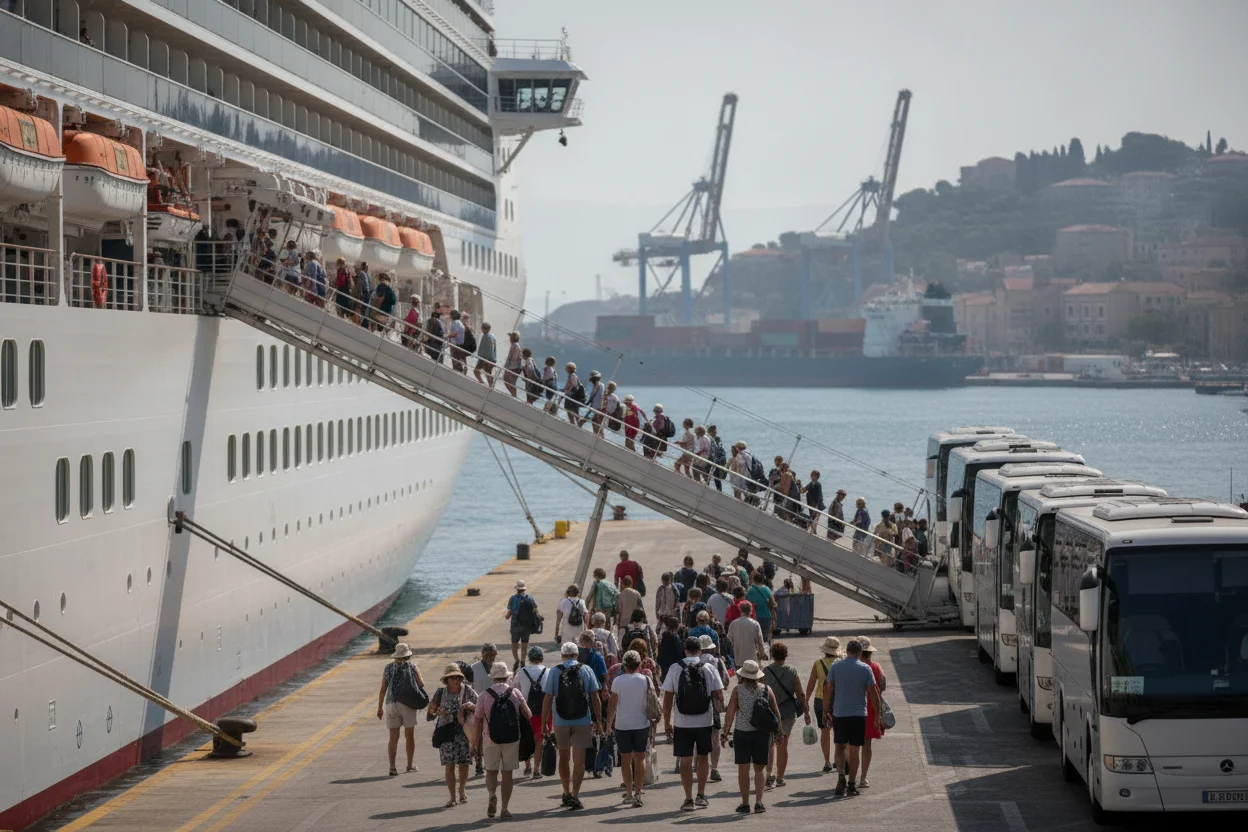
What Gets Traded Away
Here is what a heritage voyage gives up, and it is significant for a group whose purpose is meaning rather than convenience.
Time at Each Site Shrinks to a Few Hours
A cruise itinerary is built around the ship’s schedule, not the site’s significance. A stop that deserves a full day, time to walk a quarter slowly, sit in a sanctuary, read scripture aloud without rushing, gets compressed into a four or five hour shore excursion because the ship needs to sail by evening. The most meaningful moments on a heritage trip are usually the quiet, unhurried ones. Those are exactly what a fixed departure time cuts short.
The Narrative Arc Gets Broken Up
A well-built land itinerary tells a story across the days: it might trace an apostle’s journey through several connected cities, or walk a community’s history from an old quarter to a modern site of worship, in a sequence that builds meaning as you go. A cruise stops at ports in whatever order the sailing route dictates, not the order that serves the story. You get a sequence of disconnected highlights instead of a narrative. Our piece on what a heritage journey actually is goes into why that narrative structure is the core of what makes these trips work.
Depth of Guiding Suffers
A shore excursion guide is often shared across a large group from the ship, moving fast to hit the next embarkation deadline, with limited ability to adapt to your specific congregation’s interests or questions. A land-based tour lets your guide slow down at the one site that hits hardest for your particular group, skip past something less relevant to your interests, and adjust the day in real time. That flexibility disappears the moment a departure horn is involved.
Group Cohesion Is Diluted
A heritage voyage puts your congregation on a ship with hundreds or thousands of other passengers who are there for entirely different reasons, some for heritage, many simply for a cruise vacation. Your group’s shared experience gets diluted into a much larger, more generic environment. A land tour keeps your group together, in your own coach, moving as a single community with a shared purpose from morning to night. That cohesion is one of the most consistently reported benefits of a land-based trip, something we cover in our honest look at what groups actually say after a heritage journey.
Why We Build Land Tours, Honestly
Heritage Tours builds land-based, small-group journeys because our purpose is depth, not convenience. When a pastor or rabbi is bringing their people to stand in a place tied to their faith, we want that group to have the time, the guiding, and the unhurried pacing that moment deserves, not a four-hour window before the ship needs to sail. That is a genuine tradeoff against the convenience of a cruise, and I tell every group leader this plainly rather than pretending land touring has no downsides.
The honest case for a voyage is real if your group’s top priority is minimizing physical demands and daily logistics above all else. The honest case for a land tour is that if your group’s purpose is meaning, depth, and time to actually absorb what they are seeing, that is worth the extra suitcase and the extra hotel check-in. Most congregations and communities we work with choose depth, and our group heritage tours page shows how we structure that experience.
One practical note either way: with Heritage Tours, the group leader travels free when you bring fifteen or more participants, a policy built specifically around land-based group touring.
FAQ: Heritage Tours vs. Heritage Voyages
Is a heritage voyage cheaper than a land-based heritage tour?
It depends heavily on cabin category, itinerary, and season, and there is no consistent rule either way. The bigger difference is not price but structure: a voyage compresses each site into a short shore excursion, while a land tour builds full days around the sites that matter most.
Are heritage voyages easier for older travelers?
In one specific way, yes. Unpacking once and not changing hotels removes a real physical burden. But the shore excursions themselves are often faster-paced and more rushed than a land tour’s schedule, so the tradeoff is convenience between stops against unhurried time at each site.
Can a heritage voyage tell a connected story the way a land tour can?
Generally no. A cruise itinerary follows the ship’s sailing route, not the order that serves a narrative. A land-based itinerary can be built to walk a story in sequence, a journey through an apostle’s travels or a community’s history, which is much harder to replicate on a fixed cruise schedule.
Does Heritage Tours ever recommend a heritage voyage?
We are a land-based heritage tour operator, and that is where our expertise and network are built. If a group’s priorities point clearly toward voyage-style convenience, we say so honestly rather than force-fitting them into a land tour that will not serve them well.
What is the biggest difference group leaders notice between the two formats?
Depth of time at each site and cohesion of the group. Land tours consistently get reported back as feeling more connected and unhurried, since the group travels together in its own coach with a guide who can adapt the day, rather than sharing a shore excursion with hundreds of other cruise passengers.
If you are weighing a land tour against a cruise-style option for your congregation, I am glad to walk through the honest tradeoffs for your specific group. Our tours page shows the destinations we build these journeys around.
Contact us and let’s figure out which format actually fits your people.