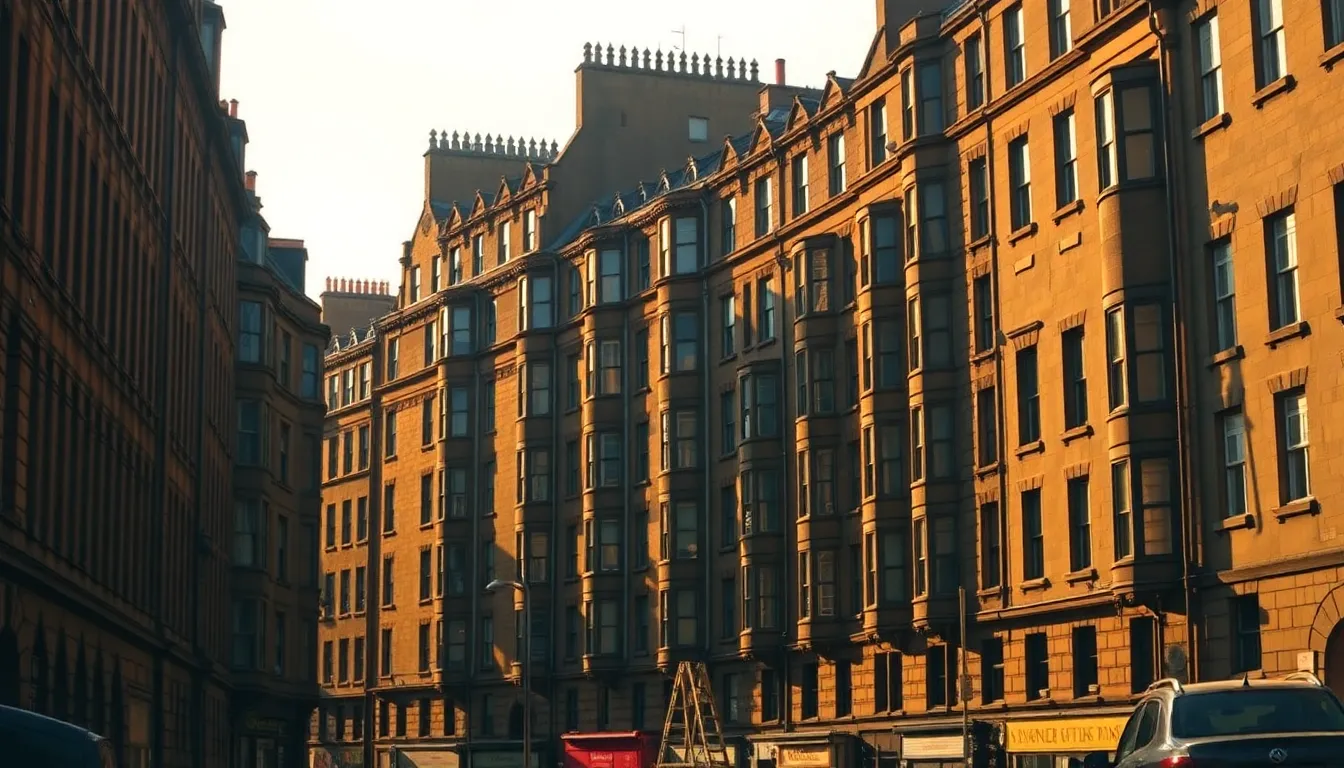
There is a moment I look for on every Glasgow trip. We are standing in the Gorbals, on the south bank of the Clyde, and I ask the group to picture it a hundred years ago: tenements packed shoulder to shoulder, washing strung between buildings, Yiddish in the air, a kosher butcher on one corner and a synagogue up the stairs of an ordinary close. Then I turn them around and point south, toward the suburbs of Giffnock and Newton Mearns, and I say, that is where their grandchildren went. The whole story of Jewish Glasgow is in that one turn of the body. Arrival, struggle, and a steady climb out.
For rabbis, ministers, and educators planning a heritage journey through the United Kingdom, Glasgow is a story worth telling in full. It is not a tale of medieval grandeur or ancient ruins. It is a modern immigrant story, raw and recent enough that families in your congregation may remember the people who lived it. That immediacy is exactly what makes it land.
How Jews Came to Glasgow
Glasgow’s Jewish community is largely a story of the late nineteenth and early twentieth centuries. The first Jews in the city were a small number of merchants and traders in the early 1800s, enough to form a congregation and, eventually, to build Garnethill Synagogue in 1879. But the community that most people picture, the dense, working-class, Yiddish-speaking world of the Gorbals, came later.
Between roughly 1880 and 1914, waves of Jews fleeing poverty and pogroms in the Russian Empire, especially what is now Lithuania, Latvia, and Poland, arrived in Britain. Many were heading for America and stopped in Glasgow, a major port, intending to move on. A good number never did. They ran out of money, found work, married, and stayed. Glasgow’s Jewish population grew from a few hundred to many thousands in a single generation.
When I explain this to a group, I want them to feel the contingency of it. People stepped off a ship meaning to cross an ocean and instead built a life on the Clyde. That is how communities are made, by accident as much as by intention.
The Gorbals: A World in a Few Streets
The Gorbals was where the new arrivals settled, and for several decades it was the beating heart of Jewish Glasgow. It was crowded, poor, and intensely alive. The streets held synagogues, cheders, kosher shops, bakeries, tailors’ workshops, and benevolent societies. Most of the work was in the needle trades: tailoring, cabinet making, peddling. People worked long hours in hard conditions and built institutions to look after each other.
It is important to be honest with a group about what the Gorbals was. It was not picturesque. It was a slum, overcrowded and unhealthy, and the people who lived there knew it. But it was also a place of extraordinary communal warmth and ambition. Parents who worked in sweatshops sent children to school with a single goal: that the next generation would not have to live this way.
Standing in the Gorbals today, you have to use imagination, because the old tenements were largely cleared in the slum-clearance programs of the mid-twentieth century. The physical fabric is mostly gone. I tell groups this plainly, because expecting an intact Jewish quarter here leads to disappointment. What remains is the ground itself, the river, the street pattern, and the story. A good guide makes that enough. We stand where the community stood, and we describe what was here.
The Move South: Giffnock and Newton Mearns
As families prospered, they moved. This is the second half of the Glasgow story, and it is the part that is still living. Through the middle of the twentieth century, the Jewish community migrated steadily south and west, out of the Gorbals and into the leafier suburbs of Glasgow’s south side. Giffnock and Newton Mearns became, and remain, the center of Jewish life in Scotland.
This is where you find the active community today: synagogues, kosher facilities, schools, care homes, community centers. If the Gorbals is the story of arrival and struggle, Giffnock is the story of having arrived. A congregation that visits both in a single day understands something about immigrant life that no lecture conveys as well. The distance from the Gorbals to Giffnock is only a few miles on a map. It represents three or four generations of work.
I encourage group leaders to build in a visit to the contemporary community, not just the historical sites. Meeting people who live the present-day life of Jewish Glasgow, in the suburbs their families climbed toward, completes the arc. History stops being something that ended and becomes something that continues.
The Records That Hold the Story
Much of what we know about ordinary Jewish Glasgow survives because of one institution: the Scottish Jewish Archives Centre, housed inside Garnethill Synagogue. Immigration papers, congregational rolls, photographs, business records, and oral histories from the Gorbals years are kept there. For a group, and especially for anyone tracing family, the archive is where the names of the Gorbals become real people again. I always pair a Glasgow heritage day with a visit to the Scottish Jewish Archives for exactly this reason.
Building a Glasgow Heritage Day
A satisfying Glasgow itinerary moves chronologically. Begin at Garnethill, the confident Victorian synagogue and the archive, to set the scene and meet the records. Move to the Gorbals to walk the ground of the immigrant generation and tell that story on the spot. Then travel south to Giffnock and Newton Mearns to see where the community lives now, ideally with a chance to meet members of the present-day community.
That structure, founding, struggle, arrival, gives a group a clear narrative and a strong emotional shape. It begins with ambition, passes through hardship, and ends in continuity. For a faith group, that arc resonates deeply, because it is the shape of so many Jewish stories across the diaspora.
Glasgow also pairs naturally with Edinburgh, an hour east by train, where a smaller but distinct community has its own history. A few days lets a group take in Jewish Edinburgh as well, and to feel how Scotland’s Jewish story differs from England’s, with its own immigration routes, its own port cities, and its own character.
Handling the Hard Parts with Care
The Glasgow story includes real hardship: poverty, exploitation in the workshops, and the long shadow of the persecution that drove people out of Eastern Europe in the first place. Many of the families who built the Gorbals had relatives who stayed behind and were murdered in the Holocaust a generation later. When you tell the arrival story, that loss is part of the background, and it deserves to be named with dignity rather than skipped.
I find groups handle this well when it is given room. The people who came to Glasgow were the ones who got out in time. Their survival and their building of a new life is not separate from the catastrophe that befell those they left. It is connected to it. Holding both, the loss and the building, is what makes the Glasgow story true rather than tidy.
FAQ: Jewish Heritage in Glasgow
Where was the historic Jewish community in Glasgow?
The immigrant Jewish community centered on the Gorbals, on the south bank of the Clyde, from roughly the 1880s through the mid-twentieth century. It was a dense, working-class neighborhood of synagogues, kosher shops, and needle-trade workshops. As families prospered, the community moved south to the suburbs of Giffnock and Newton Mearns, where Jewish life in Scotland is centered today.
Can you still see the old Jewish Gorbals?
Mostly the old tenements were cleared in twentieth-century slum-clearance programs, so the physical fabric is largely gone. What remains is the ground, the river, and the street pattern. A good guide makes the visit meaningful by telling the story on the spot. For records and photographs of the Gorbals years, the Scottish Jewish Archives at Garnethill is essential.
Why did Jews come to Glasgow?
Most came between 1880 and 1914, fleeing poverty and pogroms in the Russian Empire, especially present-day Lithuania, Latvia, and Poland. Glasgow was a major port, and many arrived intending to sail on to America. A large number ran out of money or found work and stayed, building the community from a few hundred people to many thousands in a single generation.
Where does Glasgow’s Jewish community live now?
In the south-side suburbs of Giffnock and Newton Mearns, which together form the center of Jewish life in Scotland today. Visiting both the historic Gorbals and the present-day suburbs in one day gives a group the full arc of the immigrant story, from arrival and struggle to settled community life.
Is Glasgow worth a stop on a UK heritage tour?
Very much, especially for groups interested in the modern Jewish immigrant experience rather than only medieval history. Glasgow’s story is recent enough that some families remember it directly. It also pairs well with Edinburgh, an hour away, letting a group see two distinct Scottish communities and understand how Scotland’s Jewish history differs from England’s.
If a Scottish leg appeals to your community, the Gorbals-to-Giffnock journey is one of the most moving days I run, and I would be glad to help you shape it. You can see how we build these trips at our United Kingdom destination page and our group heritage tours, where the group leader travels free with fifteen or more participants.
Contact us when you are ready to start the conversation.