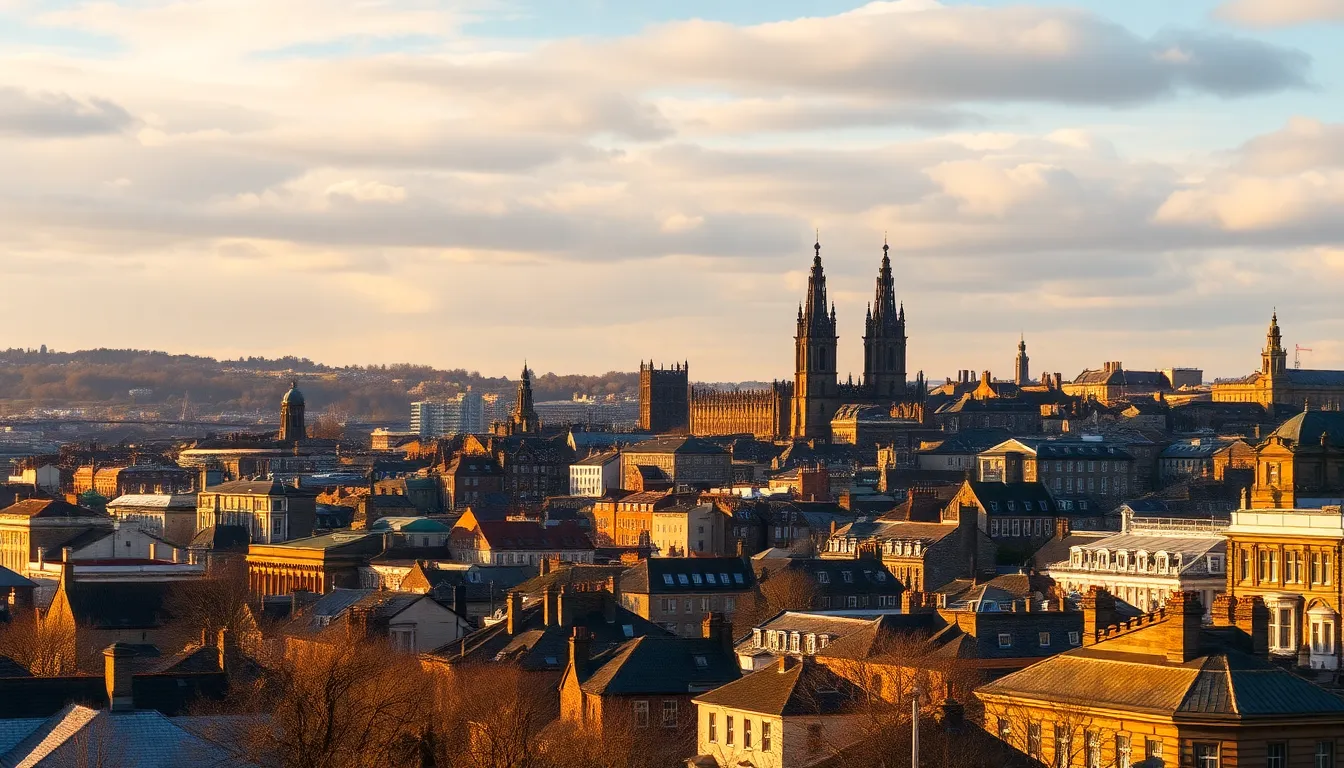
Most groups come to Edinburgh for the castle, the Royal Mile, and the dramatic skyline, and I understand why. But I always tell the rabbis and ministers I travel with that there is another Edinburgh layered underneath the postcard one, a quieter Jewish city that you can walk in an afternoon if you know where to look. It is a smaller story than Glasgow’s, and a different one. Where Glasgow is loud and industrial, Edinburgh is reserved and academic. The two cities sit an hour apart and tell two distinct chapters of Scottish Jewish life.
If you are planning a heritage journey through the United Kingdom and you are giving Scotland its proper place, Edinburgh deserves a day. This is a walking city, and Jewish Edinburgh in particular rewards the walker. Let me take you through it the way I take a group.
A Smaller, Older Story Than You Might Expect
Edinburgh’s Jewish community is older than Glasgow’s, even though it stayed smaller. Jews were living in Edinburgh by the late eighteenth century, and a congregation was formally established in 1816, making it one of the oldest in Scotland. For a city that never had a large Jewish population, that is a long and continuous presence.
The character of the community matters. Edinburgh has always been a city of universities, law, and medicine, and its Jewish community took on something of that flavor. Where Glasgow’s Jews concentrated in the needle trades and the Gorbals tenements, Edinburgh’s tended toward the professions, the university, and commerce on a quieter scale. The community never grew to Glasgow’s size, but it produced doctors, lawyers, academics, and merchants, and it was woven into the intellectual life of the city.
I find groups respond well to this contrast. It complicates the immigrant story in a useful way. Not every Jewish community in Britain looked like the Gorbals. Edinburgh shows a different texture, smaller, more dispersed, more professional, and that variety is part of an honest picture of British Jewry.
The Old Quarters: Where the Community Lived
Jewish Edinburgh has moved around the city over two centuries, and walking it means tracing that movement. The earliest community gathered in the Old Town and the area around the South Bridge and the university. As the city expanded, Jewish families spread into the newer districts.
In the late nineteenth and early twentieth centuries, when immigration from Eastern Europe added to the community, many newcomers settled in the South Side, around the streets near the university and the Meadows. This was Edinburgh’s nearest equivalent to an immigrant Jewish quarter, though it was never as dense or as poor as the Gorbals. Small synagogues, shops, and community institutions clustered here. Over the twentieth century, as in Glasgow, families moved outward to more comfortable suburbs, and the community’s center of gravity shifted accordingly.
When I walk a group through the South Side, I am honest that there is no preserved Jewish quarter to tour. The buildings are mostly ordinary tenements and townhouses, now serving other purposes. What you are reading is the geography, the streets where the community lived, studied, and prayed. A good guide brings that to life. We stand on a corner, and I describe the kosher shop that was here, the cheder up those stairs, the families who walked these pavements to synagogue on a Friday evening.
The Synagogue: Salisbury Road
The center of Jewish religious life in Edinburgh today is the synagogue on Salisbury Road in the South Side, home of the Edinburgh Hebrew Congregation. The congregation traces its roots back to 1816, and its current synagogue, opened in 1932, is the heart of the community.
I have written separately about the Edinburgh Hebrew Congregation and the Salisbury Road synagogue, because the congregation’s long history deserves its own telling. For a walking tour, the building is the natural anchor and the natural endpoint. It is an active congregation, so a visit is arranged in advance rather than walk-in, and that arrangement is part of what makes it feel personal. Standing in the sanctuary of a congregation that has prayed in this city for more than two centuries gives a group a strong sense of continuity.
Walking Jewish Edinburgh: A Suggested Route
Edinburgh is compact, and a Jewish heritage walk fits comfortably into a half day, with the historic center close enough to combine with general sightseeing. I usually structure it like this.
Begin near the university and the Old Town, where the earliest community gathered, to set the historical scene and connect the Jewish story to Edinburgh’s intellectual life. Move into the South Side, around the streets near the Meadows, to trace the immigrant-era community and describe the small synagogues and shops that once stood here. End at the Salisbury Road synagogue, the living center of the community, arranged in advance so the group can see inside.
This route works on foot, which suits Edinburgh and suits a group that wants time to absorb rather than rush between sites. The walking itself is part of the experience. You feel the city’s scale and its layers, and the Jewish story sits inside the broader story of one of Europe’s great university cities.
Edinburgh and Glasgow Together
Edinburgh makes most sense as part of a wider Scottish leg rather than on its own. An hour by train separates it from Glasgow, and the two cities together give a group the full shape of Scottish Jewish life. Glasgow brings the industrial immigrant story, the Gorbals, the move to Giffnock, and the records held at the Scottish Jewish Archives. Edinburgh brings the smaller, older, more professional community and its long continuity.
I encourage group leaders to frame the two cities as a contrast rather than a repetition. Seeing both teaches a group that there was no single Scottish Jewish experience, just as there was no single British one. The variety is the lesson. And both, crucially, are distinct from England. Scotland’s communities formed through their own port cities and their own immigration routes, and they have their own character. Folding Scotland into a generic British itinerary misses that, which is why I treat it as its own chapter.
Telling the Hard Parts with Care
Edinburgh’s Jewish story, like every European Jewish story, carries loss. Many of the families who built the community had relatives in Eastern Europe who were murdered in the Holocaust. The city also took in refugees in the 1930s, including academics and children, some of whom found shelter through Edinburgh’s universities and Jewish families. That chapter, of a small community opening its doors to people fleeing catastrophe, is one I always make room for. It is a story of refuge, and it deserves to be told with dignity and without rushing.
A walking tour gives space for these reflections in a way a packed coach itinerary does not. We can stop, stand quietly, and let a moment of remembrance happen on the street where it belongs.
FAQ: Jewish Heritage in Edinburgh
How old is the Jewish community in Edinburgh?
Jews were living in Edinburgh by the late eighteenth century, and a congregation was formally established in 1816, making it one of the oldest in Scotland. The community stayed smaller than Glasgow’s but has a long, continuous presence in the city, closely tied to Edinburgh’s universities and professions.
Where did Jews live in Edinburgh?
The earliest community gathered in the Old Town near the university. In the immigrant era of the late nineteenth and early twentieth centuries, many settled in the South Side around the Meadows, Edinburgh’s nearest equivalent to a Jewish quarter, though never as dense as Glasgow’s Gorbals. Over time the community spread into more comfortable suburbs.
Is there a synagogue to visit in Edinburgh?
Yes. The Edinburgh Hebrew Congregation worships at the synagogue on Salisbury Road in the South Side, opened in 1932. The congregation dates back to 1816. It is an active synagogue, so visits are arranged in advance rather than walk-in, which makes for a more personal experience.
Can Jewish Edinburgh be done as a walking tour?
Yes, and it suits one well. Edinburgh is compact, and a Jewish heritage walk fits into a half day, moving from the Old Town and university area, through the South Side immigrant streets, to the Salisbury Road synagogue. The walking itself, through a layered historic city, is part of what makes the experience memorable.
How does Edinburgh compare to Glasgow for a heritage trip?
They tell different and complementary stories. Glasgow is the industrial, working-class immigrant story of the Gorbals and the move to Giffnock. Edinburgh is smaller, older, and more professional, tied to the universities. Seeing both, an hour apart by train, gives a group the full and varied picture of Scottish Jewish life.
If you are shaping a Scottish leg for your community, pairing a walking day in Edinburgh with the Glasgow story makes for a rich few days, and I would be glad to help you plan it. You can see how we structure these journeys at our United Kingdom destination page and our group heritage tours, where the group leader travels free with fifteen or more participants.
Contact us whenever you are ready to start planning.