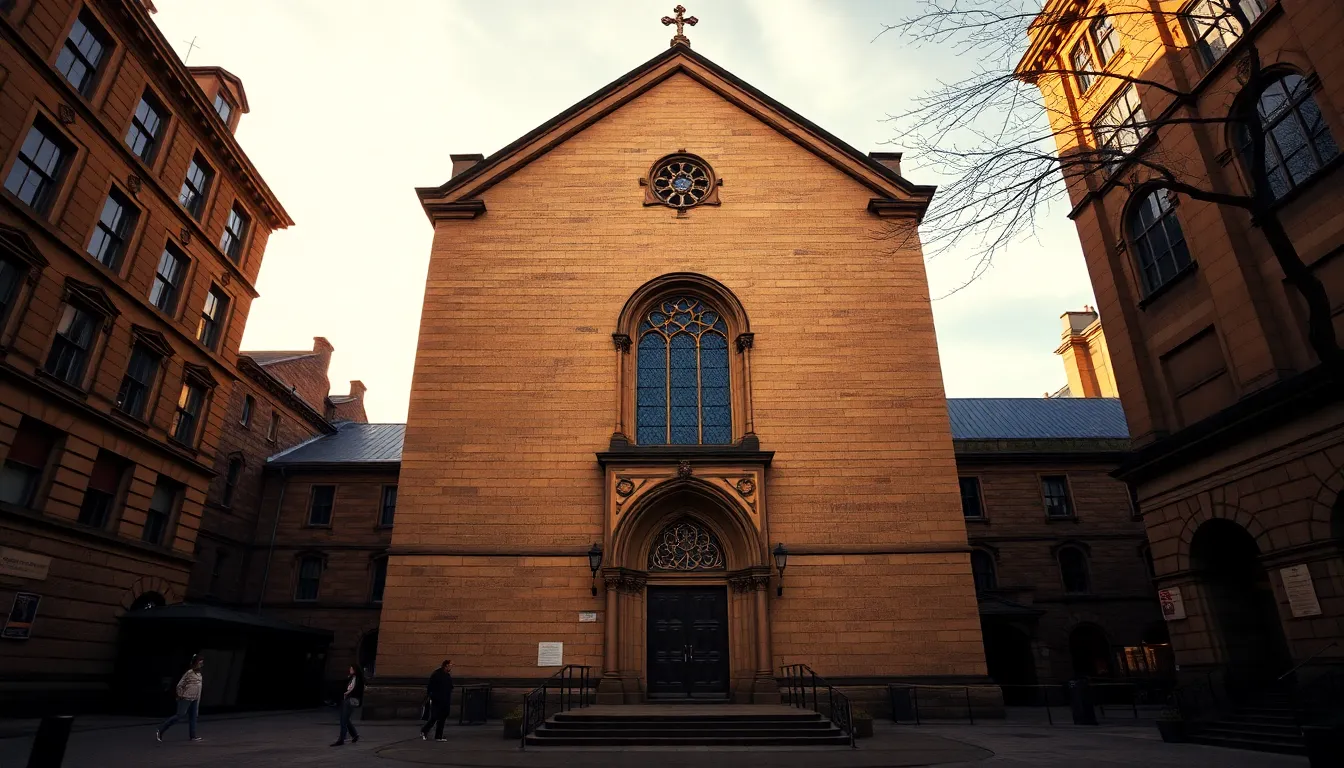
The first time I brought a group up the hill in Glasgow’s West End to stand outside Garnethill Synagogue, one of the rabbis with me went quiet for a moment. He had expected something modest. What he found was a building that announced itself, a confident Romanesque and Byzantine facade on a steep city street, built by a community that had decided, in 1879, that it was here to stay. That decision is the whole story of this place, and it is why I take groups there.
If you are a rabbi, a minister, or an educator thinking about a heritage journey through the United Kingdom, Scotland deserves more of your attention than most itineraries give it. And Garnethill is the right place to begin. It is Scotland’s oldest purpose-built synagogue, and it still holds Shabbat services today. It is not a ruin or a museum piece. It is a living building, and it houses the Scottish Jewish Archives Centre within its own walls.
A Synagogue Built to Last, in 1879
Jews had been living and praying in Glasgow for decades before Garnethill opened. The community met in rented rooms and converted spaces around the city center, growing alongside Glasgow’s rise as a center of shipbuilding and trade. By the 1870s the community had outgrown its temporary homes and wanted something permanent.
What they built tells you how they saw themselves. Garnethill was designed by John McLeod, working with the prominent Edinburgh architect James Salmon, and it opened in 1879 at a cost that stretched the community. The exterior draws on Romanesque and Byzantine forms. The interior is one of the finest Victorian synagogue spaces in Britain, with a horseshoe gallery, richly colored stained glass, and an ark framed by polished granite columns. The famous rose window above the ark fills the sanctuary with light in the late afternoon.
When your group stands inside, point out what the architecture is saying. This was a confident, established, upwardly mobile Jewish community in one of the wealthiest industrial cities in the world. They were not hiding. They built in the open, on a prominent hill, in a style meant to last for generations. For a congregation used to thinking of Jewish heritage in terms of loss and survival, Garnethill offers a different and welcome note: arrival.
What You See Inside
The sanctuary is the heart of any visit. Take your time here. The stained glass is worth a slow look, and the gallery gives a sense of how the community was seated and how the space worked on a busy Shabbat in its prime. The bimah and ark reward close attention, and the acoustics in the room are genuinely moving when someone sings.
I always tell group leaders to build in time rather than rush. Garnethill is not a large building, but it is a dense one. There is a lot to read in the details, and the volunteers who help run the place know the stories. A good visit here is unhurried, with room for questions and quiet.
Because it remains an active congregation, access is arranged rather than walk-in. Visits are coordinated in advance, often alongside the archives. That is normal for a working synagogue, and it is part of why the experience feels personal rather than touristic. You are a guest in a community’s home, not a ticket holder at an attraction.
The Scottish Jewish Archives Centre, Under the Same Roof
Here is what makes Garnethill unusual, and why I treat it as two visits in one. The Scottish Jewish Archives Centre is housed inside the synagogue building. It is the national archive of Jewish life in Scotland, and it is one of the most complete records of any Jewish community in Britain.
The collection holds congregational records, immigration documents, photographs, business records, war service records, family papers, and oral histories stretching back more than two centuries. For a group, the archive turns abstract history into something you can hold. A photograph of a family arriving from Lithuania. A ledger from a Gorbals tailor. A name on a synagogue membership roll. These are the ordinary documents of ordinary lives, and they are exactly what makes a heritage trip land emotionally.
If anyone in your group has Scottish Jewish ancestry, the archive can be the most powerful hour of the whole trip. The volunteers there have helped countless visitors trace a grandparent or a great-grandparent through these records. I have watched it happen, and there is nothing like it. To make the most of that, reach out in advance with names and approximate dates so the staff can prepare.
For the full Glasgow story that these records document, the move from the immigrant Gorbals to the suburbs of the south side, it is worth pairing Garnethill with a wider look at Jewish heritage in Glasgow. The archive is the thread that ties the whole arc together, and you can read more about the Scottish Jewish Archives on its own.
Fitting Garnethill Into a Group Itinerary
Garnethill works beautifully as the anchor of a Glasgow day. The synagogue and archive together fill a comfortable half day, with depth to spare. From there, groups often move to the south side, to Giffnock and Newton Mearns, where the bulk of Glasgow’s Jewish community lives today. The contrast between the grand Victorian synagogue in the center and the thriving suburban community to the south tells the demographic story without a single lecture.
Glasgow also pairs naturally with Edinburgh, an hour away by train. A few days in Scotland can take in Garnethill, the Glasgow story, and then Jewish Edinburgh, giving your group two distinct community histories within one region. This is genuinely different from England, and worth framing that way. Scotland’s Jewish story has its own shape, its own immigration patterns, and its own character.
A practical note on the city itself. Garnethill sits in central Glasgow, close to the Glasgow School of Art and within easy reach of the main rail stations. The hill it sits on is steep, which matters if your group includes anyone who finds steps difficult. Plan transport to drop close to the door.
Why This Place Matters for a Faith Group
I have taken groups to grander synagogues and older ones. What I keep coming back to with Garnethill is the combination. A confident, beautiful, living building, with the written memory of an entire national community held inside it. You do not get that pairing in many places. You stand in the sanctuary, then you walk down to the archive and read the names of the people who built it. The building and its memory are in the same place.
For pastors and rabbis used to telling the story of Jewish dispersion and resilience, Garnethill adds a chapter that is too often skipped: a community that crossed an ocean, climbed out of poverty, and built something permanent and proud in a Scottish industrial city. That is a story worth bringing a congregation to see.
FAQ: Visiting Garnethill Synagogue
Is Garnethill Synagogue still an active congregation?
Yes. Garnethill remains a working synagogue and holds services. Because it is active rather than a museum, visits are arranged in advance rather than as walk-in tourism. This is part of what makes a group visit feel personal. You are hosted by the community, usually alongside the Scottish Jewish Archives Centre housed in the same building.
What is the Scottish Jewish Archives Centre?
It is the national archive of Jewish life in Scotland, located inside Garnethill Synagogue. It holds congregational records, immigration papers, photographs, oral histories, and family documents going back more than two centuries. For groups, and especially for anyone with Scottish Jewish ancestry, the archive turns history into something personal and tangible.
How old is Garnethill Synagogue?
It opened in 1879, making it the oldest purpose-built synagogue in Scotland. The Glasgow Jewish community existed for decades before that in rented and converted spaces, but Garnethill was the first building they constructed for themselves, in a confident Romanesque and Byzantine style meant to last.
How long should a group spend at Garnethill?
Plan a comfortable half day. The sanctuary rewards an unhurried look, and the archive can easily fill an hour or more, especially if members of your group want to trace family records. Reach out in advance with any family names and dates so the archive staff can prepare.
Can Garnethill be combined with other Scottish Jewish sites?
Yes, and I recommend it. Garnethill pairs naturally with the wider Glasgow story, from the Gorbals to Giffnock, and Glasgow sits about an hour from Edinburgh by train. A few days in Scotland can take in both city communities, giving your group two distinct histories within one region.
If Scotland is on your mind for your community’s next heritage journey, I would be glad to talk it through. Garnethill is one of those places that quietly surprises people, and building a Scottish itinerary around it is one of my favorite conversations to have. You can see how we structure these trips at our United Kingdom destination page and our group heritage tours, where the group leader travels free with fifteen or more participants.
Contact us whenever you are ready to start planning.