When I tell people I take groups to Jewish Belfast, the response is almost always a pause, then a question: there were Jews in Belfast? There were. A real community, with a synagogue, a school, businesses that shaped the city’s linen trade, and a story that runs straight through the most turbulent decades of modern Irish history. It is one of the most surprising and rewarding stops I know on a United Kingdom heritage tour, precisely because almost no one expects it.
This guide is for group leaders considering Northern Ireland. I want to give you the real shape of the Belfast community, what built it, what it produced, and what your group can still see today.
A Community Built on Trade
Belfast’s Jewish community is younger than those of Wales or the great English cities. It took form mainly in the 19th century, and it grew for a clear reason: industry and trade.
Belfast in the 1800s was a booming industrial city, famous for linen, shipbuilding, and commerce. That growth drew Jewish settlers, first a handful of German Jewish merchants connected to the linen trade, then, from the 1880s, the much larger wave of Eastern European Jews fleeing persecution in the Russian Empire. The early German Jewish families included figures of real standing in the city’s commercial life, men whose firms helped power Belfast’s linen exports.
By the early 20th century Belfast held a community of a few thousand, concentrated in particular districts of the city, with the institutions a community needs: synagogues, a Hebrew school, charitable societies, and a strong sense of itself.
The Synagogue
The center of any community’s heritage is its house of worship, and Belfast’s is a building worth bringing a group to see.
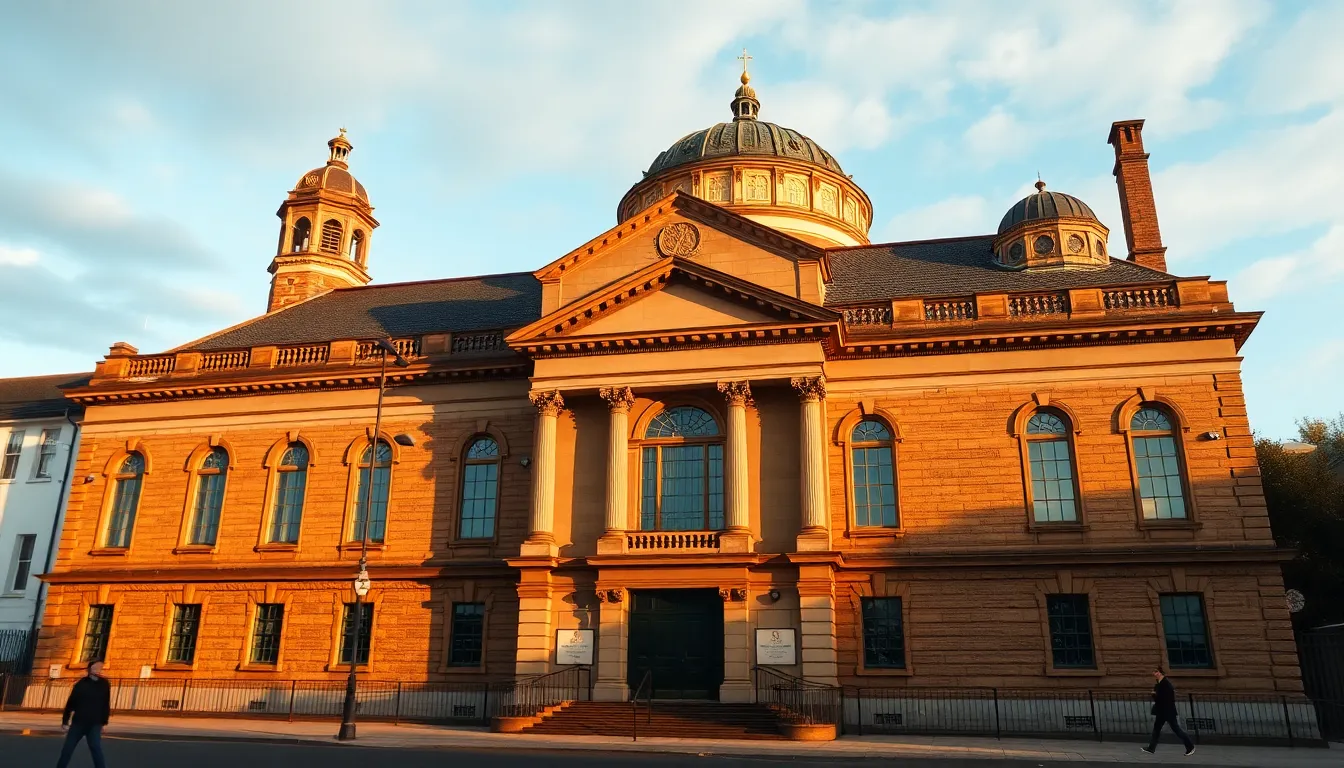
The community’s main synagogue, on the north side of the city, has served Belfast Jewry through the modern era. As the community changed and contracted, the building has been adapted to fit its present size, but it remains the living heart of Jewish Belfast, where services are held and the calendar is kept. For a group, standing in an active synagogue in a city most people never associate with Jewish life is a quietly powerful thing.
Earlier in the community’s history there were other synagogue sites in the districts where the immigrant generation first settled. Tracing that geography, from the early settlement areas to the present building, shows how the community moved and consolidated over a century. A good local guide can walk your group through that journey.
Founders and Figures
Belfast’s Jewish community was small, but it produced and attracted people of remarkable consequence.
The German Jewish merchant families who helped build the linen trade left a mark on the city’s commerce. The community also became closely tied to the early Zionist movement and to figures who would loom large in the story of the State of Israel. Most famously, Belfast was the birthplace of Chaim Herzog, who became the sixth President of Israel, and the city where his father, Rabbi Isaac Herzog, served as a rabbi before becoming Chief Rabbi of Ireland and later Chief Rabbi of the Land of Israel. That connection alone makes Belfast a destination of real significance, and I treat it in depth in our piece on the Belfast community and Chaim Herzog’s birthplace.
Helping your group grasp that a small northern community sat at the crossroads of British, Irish, and Zionist history is one of the great pleasures of leading a tour here.
A Jewish Community Through the Troubles
I cannot describe Jewish Belfast honestly without addressing the decades of conflict known as the Troubles. From the late 1960s into the 1990s, Belfast was a city divided by sectarian violence between Catholic and Protestant communities.
The Jewish community occupied an unusual position in that conflict. It belonged to neither side of the central divide. Jewish families often lived and worked across the city’s hard lines, and the community largely sought to keep clear of a struggle that was not theirs. That neutrality was its own kind of difficulty and its own kind of dignity, a small community trying to hold its life together in a city tearing itself apart.
For a faith group, this chapter raises real and worthwhile questions about how a minority community navigates a conflict it did not create. I handle it carefully and without sensationalism. It is part of the Belfast story, and your group should understand it.
Decline and Continuity
Like the Welsh communities, Belfast Jewry declined over the 20th century, and for similar reasons: emigration, the pull of larger Jewish centers, and the additional pressure of decades of civil conflict that prompted many families to leave the city. From a peak of several thousand, the community shrank to a fraction of its former size.
But it did not disappear. A community remains in Belfast today, holding services, keeping the synagogue, marking the festivals. That continuity, after everything the city has been through, is itself a testament. When I bring a group to meet what remains of Jewish Belfast, the lesson is not only about loss. It is about persistence.
Belfast in a Wider Itinerary
Belfast is the natural Northern Irish chapter of a three-nations United Kingdom journey. It pairs powerfully with the Welsh communities of Cardiff and the valley towns, because the parallels are so clear: industrial cities, immigrant founders, a rise, a peak, a decline, and a small surviving remnant. Seeing both helps a group understand that British Jewish history played out in many cities, each with its own shape.
If your group keeps kosher or observes Shabbat, Belfast requires advance planning given the community’s size. Our guides to keeping kosher and observing Shabbat across these communities cover what is realistic and how we arrange it.
You can see how Belfast fits the wider picture on our Jewish heritage of the United Kingdom hub, and our United Kingdom destination page explains how we build these itineraries.
What Belfast Gives a Group
Belfast surprises people. They come expecting a footnote and find a full community story, founders who built an industry, a rabbinic family that shaped Israel’s history, a minority that held its dignity through decades of conflict, and a remnant that endures still. There are no crowds, no tourist machinery. There is a city, a synagogue, and a story almost no one knows.
For a group leader, that is a rare offering. Your congregation will leave Belfast with something they did not expect to find, and that is exactly what makes a heritage trip stay with people.
If Northern Ireland interests your community, I would welcome the conversation. Heritage Tours builds every itinerary around your group’s interests, and with 15 or more participants, the group leader travels free.
FAQ: Jewish Heritage in Belfast
Was there really a significant Jewish community in Belfast?
Yes. Belfast’s Jewish community formed mainly in the 19th century and grew to several thousand by the early 20th century. It was built first by German Jewish merchants tied to the linen trade, then by a larger wave of Eastern European immigrants from the 1880s, and it sustained synagogues, a Hebrew school, and charitable institutions.
Is there still a Belfast synagogue you can visit?
Yes. The community’s main synagogue on the north side of the city remains active, adapted over time to fit the community’s present size. It is the living center of Jewish Belfast, and visiting an active synagogue in a city rarely associated with Jewish life is a memorable part of any Northern Ireland heritage tour.
How did the Belfast Jewish community fare during the Troubles?
The Jewish community belonged to neither side of the Catholic-Protestant divide and largely sought to stay clear of the conflict. Families often lived and worked across the city’s hard lines. The decades of violence did contribute to emigration and the community’s decline, but a community remained throughout and continues today.
Why is Belfast important to Jewish and Israeli history?
Belfast was the birthplace of Chaim Herzog, the sixth President of Israel, and the city where his father Rabbi Isaac Herzog served before becoming Chief Rabbi of Ireland and later Chief Rabbi of the Land of Israel. The community was also closely connected to the early Zionist movement, giving this small northern community an outsized place in the story of Israel.
Does Belfast work as part of a larger heritage tour?
Very well. Belfast is the natural Northern Irish chapter of a three-nations journey through Scotland, Wales, and Northern Ireland. Its story closely parallels the Welsh communities, which makes pairing them especially instructive for a group.
If you would like to explore a Belfast visit for your community, contact us and we will start planning together.