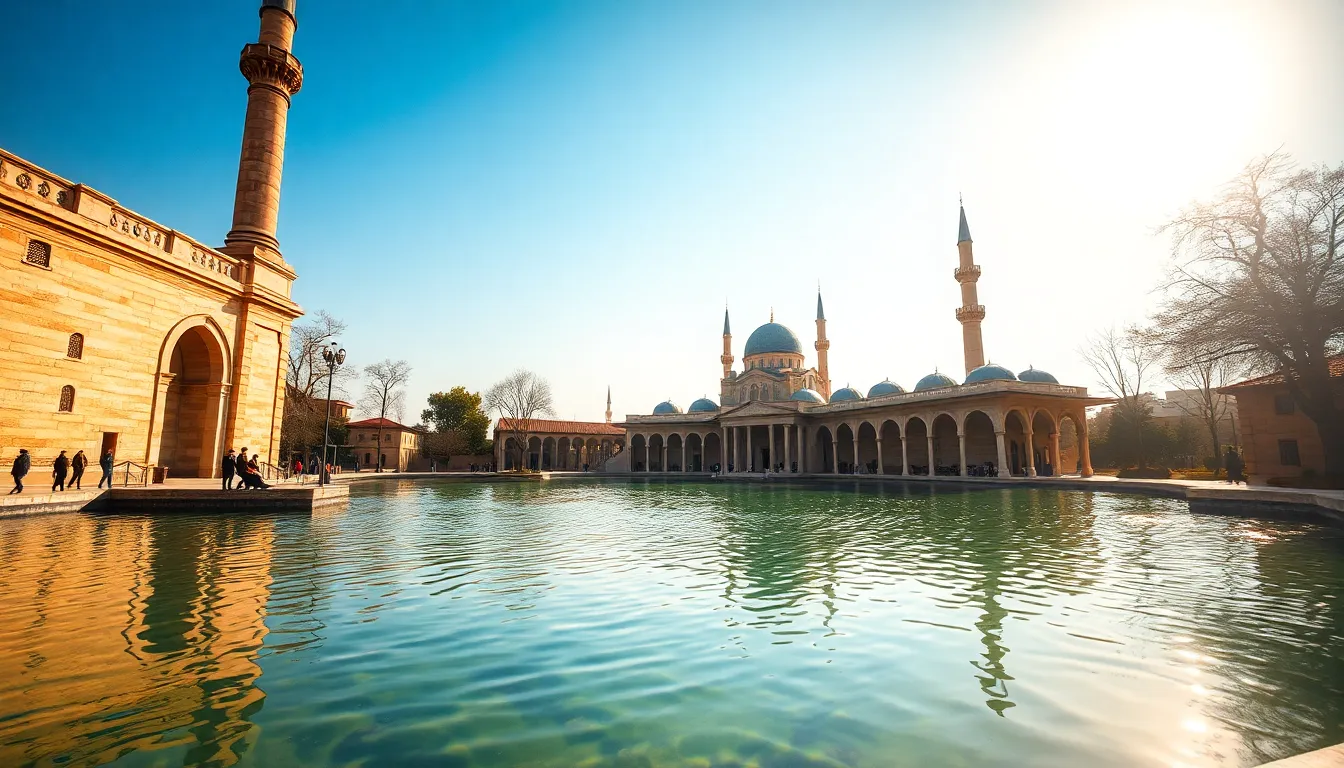
The first time I brought a group to Sanliurfa, an older pastor stood at the edge of the carp pool, looked at the water and the minarets reflected in it, and said quietly, “I did not expect to feel this here.” That is the thing about Urfa. It is far from the usual Turkey circuit, deep in the southeast near the Syrian border, and most faith travelers have never heard of it. Then they arrive, and the place reaches them.
This is the city that local tradition names as the birthplace of Abraham. The cave, the pools, the whole complex sit together in the heart of the old town, and they carry a weight you feel before anyone explains a word of it. Let me tell you what is here, how to read it honestly, and how a group makes the most of a day in it.
The Birthplace Tradition
Sanliurfa was known in antiquity as Edessa, and to Jews, Christians, and Muslims alike it has long been tied to Abraham. The local tradition holds that Abraham was born in a cave on the slope of the citadel hill, and that he spent his early years hidden there. You will hear the city called the place where Abraham first knew God.
I am always careful with my groups about what we can and cannot prove. The Bible names Ur of the Chaldees as Abraham’s origin, and scholars still debate whether that points to southern Mesopotamia or to this northern region of Urfa and Harran. What is certain is that Harran, less than an hour south of the city, is named directly in Genesis as the place where Abraham’s family settled and where God called him to go to Canaan. So whatever you conclude about the cave itself, you are standing in the landscape of the patriarch. That much the text supports.
I tell groups this plainly. The cave is a tradition, not a verified site. But the region is genuinely Abraham’s country, and that combination, honest about one thing and confident about the other, lets people receive the place without checking their minds at the door.
The Cave Itself
The Cave of Abraham, the Hz. Ibrahim Halilullah cave, sits inside a mosque complex at the base of the citadel hill. The entrance is modest. You remove your shoes, and men and women enter through separate doorways into a small viewing area where you look through glass at the cave interior and a spring of water within it.
It is not a grand space. Pilgrims come to pray and to drink from the spring, which is believed to carry blessing. For a Christian or Jewish group this is a quiet, observant stop rather than a place to linger. I gather people beforehand outside, read a few verses from Genesis 12 where God calls Abraham, and then we go in respectfully, a few at a time. The reverence of the Muslim pilgrims around you is part of what makes it move people. Abraham belongs to all three faiths, and you feel that here in a way no lecture conveys.
The Sacred Pools of Balikligol
Just below the cave lie the pools that most visitors remember longest. Balikligol means “pool of fish,” and the pools are full of carp that no one is permitted to catch or harm.
The legend behind them is worth telling your group, because it shapes everything you are looking at. The story goes that the tyrant king Nimrod ordered Abraham thrown into a great fire for smashing idols and proclaiming one God. As Abraham fell, God turned the fire into water and the burning coals into fish. The pool, in the tradition, is that water. The fish are sacred descendants of that moment.
You will not find this account in Genesis. It comes from later Jewish midrash and from Islamic tradition, where the Abraham and Nimrod confrontation is told at length. I name that for my groups so no one walks away thinking they missed it in their Bible. But standing at the pool, watching hundreds of dark carp move through clear green water beneath the Ottoman arcades, with families feeding them and the call to prayer rising over the gardens, you understand why this story has held people for so long. It is a meditation on a God who turns judgment into mercy, and it is beautiful.
How Groups Visit Sanliurfa
The whole sacred complex, the cave, the pools, the Halil-ur Rahman and Rizvaniye mosques, and the gardens, sits in a single walkable area at the foot of the citadel. A group can take it in over a calm two to three hours.
Here is how I structure it. We start in the gardens to orient and read from Genesis. Then we visit the cave, quietly and a few at a time. We come down to the pools and spend unhurried time there, which is where the reflection naturally happens. If energy and time allow, we climb a portion of the citadel hill for the view over the old city and the desert beyond, the land Abraham’s family knew.
Modest dress matters at every part of this complex. Women should bring a head covering for the mosque areas, and everyone needs shoulders and knees covered. Photography is fine in the gardens and at the pools, but follow posted guidance inside the cave and mosques.
Most groups pair Urfa with a half day at Harran, where the beehive mud-brick houses and the ruins still mark the town Genesis names. The two together make a full and unusual day that few faith itineraries include.
A Practical Word on Getting There
I want to be straight about the logistics, because they affect planning. Sanliurfa is in southeastern Turkey, a long way from Istanbul and the Aegean coast where most Turkey heritage tours concentrate. You reach it by a domestic flight into Sanliurfa GAP Airport, usually connecting through Istanbul or Ankara.
That distance is exactly why it stays uncrowded and why the experience feels different from Ephesus or Cappadocia. For groups building a wider biblical journey, Urfa pairs naturally with Gobekli Tepe just outside the city, which we cover in our guide to Gobekli Tepe in heritage context. With 15 or more travelers we can arrange the domestic flights, a knowledgeable local guide, and the full Abraham circuit as one coordinated leg of your trip. We plan the pace around the people you bring.
FAQ: Visiting the Cave of Abraham in Sanliurfa
Is Sanliurfa really the birthplace of Abraham?
It is the traditional birthplace, held by local Jewish, Christian, and Muslim memory, not a site verified by archaeology. The Bible names Ur of the Chaldees as Abraham’s origin and Harran, just south of Urfa, as where his family settled. The region is genuinely Abraham’s country. The specific cave is a tradition, and we present it that way to groups.
What is the legend of the sacred fish pools?
The tradition holds that King Nimrod threw Abraham into a fire for destroying idols and preaching one God, and that God turned the fire to water and the coals to fish. The carp in the Balikligol pools are considered sacred and are never caught. The story comes from Jewish midrash and Islamic tradition rather than the Book of Genesis.
What should our group wear to the cave and mosque complex?
Modest dress is required. Women should carry a head covering for the mosque and cave areas, and everyone needs shoulders and knees covered. You remove your shoes to enter the cave, and men and women use separate entrances.
How do you get to Sanliurfa from the rest of Turkey?
By domestic flight into Sanliurfa GAP Airport, usually connecting through Istanbul or Ankara. The city is in the far southeast near the Syrian border, well away from the Aegean coast, which is part of why it stays quiet and meaningful.
How long should a group plan for the Abraham sites?
Allow two to three hours for the cave, pools, and gardens at an unhurried pace. Many groups add a half day at nearby Harran, named in Genesis, and a morning at Gobekli Tepe, making Urfa a full and distinctive part of a Turkey journey.
Sanliurfa is the kind of place that rewards the groups willing to travel a little further than the standard route. If you want to build the Abraham country into a heritage journey for your congregation, I would be glad to help. You can see how we structure these trips on our Turkey heritage page or explore our group heritage tours.
Contact us whenever you are ready to start the conversation.