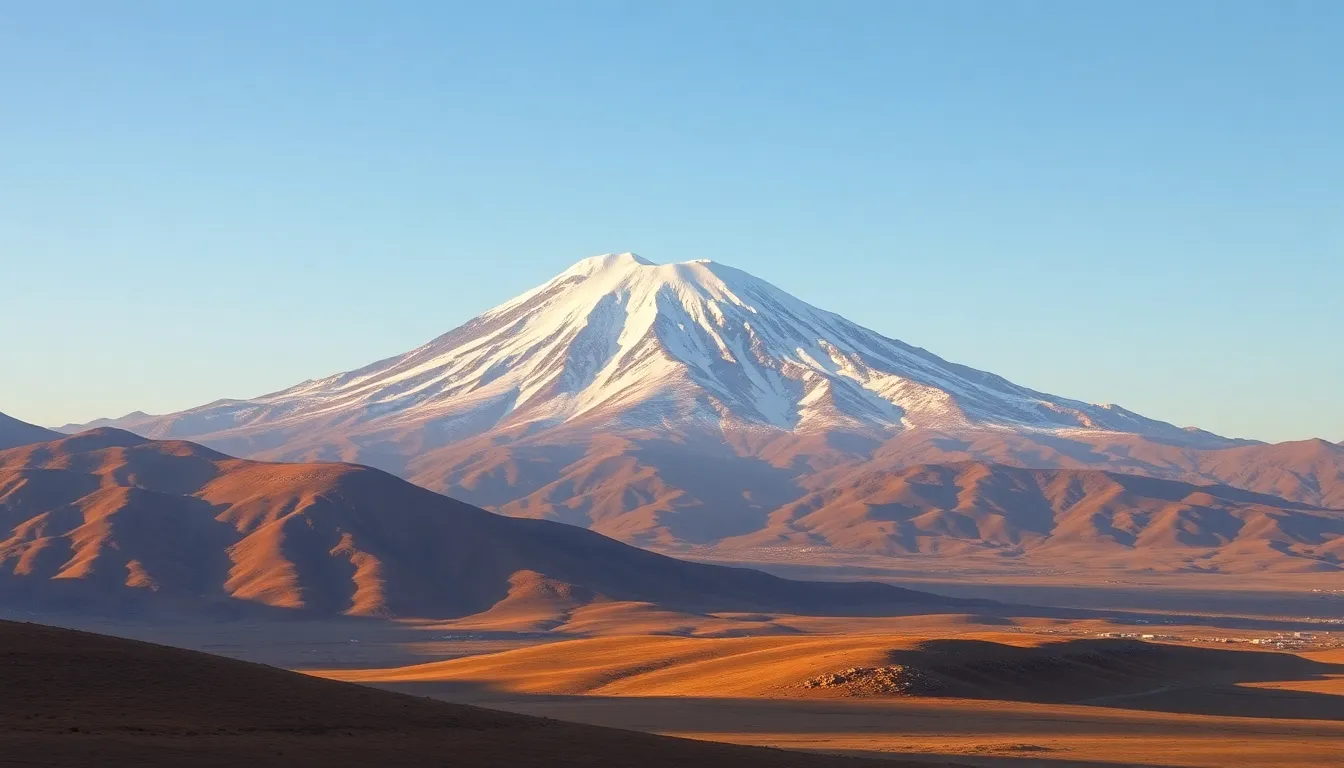
I will never forget the first time a group of mine came around a bend in the road in eastern Turkey and Mount Ararat filled the windshield. Someone said, out loud, “That is it. That is the mountain.” Nobody had to explain which mountain. At over sixteen thousand feet, snow-capped year round, rising alone off a flat plain, Ararat does not look like an ordinary peak. It looks like the kind of place a story like Noah’s would attach itself to.
For a faith group, Ararat is a different kind of stop than a ruin or a church. You do not walk its halls. You stand before it. And done right, that is exactly enough. Let me explain what it is, what the tradition holds, and how groups take it in.
What Mount Ararat Is
Mount Ararat is the tallest mountain in Turkey, in the far east of the country near the borders with Armenia and Iran. It is actually two peaks, Greater Ararat at over sixteen thousand feet and Lesser Ararat beside it, both volcanic, joined at the base. The summit holds permanent snow and a small ice cap, and the whole massif rises dramatically off the surrounding plain, which makes it visible from a great distance.
The local Turkish name is Agri Dagi, and the mountain sits near the town of Dogubayazit. To the Armenian people, who see it across the border, Ararat is a national symbol, pictured on their coat of arms even though the peak itself lies inside Turkey today.
The Bible places the ark’s resting point “on the mountains of Ararat,” using a regional name rather than naming this single peak. Ancient Ararat referred to the kingdom of Urartu, a broader area of eastern Anatolia. Over the centuries, tradition focused that broad reference onto this one towering, snow-crowned mountain, and it has carried the name and the story ever since.
The Faith Significance for a Group
The story of Noah is one of the foundational accounts shared across Judaism, Christianity, and Islam, which makes Ararat meaningful to a wide range of groups. Genesis tells of the flood, the ark built at God’s command, and the moment the waters receded and the vessel came to rest “on the mountains of Ararat.” The dove, the olive branch, and the rainbow covenant all follow.
Standing before the mountain, a group can sit with what that story means rather than debating its geography. The flood narrative is about judgment and mercy held together, about a remnant preserved, about a promise that the earth would not be destroyed again. Reading Genesis 8 and 9 with this peak in front of you gives those chapters a weight that is hard to manufacture in a sanctuary.
I am always honest with groups about what we know and do not know. No ark has been confirmed on Ararat despite many expeditions and many claims over the years. What the mountain offers is not proof. It is presence, the chance to stand where the tradition has pointed for thousands of years and let the story breathe. For the wider Christian and biblical landscape of the country, our overview of Turkey’s spiritual sites sets the context.
Eastern Turkey and the Sites Around Ararat
Ararat sits in a remarkable corner of the country, and groups that make the journey east usually build a small circuit around it rather than coming for the mountain alone.
Near the base, just outside Dogubayazit, is the Ishak Pasha Palace, a beautiful eighteenth-century Ottoman-era palace perched on a hillside with the mountain as its backdrop. A short distance away is a site some identify with the ark, the so-called Durupinar formation, a boat-shaped ridge that draws curious visitors, though most scholars read it as a natural geological feature. Seeing it lets a group weigh the claims for themselves.
Farther afield, the region holds Lake Van, the ancient Armenian church on Akdamar Island, and traces of the old Urartian kingdom that gave Ararat its biblical name. For a group willing to travel into eastern Anatolia, the area is rich, and the long drives are part of the experience, opening onto landscapes most travelers never see.
How Groups View Mount Ararat
Let me be clear about the practical reality first, because it shapes everything. Climbing Ararat is a serious mountaineering undertaking that requires permits, guides, and real fitness, and it is not what a heritage group does. Groups come to view the mountain, not to summit it, and the viewing is the meaningful part.
Here is how I structure it. We reach the Dogubayazit area and find a clear vantage, often near the Ishak Pasha Palace or a viewpoint on the plain, where the full sweep of the mountain is in front of the group. Morning light is usually clearest, before clouds gather around the peak, which they often do by afternoon.
This is the place for the group’s reflection. We read Genesis 8 and 9, talk briefly about the flood and the covenant, and leave room for quiet. Ararat is one of those sites where silence does more than words. Then we usually pair the viewing with the palace and the surrounding landscape so the day has shape.
A Practical Word on Access
The honest planning point is distance. Ararat is in the far east of Turkey, a long way from Istanbul and the Ephesus region, and reaching it usually means a domestic flight to a regional airport such as Igdir or Agri, then a drive to the Dogubayazit area. This is a destination you commit to, not a casual add-on, and it works best for groups that want a deeper, more adventurous itinerary.
The viewing itself is gentle. The vantage points are accessible, the terrain at the viewpoints is easy, and no climbing is involved, which makes the experience open to a mixed-age group of any fitness level. The effort is in the travel, not the standing. We handle the regional flights, the drives, and the local guides, and we plan the timing for the clearest views of the peak.
FAQ: Visiting Mount Ararat
Is Mount Ararat where Noah’s ark landed?
The Bible says the ark came to rest “on the mountains of Ararat,” a regional name for ancient eastern Anatolia rather than this single peak. Over the centuries, tradition focused the story on this tall, snow-capped mountain, which has carried the name ever since. No ark has been confirmed there, but it is the traditional resting place honored for thousands of years.
Can heritage groups climb Mount Ararat?
No. Climbing Ararat is a serious mountaineering effort requiring permits, guides, and high fitness, and it is not part of a heritage tour. Groups come to view the mountain from accessible vantage points on the plain, which is the meaningful experience and open to travelers of any age and fitness.
Where is Mount Ararat and how do groups get there?
It is in far eastern Turkey near the borders with Armenia and Iran, close to the town of Dogubayazit. Reaching it usually means a domestic flight to a regional airport like Igdir or Agri, then a drive. It is a committed destination best suited to a deeper, more adventurous itinerary.
What else is there to see near Mount Ararat?
The Ishak Pasha Palace, an eighteenth-century Ottoman-era palace with the mountain as its backdrop, sits nearby. The boat-shaped Durupinar formation, which some link to the ark, is a short distance away. Farther out lie Lake Van, the Armenian church on Akdamar Island, and traces of the ancient Urartian kingdom.
Is the best part of Ararat the view or a specific site?
It is the view. Ararat rewards a group that simply stands before it, reads the flood narrative from Genesis, and takes in the scale of a snow-capped peak rising alone off the plain. Morning offers the clearest sightlines before clouds gather around the summit.
Mount Ararat is a destination for groups that want something deeper and more adventurous from a Turkey journey. If that describes your congregation, I would be glad to help you plan it. You can see how we shape these trips on our Turkey heritage page or explore our group heritage tours.
Contact us whenever you are ready to start the conversation.