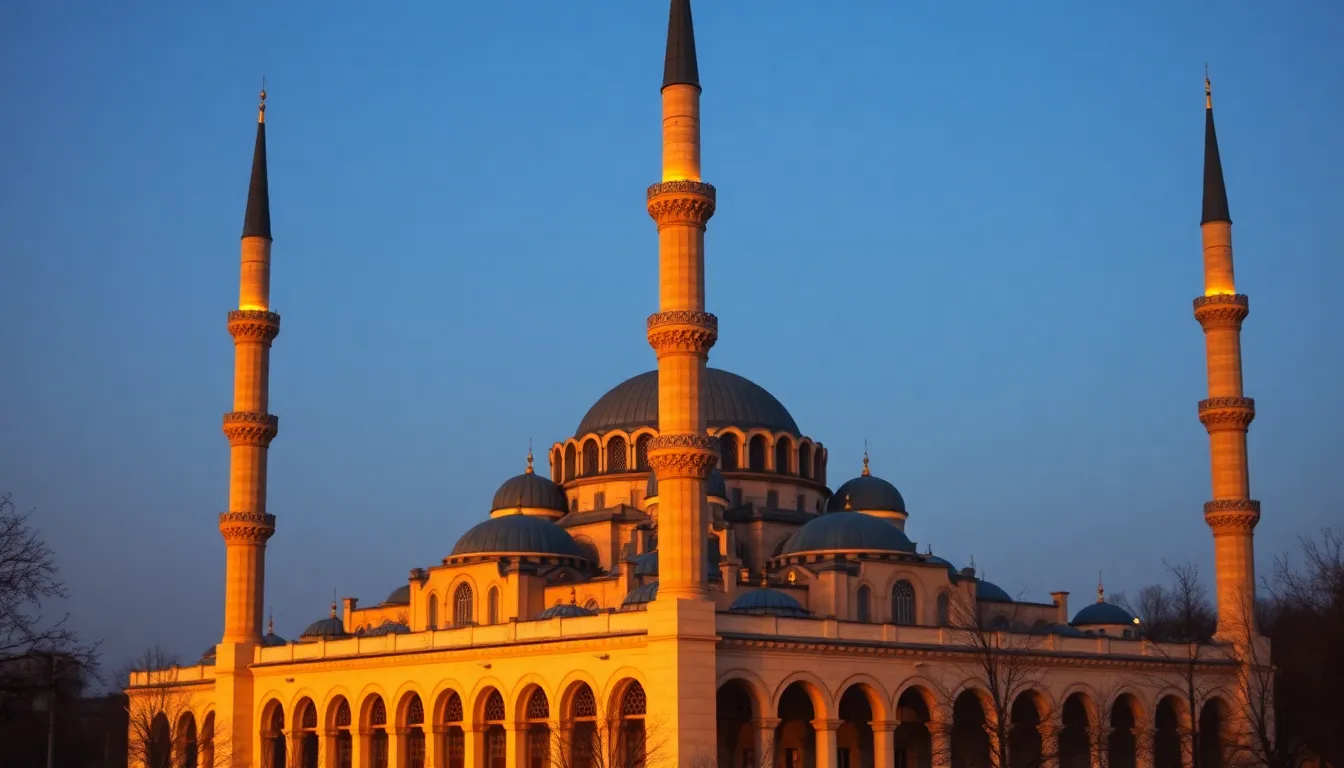
I always bring my groups to the open square between the Blue Mosque and Hagia Sophia first, before we step inside anything. We stand in the middle of it, and I ask people to turn slowly in a full circle. On one side, the great Byzantine cathedral. On the other, the cascading domes and six minarets of the Blue Mosque. Under your feet, the buried racetrack of an empire. There is no other patch of ground in the world quite like it. This square has been the sacred and political heart of one of history’s most important cities for sixteen hundred years.
For a faith-heritage group, the Blue Mosque is not just a beautiful building to photograph. It is the key to reading the whole layered center of old Constantinople. Let me walk you through what is here and how to take it in.
The Mosque on the Old Hippodrome
The Blue Mosque, properly the Sultan Ahmed Mosque, was built between 1609 and 1616 under the young Sultan Ahmed I. It takes its English nickname from the tens of thousands of blue Iznik tiles that line its interior, glowing in the light from more than two hundred windows.
What I want groups to grasp is where it stands. The mosque was deliberately built on the site of the ancient Hippodrome of Constantinople, the chariot-racing stadium that was the social and political center of the Byzantine city. The Hippodrome could hold an enormous crowd, and it was the stage for celebrations, riots, and imperial display for centuries. When Sultan Ahmed chose this ground, he was placing his mosque at the symbolic heart of the empire the Ottomans had conquered, directly facing Hagia Sophia, the cathedral they had turned into a mosque a century and a half earlier.
You can still read the Hippodrome in the long open park beside the mosque. Three monuments remain standing on its central spine. There is an Egyptian obelisk that Theodosius brought from Karnak, already ancient when it arrived. There is the Serpent Column, a bronze monument the Greeks cast from the melted weapons of the Persians they defeated at Plataea in 479 BC. And there is a rough stone column once sheathed in bronze. Standing among them, your group is standing on the floor of Byzantine public life.
Why It Matters to a Faith Group
Some leaders wonder why a Christian or Jewish group would spend time at an active mosque. Here is how I frame it, and it has never failed to land.
This square is where you see the whole arc of the city’s faith history in one place. Constantinople was the capital of Christendom for over a thousand years, the seat of the Eastern Orthodox church, the city Constantine founded and named for himself, the host of the church councils that defined core Christian doctrine. Then in 1453 it fell to the Ottomans, and the Christian capital became the Islamic one. The Blue Mosque is the architectural statement of that turning point, raised in answer to Hagia Sophia across the square.
You cannot understand the story of the early and medieval church without understanding what happened to its greatest city. The Blue Mosque, set against Hagia Sophia, makes that history visible and immediate. Standing between them, your group sees Christianity’s eastern center and the empire that succeeded it, facing each other across an ancient racecourse. That is a teaching moment no book delivers as well.
Inside the Mosque
The interior is genuinely breathtaking. The vast central space is crowned by a great dome resting on four massive fluted piers the guides call “elephant feet.” Light pours through colored glass, the blue tiles climb the walls, and the scale is humbling.
As an active place of worship, the Blue Mosque welcomes respectful non-Muslim visitors outside the five daily prayer times. Modest dress is required. Women cover their heads, and everyone covers shoulders and knees. You remove your shoes at the entrance and carry them in a bag provided. I ask my groups to keep voices low and to be especially mindful if anyone is praying. We are guests, and behaving as gracious guests in a sacred space is itself part of the heritage we are honoring.
I usually let people take in the interior in their own quiet time rather than lecturing inside. The space speaks for itself.
How Groups Visit the Square
The beauty of this center is that the major sites cluster within a few minutes’ walk of each other, so a group can take in an enormous sweep of history in a single well-paced morning.
Here is the rhythm I use. We start in the Hippodrome park among the obelisks to set the Byzantine stage. We move into the Blue Mosque, timed to avoid prayer hours. We cross the square to Hagia Sophia, the cathedral that became a mosque, a museum, and a mosque again, which we cover in our wider guide to spiritual sites across Turkey. Many groups also add the underground Basilica Cistern nearby and Topkapi Palace just beyond. It is a dense, rewarding area.
Plan around prayer times, because the mosque closes to visitors during the five daily prayers and the midday Friday prayer brings the largest crowds. We build the schedule around these, so your group enters when the space is open and contemplative rather than rushed.
A Practical Word on Access and Pace
I want to be honest about the day, because the area is busy. This is one of the most visited parts of Istanbul, and in high season the square fills with people and the mosque entrance can mean a wait in line. For a faith group that wants reflection rather than a crowd crush, timing is everything.
We schedule the mosque early in the day and coordinate the order of sites to keep the walking efficient and the lines short. The square itself is flat and easy underfoot, which makes it comfortable for mixed-age groups, though the cobbles can be uneven in places. For 15 or more travelers we arrange a local guide who knows the prayer schedule, the dress requirements, and how to move a group through this center smoothly. We plan the pace around the people you bring.
FAQ: Visiting the Blue Mosque
Why is the Blue Mosque built on the Hippodrome?
Sultan Ahmed I built the mosque between 1609 and 1616 on the site of the ancient chariot-racing stadium that was the political and social heart of Byzantine Constantinople. Placing it there, facing Hagia Sophia, was a deliberate statement at the symbolic center of the empire the Ottomans had conquered. Three Hippodrome monuments still stand in the adjacent park.
Can a Christian or Jewish group visit the Blue Mosque?
Yes. The Blue Mosque welcomes respectful non-Muslim visitors outside the five daily prayer times. Modest dress is required, women cover their heads, everyone covers shoulders and knees, and shoes come off at the entrance. We schedule visits to avoid prayer hours so the experience is calm.
Why does the Blue Mosque matter for Christian heritage?
It is the architectural statement of 1453, when Constantinople, the capital of Eastern Christianity for over a thousand years, fell to the Ottomans. Built facing Hagia Sophia across the old Hippodrome, it lets a group see the turning point in the city’s faith history made visible in stone.
What should our group wear and bring?
Modest clothing covering shoulders and knees, a head covering for women, and slip-on shoes are ideal since you remove footwear to enter. Bags are provided to carry your shoes. Keep voices low inside out of respect for anyone praying.
How much time should we plan for this area?
Allow a half day for the central square. The Blue Mosque, the Hippodrome monuments, and Hagia Sophia all sit within a few minutes’ walk, and many groups add the Basilica Cistern and Topkapi Palace nearby to make a full and rich morning.
The center of old Constantinople is one of the great heritage walks in the world, and the Blue Mosque is the key that unlocks it. If you want to build Istanbul into a heritage journey for your congregation, I would be glad to help. You can see how we structure these trips on our Turkey heritage page or explore our group heritage tours.
Contact us whenever you are ready to start the conversation.