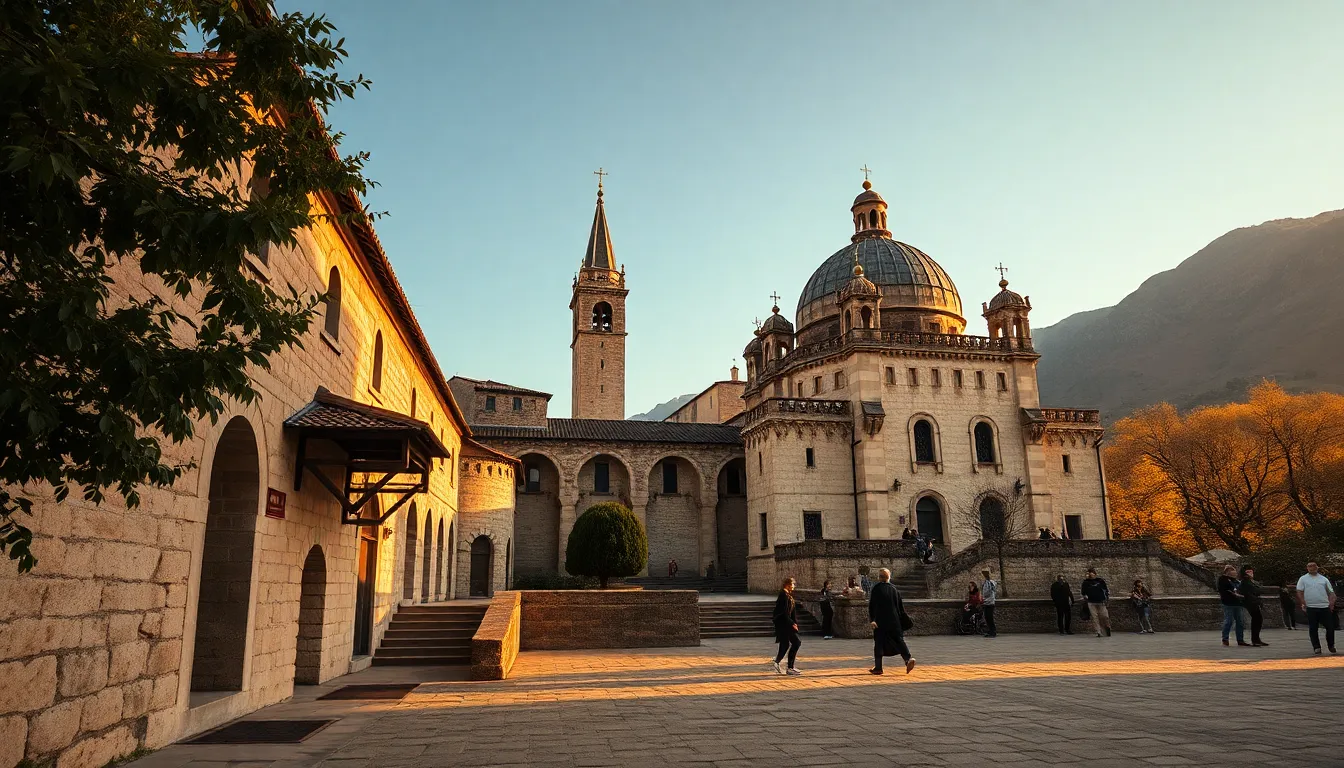
Some groups come to Portugal for the Sephardic story. Others come for Fatima. But every so often a pastor or an educator sits across from me and says they want to understand the orders. The Templars, the Cistercians, the warrior monks and the silent ones, the men who built the great stone monasteries that still stand across this country eight hundred years later. They want to walk inside the architecture of medieval faith and feel how it shaped a kingdom.
That trip exists, and it is one of my favorites to lead. Portugal holds three of the most extraordinary monastic monuments in Europe, all within reach of one another, plus the Templar headquarters that helped found the nation itself. This itinerary traces that thread from Lisbon through the great abbeys and into Tomar, where the Knights Templar made their last home in the West.
If you want the broader heritage picture, our 9-day route covers Portugal’s full story. This one goes deep on stone, order, and faith.
Day 1: Lisbon and Jeronimos, Where Empire Met Devotion
Most groups arrive in Lisbon, and Lisbon holds the first of our great monasteries. After settling in, we go straight to Belem and the Jeronimos Monastery.
Jeronimos is the masterpiece of Manueline architecture, Portugal’s own late-Gothic style, dense with carved rope, coral, and the symbols of the sea. It was built in the early sixteenth century, funded in large part by the wealth of the Age of Exploration, and dedicated to the Order of Saint Jerome. Vasco da Gama is entombed inside. Standing in the church and the two-story cloister, your group feels how thoroughly faith, empire, and discovery were braided together in this period. This is not a quiet country abbey. It is the spiritual statement of a nation at the height of its reach.
I let the first day stay here, in Belem, with the monastery and the nearby tower. It sets the theme for everything that follows.
Day 2: Lisbon to the North, Setting the Context
The second day is for context before we reach the great abbeys. In Lisbon I walk the group through the medieval foundations of the Portuguese kingdom, because the monasteries we are about to visit were not decoration. They were instruments of state. The Cistercians cleared and farmed the land. The Templars and later the Order of Christ held the frontier. The crown and the orders rose together.
I keep this day flexible. Sometimes we add the Sao Vicente de Fora monastery in Lisbon, with its royal pantheon of the Braganza dynasty. Sometimes we simply give the group a slower day to absorb Jeronimos before the trip’s pace picks up. Either way, by evening the group understands that we are about to drive into the engine room of medieval Portugal.
Day 3: Alcobaca, the Cistercians, and a Tragic Love Story
The drive north from Lisbon to Alcobaca takes around ninety minutes, and Alcobaca is where the monastic heart of this itinerary begins.
The Monastery of Alcobaca was founded in 1153 for the Cistercian order, and it is one of the largest and purest expressions of early Cistercian architecture anywhere. The Cistercians built for silence and austerity, and the church reflects it. Long, high, stripped of ornament, it pulls the eye and the spirit upward. The kitchen, with its vast chimney and the channel of river water once used to carry fish straight into the monastery, tells you how completely these monks built a self-sustaining world inside the walls.
Alcobaca also holds the tombs of King Pedro and Ines de Castro, whose tragic love story is one of the most famous in Portuguese history. Their carved tombs face each other so that, as the legend goes, the lovers will see one another first at the resurrection. Even groups focused on faith and architecture fall silent at those two tombs. It is a reminder that these monasteries held the whole of human life, not only prayer.
Day 4: Batalha, the Monastery Built on a Promise
A short drive from Alcobaca brings us to Batalha, and Batalha may be the single most breathtaking building on this entire route.
The Monastery of Batalha was begun in 1386 to fulfill a vow. King John I had promised to build a great monastery to the Virgin if Portugal won independence from Castile at the Battle of Aljubarrota in 1385. Portugal won, and Batalha is the promise made stone. It is high Gothic shading into Manueline, with tracery so fine it looks like lace cut from rock. The Founder’s Chapel holds the royal tombs. The Unfinished Chapels, open to the sky after centuries of work that was simply never completed, are among the most moving spaces in Portugal precisely because they are unfinished. A monument to faith, ambition, and the limits of human time, all at once.
I give Batalha real space in the day. It rewards slow looking, and it raises questions worth talking through over dinner about vows, victory, and what we build to thank God.
Days 5 and 6: Tomar and the Knights Templar
From Batalha it is about an hour to Tomar, the climax of this itinerary, and I give it two days because it earns them.
Tomar is dominated by the Convent of Christ, the headquarters of the Knights Templar in Portugal. The Templars were granted Tomar in the twelfth century, and they built and rebuilt here for centuries. The heart of the complex is the Charola, the round church modeled on the Holy Sepulchre in Jerusalem, where knights are said to have heard Mass on horseback. When the Templar order was suppressed across Europe in the early fourteenth century, Portugal did something almost no other kingdom did. It refused to destroy the order. Instead the king transformed it into the Order of Christ, which inherited the Templars’ wealth and knowledge and later helped fund the Age of Exploration. The cross of the Order of Christ sailed on the ships of Vasco da Gama and Henry the Navigator.
The first day is for the convent itself, the round church, the cloisters built across different centuries, and the famous Manueline window, one of the most ornate carved windows in the world. The second day lets the group go deeper, and it is also when I bring them down into the old town to the Synagogue of Tomar, the oldest surviving synagogue in Portugal. Seeing the warrior-monk convent on the hill and the small medieval synagogue in the streets below, on the same day, tells the whole layered story of medieval Portuguese faith in a single town.
Day 7: Fatima and a Modern Coda
The route ends with a short drive to Fatima, a fitting close because it connects the medieval thread to living devotion. Fatima is one of the world’s great pilgrimage sites, where in 1917 three shepherd children reported apparitions of the Virgin Mary, witnessed in the final apparition by an estimated 70,000 people.
After a week inside eight-hundred-year-old monasteries, Fatima reminds the group that Portuguese faith did not stop in the Middle Ages. The same impulse that raised Batalha to fulfill a vow still fills the sanctuary at Fatima today. It is a strong final note, and for Christian groups it is often the most personally affecting day of the trip. Our 12-day complete route extends this thread further into Lisbon, Belmonte, and the south for groups who want the whole country.
Why Trace the Orders
To walk Jeronimos, Alcobaca, Batalha, and Tomar in one week is to read the spiritual biography of a nation in its own architecture. The Cistercians and their silence, the Templars and their frontier, the crown and its vows, the carved Manueline stone of an empire. For pastors, educators, and any group serious about medieval Christian heritage, there is no richer concentration of it anywhere in Europe, and it all sits within a few hours of road.
You can see the full destination on our Portugal page, and our group tours page explains how the group experience works. With 15 or more participants, the group leader travels free, which frees you to focus on leading the group through the meaning of what they are seeing rather than the logistics of getting there.
FAQ: Templar and Monastery Heritage in Portugal
What are the main monasteries on a Portugal heritage tour?
The four anchors are the Jeronimos Monastery in Lisbon, the Cistercian Monastery of Alcobaca, the Monastery of Batalha, and the Convent of Christ in Tomar. Together they trace Portuguese monastic and Templar history across the Romanesque, Gothic, and Manueline periods. Alcobaca, Batalha, and Jeronimos are all UNESCO World Heritage sites.
Where were the Knights Templar based in Portugal?
In Tomar, at the Convent of Christ, which served as the Templar headquarters in Portugal from the twelfth century. When the order was suppressed across Europe, Portugal preserved it as the Order of Christ, which later helped fund the Age of Exploration. The round Charola church there is the most iconic Templar building in the country.
How are Alcobaca and Batalha different?
Alcobaca is early Cistercian, built for austerity and silence, long and stripped of ornament. Batalha is high Gothic and Manueline, ornate and lace-like, built to fulfill a royal vow after a battle. Visiting them on consecutive days shows the full range of medieval Portuguese monastic architecture.
Can a Templar and monastery itinerary include Jewish heritage?
Yes, and Tomar is the natural bridge. The same town holds the Templar Convent of Christ on the hill and the oldest surviving synagogue in Portugal in the streets below. Seeing both in one day captures the layered religious history of medieval Portugal. We can weight the route toward either thread.
Is this itinerary suitable for a Christian study group?
It is built for exactly that. Pastors, seminarians, and educators focused on medieval Christian heritage find this the richest route in Portugal. The architecture, the monastic orders, and the vows behind the buildings give a study group substantial material for reflection and discussion.
If your group wants to trace the orders and the great monasteries of Portugal, I would love to help you plan it. Contact us whenever you are ready.