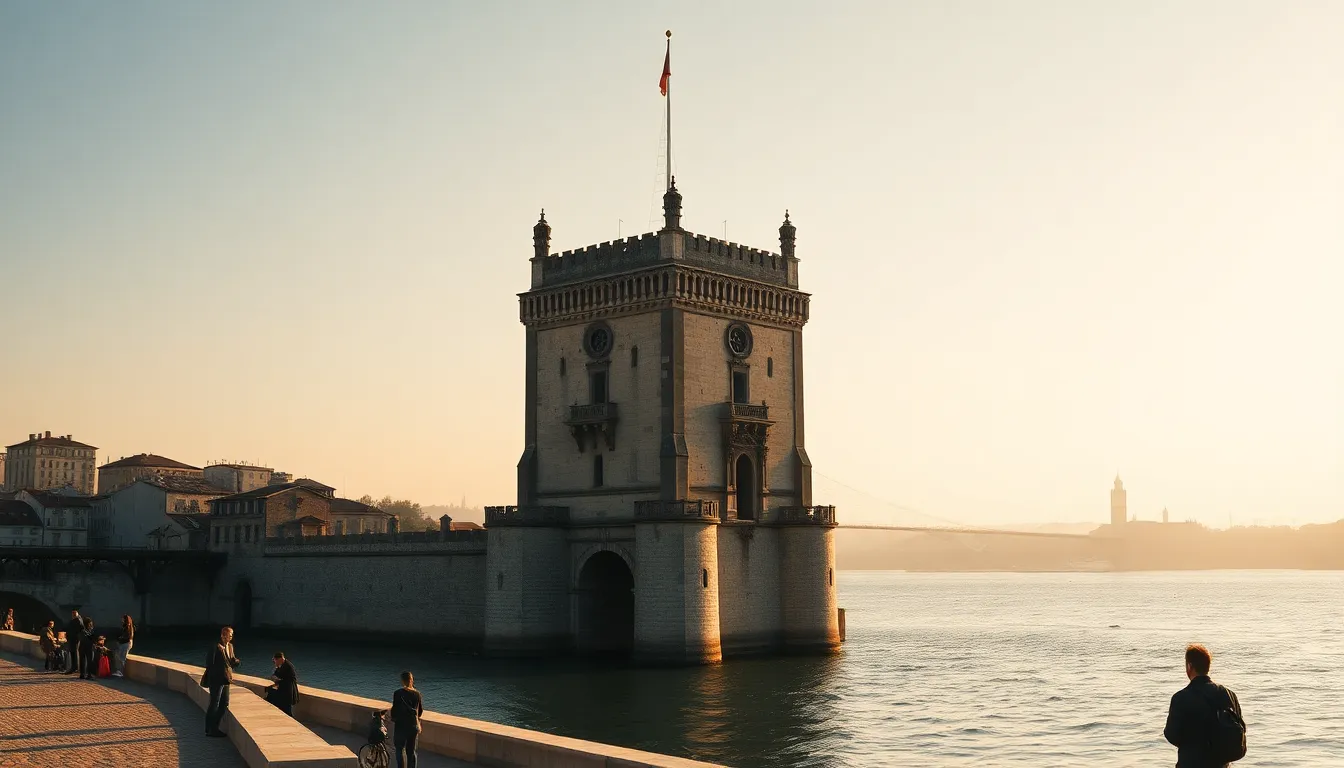
When I want a group to understand what the Age of Discovery actually felt like, I take them to the Belem Tower and have them look at the water, not the building. From this spot on the Tagus, ships left Lisbon to sail into oceans no European had charted. Most of the sailors did not know if they would return. The tower was often the last piece of Portugal they saw on the way out and the first they saw coming home. Once a group grasps that, the stone in front of them stops being a postcard and becomes a threshold.
The Belem Tower is one of Lisbon’s most photographed landmarks, and it earns the attention. But for a heritage group, the value is not the architecture alone. It is what the tower stands at the edge of: an era that remade the world, for better and for worse, and that carried faith, ambition, and consequence out across every ocean.
A Fortress at the Mouth of the Tagus
The Belem Tower was built between 1514 and 1519, during the reign of King Manuel I, as part of a defensive system guarding the entrance to Lisbon’s harbor. Its job was military. From its position in the river, it could fire on ships trying to approach the city, working together with another fort across the water to control who came and went.
But the tower was never only a fortress. It was built at the high tide of Portuguese wealth and confidence, when ships were returning from India and Africa loaded with spices, gold, and goods that made Lisbon one of the richest cities in Europe. The crown poured that wealth into building, and the Belem Tower shows it. This is a military structure dressed in the ornament of a triumphant age.
Over the centuries it served other roles, including a stint as a prison, with cells in its lower levels. But its enduring identity is tied to the river and the ships, to the moment Portugal turned its small Atlantic coast into the launching point for global exploration.
Manueline Style and What It Tells You
The Belem Tower is the signature example of Manueline architecture, the distinctively Portuguese style named for King Manuel I. If you have a group that thinks all old European buildings look alike, this is the place to change their minds, because Manueline design is unmistakable once you know what to look for.
Manueline ornament is the sea carved into stone. The tower is covered with maritime motifs: thick ropes twisted into stone cords, armillary spheres (the navigational instrument that became Manuel’s personal emblem), crosses of the Order of Christ that marked Portuguese sails, and even, on one corner, a carved rhinoceros, thought to be one of the first European depictions of the animal, based on one shipped back from India. The style takes the iconography of exploration and makes it permanent.
There is faith in this stone too. The Cross of the Order of Christ, the successor to the Knights Templar in Portugal, appears throughout. The exploration the tower celebrates was framed, in its own time, as a Christian mission as much as a commercial one, carrying the faith to new lands alongside the trade. I always make sure groups understand that the cross on those sails was not decoration. It was the stated purpose, woven through with all the complications that purpose carried.
How Groups Experience the Belem Tower
The tower sits in the Belem district, a riverside neighborhood that holds several of Lisbon’s most important monuments within walking distance of each other. That clustering is a gift to a group leader. You can build a half day or full day here that flows naturally from one site to the next without long transfers.
I usually approach the tower from the riverside promenade, which gives the best view and the best photographs, and which lets a group take in the setting before focusing on the building. The interior can be visited, but it is compact and reached by a narrow spiral staircase, so for a large group I am realistic about it. I often let those who want to climb go up in small numbers while the rest of the group enjoys the riverfront and the views, then we regather.
The real teaching happens outside, at the water’s edge. This is where I talk about the ships, the voyages, the men who left from this exact shoreline. A short distance upriver stands the Padrao dos Descobrimentos, the great monument to the Discoveries, and the two sites belong together on any itinerary. Nearby is the Jeronimos Monastery, also Manueline, also tied to the explorers, which rounds out the Belem story.
I am also honest with groups about the fuller picture. The Age of Discovery opened the world and it also opened the transatlantic slave trade and centuries of colonization. A faith group is exactly the kind of group that can hold both truths at once, the wonder and the cost. Standing at the Belem Tower is a good place to have that honest conversation.
Practical Access and Planning
The Belem Tower is open to visitors most days, with a closure day midweek, and it draws crowds, so timing matters. I aim for early morning, soon after opening, before the tour buses arrive, or late afternoon as they clear out. A group that arrives at midday in high season will spend more time in line than at the site.
Reaching the tower involves a short walk across a footbridge from the promenade, and the interior climb is via tight spiral stairs with no elevator, which makes the upper levels unsuitable for anyone with mobility difficulties. The good news is that the most meaningful part of a visit, the setting and the exterior, is fully accessible from the level riverside path. Nobody needs to climb to grasp what this place means.
Belem is about twenty minutes from central Lisbon by road or tram, which makes it easy to fold into a city-based itinerary. I usually pair it with the monastery, the Discoveries monument, and a stop for the famous custard tarts the neighborhood is known for. It makes for a full, rich day that mixes faith, history, and a real sense of place.
You can see how Belem fits into a wider Portugal heritage journey on our Portugal destination page and in our overview of Portugal’s hidden heritage sites.
FAQ: The Belem Tower and the Age of Discovery
What is the Belem Tower and why is it important?
The Belem Tower is a 16th-century fortress on the Tagus River in Lisbon, built between 1514 and 1519 under King Manuel I. It guarded the entrance to Lisbon’s harbor during the height of Portugal’s Age of Discovery, when ships left from this shoreline to explore Africa, India, and the Atlantic. It is one of the finest examples of Manueline architecture and a symbol of Portugal’s maritime era.
What is Manueline architecture?
Manueline is a distinctively Portuguese architectural style from the early 16th century, named for King Manuel I. It covers buildings in maritime ornament: carved ropes, armillary spheres, crosses of the Order of Christ, and other symbols of exploration. The Belem Tower is its most famous example, with sea motifs and even a carved rhinoceros worked into the stone.
How is the Belem Tower connected to faith?
Portugal’s exploration was framed in its time as a Christian mission alongside a commercial one. The Cross of the Order of Christ, the Portuguese successor to the Knights Templar, appears throughout the tower and marked the sails of Portuguese ships. For a faith group, the tower opens a conversation about how faith, ambition, and the consequences of empire traveled together across the oceans.
Can a group go inside the Belem Tower?
Yes, though the interior is compact and reached by a narrow spiral staircase with no elevator, which makes the upper levels difficult for large groups or anyone with mobility limitations. The most meaningful part of a visit is the exterior and the riverside setting, which is fully accessible. Many group leaders let a few members climb while the rest enjoy the riverfront, then regather.
When is the best time to visit the Belem Tower with a group?
Early morning soon after opening, or late afternoon, to avoid the heaviest crowds and tour-bus traffic. The tower closes one day midweek, so check the schedule when planning. Belem pairs naturally with the nearby Jeronimos Monastery and the Padrao dos Descobrimentos for a full day in the district.
If you want your group to stand where the Age of Discovery began and to talk honestly about what that era set in motion, the Belem Tower belongs on your Lisbon itinerary. For groups of 15 or more, the group leader travels free. Explore our group heritage tours or contact us to start planning.